Chasing APY: The Yield Traps That Drain DeFi Farmers
A protocol offering 2,000% APY isn't being generous — it's telling you something, if you know how to listen. Here's where eye-watering DeFi yields actually come from, and the specific ways they end up costing more than they pay.
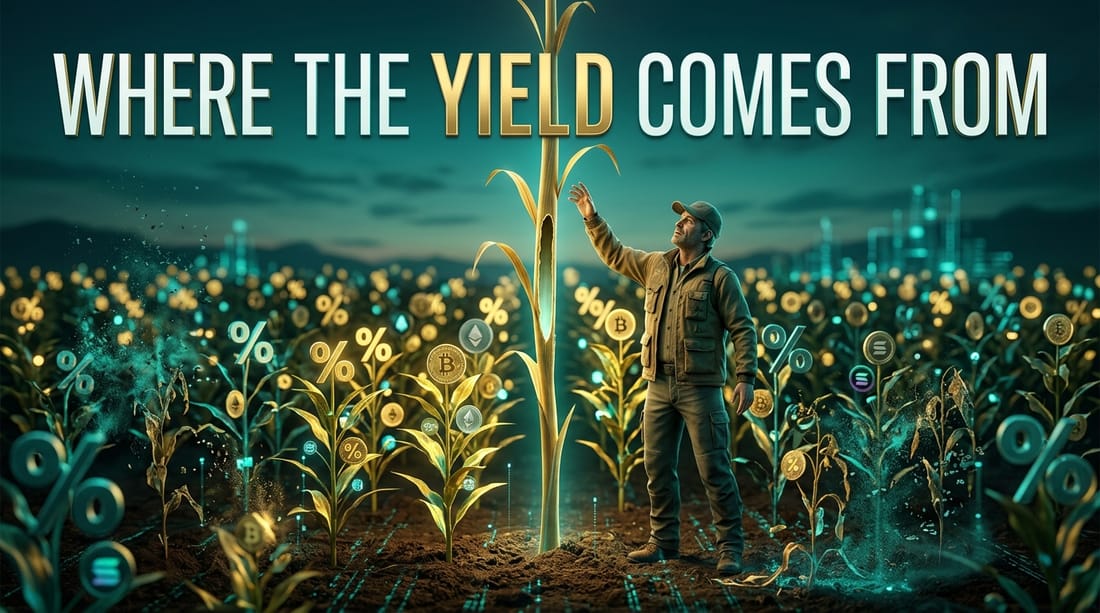
A bank offers you 4% and you're mildly pleased. A DeFi protocol offers you 2,000% and you should be mildly terrified. That gap isn't because crypto found a magic money machine the banks missed — it's because that 2,000% is made of something very different from what you think, and the difference is exactly where farmers get drained. The first skill in yield farming isn't finding the highest number. It's learning to read what a high number is actually telling you.
What "yield farming" even is
Yield farming means putting your crypto to work in DeFi protocols to earn a return — lending it out, providing it to liquidity pools, or staking it in various schemes. In exchange, you earn yield, usually quoted as an APY (annual percentage yield). Some of this is legitimate and sustainable. A lot of the eye-popping numbers are not, and telling them apart starts with one question: where is this yield coming from?
Source one: real economic activity (the sustainable kind)
Some yield is genuine. When you provide liquidity to a busy trading pool, traders pay fees and you earn a share — that's real money from real activity. When you lend a stablecoin to borrowers who pay interest, that interest is real. This kind of yield is grounded in actual economic value being created, and it tends to be modest — low single digits to maybe low double digits, depending on demand and risk. It's not exciting, which is precisely why it's more trustworthy.
Source two: printed tokens (the trap)
Now the dangerous kind. The vast majority of those jaw-dropping APYs come from a completely different source: the protocol printing its own token and handing it to you as a reward. This is called emissions. The protocol invents a new token out of thin air, distributes truckloads of it to farmers, and advertises the dollar value as "yield."
The problem is staring you in the face once you see it. If a protocol mints and gives away enormous quantities of a token, what happens to that token's price? Everyone receiving it does the same thing — sells it, to capture the "yield" in real money. That relentless selling pressure crushes the token's price. So your 2,000% APY, paid in a token that's losing value as fast as it's printed, is often a mirage. You earn a thousand tokens that were worth a dollar each when you started and a few cents each by the time you sell. The advertised number was real; the return was fiction.
A sky-high APY is not a gift, it's a confession. It usually means the yield is paid in a freshly printed token that is inflating toward zero, that the protocol is too new and risky to attract money any other way, or both. Sustainable, real-economy yield rarely needs to shout. When a number is absurd, assume the absurdity is the warning, not the opportunity — and ask what they're printing to pay it.
The specific ways farmers get drained
Beyond the emissions illusion, several concrete traps do the actual draining:
- Token-emission collapse. Covered above — the reward token's price falls faster than you can earn it, so your real return is far below the headline, often negative.
- Impermanent loss. Many farms require you to deposit two tokens into a liquidity pool. If their prices diverge, impermanent loss quietly eats your capital — and a juicy APY can be entirely canceled out, or worse, by a loss you never see itemized.
- The rug pull. The highest yields often live on brand-new, anonymous protocols. Sometimes the entire thing is a rug pull: the team lures deposits with an irresistible APY, then drains the pooled funds and vanishes. The yield was bait for your principal.
- Smart contract risk. Even honest farms run on code that can have bugs. A flaw in an unaudited contract can let an attacker drain everything deposited, no matter how good the yield looked.
- The gas-and-fee drain. Constantly moving between farms to chase the best rate racks up transaction fees that can quietly outweigh small farmers' actual profits.
Farming without getting farmed
You can earn real yield in DeFi. The discipline is to treat high numbers as suspects, not prizes:
- Always ask where the yield comes from. Real fees and interest, or printed tokens? If you can't answer, you can't assess the risk, and you shouldn't deposit.
- Calculate your real return. Subtract likely token depreciation, impermanent loss, and fees from the headline. The honest number is often a fraction of the advertised one.
- Favor the boring and battle-tested. Established, audited protocols with track records pay less and lose your money far less often. The risk-reward math usually favors them despite the smaller number.
- Size it as risk capital. Treat every farm, especially a high-yield one, as money you could lose entirely. Never farm with funds you can't afford to watch disappear.
- Be most suspicious when most tempted. The strongest pull toward a too-good yield is exactly when you should slow down, the same instinct that protects you in how to spot a crypto scam.
The bottom line
Yield farming isn't inherently a scam, but it's a field where the most attractive-looking opportunities are usually the most dangerous, and the math is deliberately obscured behind a big friendly percentage. The number you're shown is rarely the return you'll get, because it's quietly funded by token inflation, exposed to impermanent loss, or set as bait by people who plan to take your principal.
Reframe the whole thing and you'll be fine: in finance, yield is the reward for risk, and there are no exceptions in DeFi. A modest, well-understood yield from a real source is a tool. A spectacular yield from a source you can't explain is a trap wearing a tool's clothes. Learn to hear what the big number is really saying, and you stop being the crop.
Frequently asked questions
Usually from a protocol printing and handing out its own token as a reward, not from real economic profit. That inflationary emission can produce huge advertised APYs, but the reward token often loses value fast as everyone sells it, erasing the gains.
Generally the opposite. Extremely high yields signal high risk: the reward token may be inflating to nothing, the protocol may be unproven or fraudulent, or the strategy may carry hidden losses. Sustainable yield tends to be modest.
When you provide two tokens to a liquidity pool to earn yield, divergence in their prices can leave you with less value than simply holding them. A high advertised yield can be quietly canceled out, or exceeded, by this loss.
Be skeptical of huge numbers, understand exactly where the yield comes from, favor established and audited protocols, account for impermanent loss and token inflation in your real return, and never deposit more than you can afford to lose.
Keep reading




Popular this week
- 01Rug Pulls Hall of Shame: Famous Crypto Exit ScamsAnalysis · 4 min
- 02Grid Trading Bots Explained, and When They Blow UpGuide · 4 min
- 03Where AI and Crypto Actually Meet: Compute, Data, and DePINAnalysis · 9 min
- 04Coinbase Review: Paying a Premium for Peace of MindAnalysis · 4 min
- 05What Is the Bitcoin Halving and Why Does It Matter?Explainer · 2 min