Where AI and Crypto Actually Meet: Compute, Data, and DePIN
Strip away the AI-token hype and a real question remains: are there genuine problems where AI actually needs a blockchain? The answer is yes — a small number of them, and they're more interesting than the buzzword soup suggests. A long look at the places the two technologies truly touch.
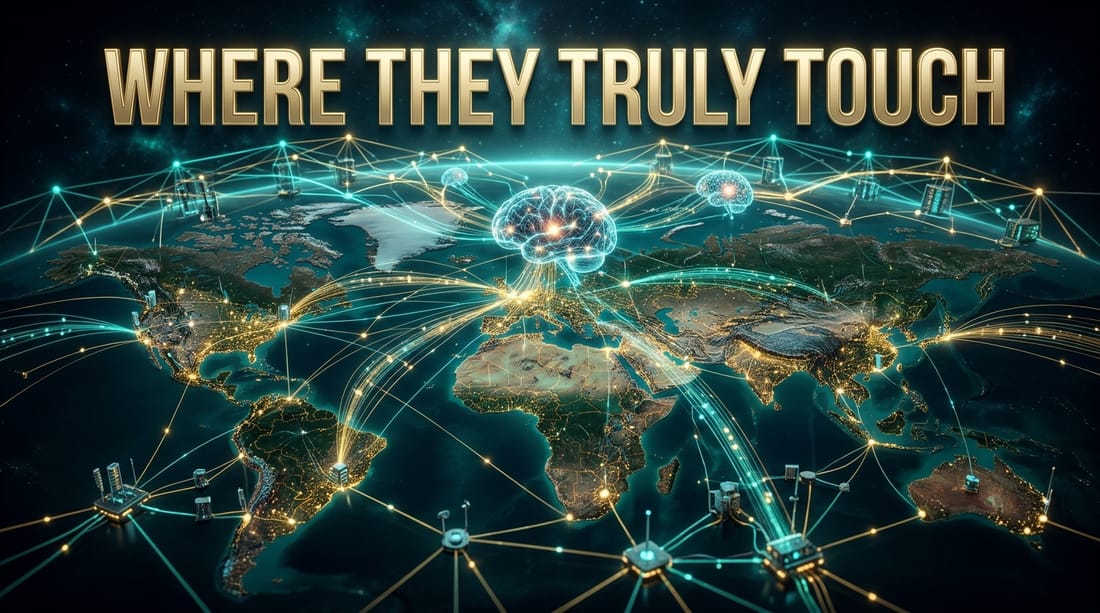
Most "AI plus crypto" projects are, as the AI token bubble lays out, branding with nothing underneath. So it would be easy to conclude the whole intersection is a mirage. That conclusion would be wrong, and the mistake matters. Beneath the buzzword soup sits a real, narrow set of places where AI and crypto genuinely need each other — where a blockchain isn't bolted on for fundraising but actually solves a problem AI has. This is a long, careful tour of those places, because telling the real intersections from the fake ones is one of the more useful things you can learn in this corner of the market.
The test that separates real from fake
Before touring the intersections, fix the filter in your mind, because you'll apply it to everything below. The question is never "does this involve AI?" or "does this have a token?" The question is: does this problem genuinely need both AI and a blockchain? Remove the blockchain — does the project still work just as well as an ordinary AI company? If yes, the crypto part is decorative, a vehicle for a token. If no — if the decentralization, the incentives, or the verification a blockchain provides is actually load-bearing — you may have found a real intersection.
What does a blockchain actually provide that AI might need? Strip it to essentials and it offers three things: coordination among many participants who don't trust each other, payments and incentives that flow automatically without a middleman, and verification — provable records of what happened, who contributed, and what's authentic. The genuine intersections are all cases where AI runs into a problem that one of those three things solves. Keep that in hand as we walk through them.
Intersection one: decentralized compute
Start with AI's most physical, unglamorous bottleneck: it is staggeringly hungry for computing power. Training and running modern AI models demands enormous quantities of specialized chips — GPUs — and that hardware is scarce, expensive, and concentrated in the hands of a few giant cloud providers and companies. If you're not one of the tech titans, getting the compute you need is hard and costly, and the concentration gives a handful of players outsized control over who gets to build AI at all.
Here's where crypto offers something real. Around the world, there's a vast amount of idle GPU power — in gaming machines, in smaller data centers, in hardware sitting unused. The problem has always been coordination: how do you pool computing power from thousands of strangers who don't know or trust each other, fairly reward them, and verify the work was actually done? That is exactly the kind of coordination-and-payment problem a blockchain is built for. Decentralized compute networks use crypto incentives to let people contribute their spare GPU power to a shared pool, get paid automatically for it, and have their contributions verified — creating a marketplace for computing power that isn't controlled by any single company.
Notice that this passes the test cleanly. The blockchain isn't decoration here; the coordination of many untrusting hardware providers, the automatic payments, and the verification of work are the whole point. Remove the blockchain and you don't have a decentralized compute network — you just have someone trying to manually wrangle thousands of strangers, which doesn't work. Whether any particular project executes this well is a separate question, but the intersection itself is genuine: AI needs compute, compute is concentrated, and crypto is a real tool for pooling and rewarding distributed resources.
Intersection two: data, provenance, and authenticity
AI runs on data — to train models and to feed them. And data raises a cluster of problems where crypto's verification strength becomes relevant.
The first is data marketplaces and fair contribution. Valuable data is often locked away or contributed without the contributors being rewarded. Crypto can underpin marketplaces where people contribute or sell data and are automatically and verifiably compensated, coordinating many participants around a shared resource — again, the coordination-and-incentive pattern.
The second, and arguably more profound, is provenance and authenticity — and this one gets more important by the day. We are entering a world flooded with AI-generated content: images, video, audio, text, all increasingly indistinguishable from the real thing, the same forces behind deepfake and AI voice scams. That creates a desperate need for a way to verify what's real — to prove that a piece of content came from a particular source, was created at a particular time, or was made by a human rather than a machine. A blockchain is fundamentally a system for creating tamper-evident, provable records, which makes it a natural candidate for establishing the origin and authenticity of content and data. In a world where you can no longer trust your eyes and ears, provable provenance is not a nice-to-have; it's infrastructure. This is one of the most genuine and underrated intersections, precisely because AI itself is creating the problem that crypto's verification properties can help address.
Intersection three: DePIN, the crowdsourced physical world
The third real intersection has an ugly acronym and a genuinely interesting idea behind it: DePIN, decentralized physical infrastructure networks. The concept generalizes the decentralized-compute idea to all kinds of real-world hardware.
Traditionally, building physical infrastructure — wireless networks, mapping data, energy grids, storage, sensor networks — requires a giant company to spend a fortune deploying equipment everywhere. DePIN flips this: it uses crypto incentives to get ordinary people to contribute hardware and build the infrastructure collectively. Want a wireless network? Instead of one company building towers everywhere, reward thousands of individuals for running small devices that provide coverage, coordinated and paid through a blockchain. Want a vast network of environmental sensors, or distributed storage, or mapping data? Same pattern: crypto incentives align a crowd to contribute physical resources, with automatic payments and verification of their contribution.
The connection to AI is twofold. First, much of what AI needs — compute, storage, real-world data from sensors — is physical infrastructure, so DePIN is one of the main ways the distributed resources AI hungers for can be assembled outside the big centralized providers. Second, the model itself depends on exactly crypto's strengths: coordinating huge numbers of untrusting participants and paying them automatically and verifiably for real-world contributions. DePIN passes the test because the incentive coordination across a massive, distributed crowd of hardware contributors is something a blockchain does and a normal company structure can't easily replicate. It's one of the more concrete, less hand-wavy intersections in the whole space.
The thread running through every real intersection is the same: AI needs resources and trust at scale across many untrusting participants — pooled compute, contributed data, crowdsourced hardware, verified authenticity — and a blockchain is a machine for coordinating, paying, and verifying exactly that kind of distributed cooperation. Wherever AI hits a wall that's really a coordination, payment, or verification problem, that's where crypto genuinely belongs. Wherever it doesn't, the token is decoration.
Intersection four: payments and the rise of AI agents
Here's an intersection that's still early but conceptually clean. As AI agents become more autonomous — software that acts on its own, as in AI trading agents — they increasingly need to transact: to pay for compute, buy data, access services, or pay each other, all without a human clicking "confirm" each time.
Traditional payment systems are built around humans, bank accounts, and friction. They're awkward for software agents that need to make many tiny, instant, automated payments around the clock, potentially across borders, without a person in the loop. Crypto, by contrast, is natively programmable money — value that software can send and receive directly, automatically, in tiny amounts, without asking a bank's permission. That makes crypto a natural payment rail for a future economy of AI agents transacting with each other and with services. It's still emerging and shouldn't be oversold, but the logic is real: if autonomous software needs to move money on its own, money that's already software is the obvious fit. The blockchain here provides what banks can't easily give machines — permissionless, programmable, automatic payments.
Intersection five: verifying AI itself
A subtler frontier: using crypto's verification properties to make AI itself more trustworthy. As AI makes more consequential decisions, hard questions follow — was this model actually the one that ran? Was this output really produced by the AI it claims? Was the computation done honestly? These are verification problems, and verification is crypto's home turf. Approaches that use blockchains to provide provable records of what an AI did, which model produced a result, or that a computation was performed correctly, point at a real need: trust in AI systems we increasingly rely on but can't easily inspect. This is among the more experimental intersections, but it sits squarely on crypto's core strength, so it's worth watching rather than dismissing.
Holding the froth and the substance together
Now zoom back out, because perspective is everything here. Everything above is real — genuine problems where AI authentically needs what a blockchain provides. And it remains true that most projects waving "AI" branding have none of this substance. Both things are true at once, and the mature view holds them together: the intersection is real, and most of what's marketed as the intersection is not.
That's not a contradiction; it's the normal shape of an early, hype-saturated technology. The real opportunities are surrounded by a thick fog of imitators riding the buzzword, and the fog is where people lose money. The skill isn't deciding whether AI-and-crypto is "real" or "fake" as a category — it's neither, it's a small real core inside a large froth. The skill is applying the test, project by project: does this specific thing solve a problem that genuinely needs both technologies, or is the crypto bolted onto an ordinary AI idea, or the AI bolted onto an ordinary crypto idea, purely for hype?
The takeaway
AI and crypto do genuinely meet — in a handful of real places, all sharing one logic. AI needs resources and trust coordinated across many untrusting participants at scale: pooled compute, contributed and authenticated data, crowdsourced physical infrastructure through DePIN, programmable payments for autonomous agents, and verification of what AI actually did. A blockchain is, at its core, a machine for coordinating, incentivizing, and verifying exactly that kind of distributed cooperation. Where AI's wall is really a coordination, payment, or verification problem, crypto genuinely belongs.
But the real intersections are a minority, surrounded by a vast majority of projects that simply stapled the most exciting buzzwords of the moment together to attract money. Don't let the froth convince you the substance is fake, and don't let the substance convince you the froth is real. Carry the test with you — does this actually need both? — and you'll be able to walk through the noisiest sector in crypto seeing clearly what almost everyone else, dazzled by the letters, cannot.
Frequently asked questions
In a handful of real areas: decentralized compute networks that pool GPU power, data marketplaces and provenance, DePIN networks that crowdsource physical infrastructure, payment rails for AI agents, and systems for verifying whether content is human or AI-generated. These address problems where blockchain adds something AI needs.
DePIN stands for decentralized physical infrastructure networks. It uses crypto incentives to coordinate large numbers of people to contribute real-world hardware — like GPUs, wireless coverage, storage, or sensors — building infrastructure collectively rather than through a single central company.
Mainly for coordination, payments, and verification across many untrusting participants: pooling distributed compute, rewarding data and hardware contributors, letting AI agents transact autonomously, and proving the origin or authenticity of data and content in a world flooded with AI-generated material.
No. Most attach AI branding for hype without genuine substance. The real intersections are a minority, and the test is whether the project solves a problem that authentically needs both AI and a blockchain, rather than bolting a token onto an ordinary AI idea.
Keep reading




Popular this week
- 01Grid Trading Bots Explained, and When They Blow UpGuide · 4 min
- 02Rug Pulls Hall of Shame: Famous Crypto Exit ScamsAnalysis · 4 min
- 03What Moves Crypto Prices? The Forces Behind the VolatilityAnalysis · 3 min
- 04What Is the Bitcoin Halving and Why Does It Matter?Explainer · 2 min
- 05How Hedge Funds Actually Trade CryptoExplainer · 6 min