Deepfakes and AI Voice Scams: The New Face of Crypto Fraud
A video of a famous founder promising to double your Bitcoin. A phone call in your boss's exact voice asking for an urgent transfer. AI has made the oldest crypto scams terrifyingly convincing — and here's how to stay ahead of them.
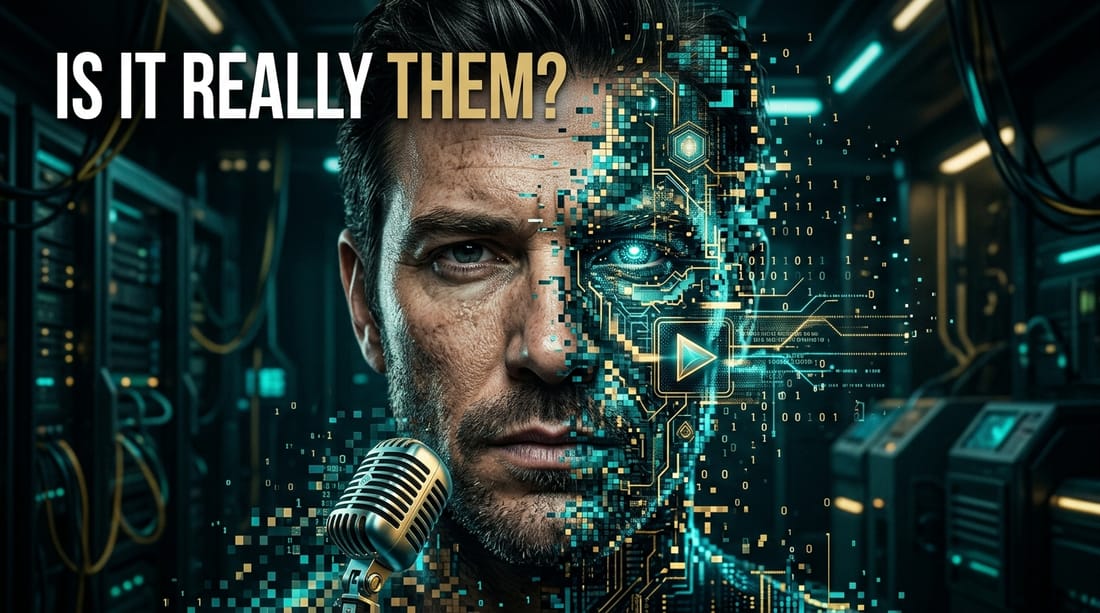
The scam itself is ancient: send me one Bitcoin, I'll send you two back. For years it was easy to laugh off — a sketchy text post, an obvious fake account, a typo-ridden message. What changed is the packaging. Now that pitch can arrive as a flawless video of a billionaire founder, in his real voice, on a livestream that looks official, talking directly to the camera about his "special event." The con is the same. The face is new. And the face is the whole problem.
The deepfake giveaway
The most visible AI-powered crypto scam is the fake celebrity giveaway. Scammers take a recognizable figure — a tech founder, a crypto personality, a famous investor — and generate or manipulate a video of them announcing a giveaway: "To celebrate, I'm doubling any crypto you send to this address for the next hour." These run as fake "live" streams, hijacked accounts, and slick ads. The video quality keeps getting better, the lip-sync keeps getting tighter, and the voice is cloned closely enough to fool people who know what the person actually sounds like.
The underlying mechanic never changes. You send crypto to the address expecting double back. Nothing comes back. Crypto transactions are irreversible, the address is the scammer's, and the "famous" endorsement was a puppet show. But a believable human face delivering the pitch dramatically raises how many people fall for it, because skepticism that easily dismisses text struggles against the evidence of a familiar face and voice.
Burn this into memory: no legitimate giveaway, event, or investment ever requires you to send crypto first in order to receive more. That structure — send to receive — is the scam, every single time, no matter whose face is on the screen. A real airdrop or promotion does not work by you transferring coins to a stranger's address and trusting them to return more.
The cloned voice in your ear
The more personal and frightening evolution is voice cloning. Modern tools can reproduce a specific person's voice convincingly from a short audio sample — a few seconds scraped from a video, a voice note, a podcast. That capability turns two classic scams radioactive.
The first targets businesses. An employee gets a call or voice message in the unmistakable voice of their CEO or finance chief: "I need you to authorize an urgent crypto transfer for a deal closing right now — keep it confidential." Under the pressure of an executive's voice and a manufactured deadline, people have sent very real money to scammers. The second targets families. A parent receives a panicked call in their child's voice claiming a crisis — an accident, an arrest, a debt — and begging for crypto immediately. The voice is right. The terror is real. The child is fine and was never on the phone.
Why AI raises the stakes — and why it doesn't change the defense
AI hasn't invented new scams. It has industrialized the believability of old ones and removed the friction. It mass-produces convincing fakes, personalizes them at scale, and clears away the typos and awkwardness that used to trip our instincts. The "tells" we relied on — bad grammar, a face that's clearly not them, a voice that's slightly off — are evaporating.
But here's the reassuring part. Because these fakes depend entirely on getting you to act before you verify, the defense is the same as it ever was, just applied more rigorously: verify through a separate, trusted channel, always.
- For any urgent money request — boss, colleague, family — stop and confirm independently. Hang up and call the person back on their known number. Message them on a different app. The cloned voice cannot survive a real conversation you initiate yourself.
- Agree on a family code word. A private word or question only your real family would know defuses the emergency-call scam instantly. If the "child" can't answer it, it's not your child.
- Treat every "send crypto to receive more" as a scam by definition. The format is the proof. The famous face is irrelevant.
- Distrust manufactured urgency. The emergency, the closing deal, the one-hour window — urgency exists to stop you from verifying. Its presence is itself the warning, the same instinct that protects you in how to spot a crypto scam before it costs you money.
The deeper shift
We're entering a period where "I saw it with my own eyes" and "I heard their voice" are no longer proof of anything. That's genuinely unsettling, and it will get more so as the tools improve. The same AI advances that make legitimate tools powerful — explored in where AI and crypto actually meet — also arm fraudsters with synthetic faces and voices on demand.
The mental upgrade required is to shift trust from content to channel. Stop trusting how real a message looks or sounds, and start trusting only how you received it and whether you can independently confirm it. A request is legitimate not because the voice is right, but because you verified it through a path the scammer doesn't control. In a world where anyone's face and voice can be faked, that habit — verify the channel, never the content — is the one that keeps your crypto yours.
Frequently asked questions
Scammers create fake videos of well-known figures appearing to endorse a giveaway or investment, telling viewers to send crypto to receive more back. The person never said it; the video is AI-generated or manipulated. The classic 'send 1, get 2 back' scam, now with a believable face.
Yes, convincingly, from just a short sample of their speech. Scammers use cloned voices to impersonate executives requesting urgent transfers, or family members claiming an emergency, pressuring the target to send money fast before they think to verify.
Verify through a separate, trusted channel before acting on any urgent money request, no matter how real the voice or video seems. Use a private code word with family, confirm requests with executives directly, and remember that no legitimate giveaway asks you to send crypto first.
Because the entire scam depends on you acting before you verify. Cloned voices and deepfakes are convincing but fragile; a single independent check breaks them. So scammers manufacture emergencies to stop you from making that check.
Keep reading




Popular this week
- 01Rug Pulls Hall of Shame: Famous Crypto Exit ScamsAnalysis · 4 min
- 02Grid Trading Bots Explained, and When They Blow UpGuide · 4 min
- 03Where AI and Crypto Actually Meet: Compute, Data, and DePINAnalysis · 9 min
- 04Base and Coinbase's Quiet Bet on Bringing Millions On-ChainAnalysis · 5 min
- 05What Moves Crypto Prices? The Forces Behind the VolatilityAnalysis · 3 min