How Dogecoin Started as a Joke and Refused to Die
Two strangers made a cryptocurrency out of a dog meme in an afternoon, mostly to mock the whole industry. Then it raised money for the Jamaican bobsled team, got adopted by the world's richest man, and became a top cryptocurrency. The most absurd success story in finance.
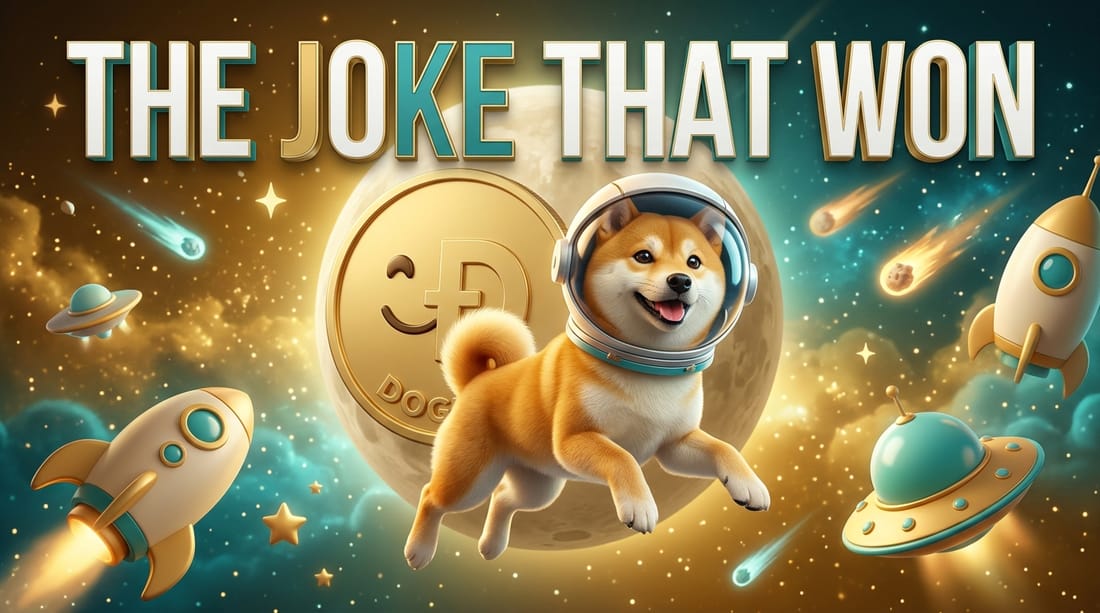
Here is a sentence that should not be true: one of the most valuable cryptocurrencies in the world is based on a photo of a surprised Shiba Inu, was built in a few days as a joke, and has no business model, no roadmap, and no real reason to exist. And yet here we are. Dogecoin is the punchline that refused to leave the stage, and honestly, its story might be my favorite in all of crypto.
A joke between two strangers
In late 2013, the crypto world was knee-deep in its first altcoin gold rush. Hundreds of "serious" coins were launching, each with a grand whitepaper promising to revolutionize something. It was, frankly, ridiculous, and two people on opposite sides of the world independently thought so.
Jackson Palmer, a marketer at Adobe in Australia, jokingly tweeted that "Dogecoin" was the next big thing, mashing up the cryptocurrency mania with the wildly popular "doge" meme — that picture of a Shiba Inu surrounded by broken-English captions in Comic Sans. People egged him on. Around the same time, Billy Markus, a software engineer at IBM in Oregon, was tinkering with making his own coin. The two connected, and in a matter of days in December 2013, they forked existing cryptocurrency code, slapped the dog on it, and launched Dogecoin.
It was satire. The whole point was to make fun of how seriously everyone was taking these things. They deliberately made it silly and abundant — no scarcity drama, just a fun internet tipping coin. To make sure nobody mistook it for a get-rich scheme, they gave it no supply cap at all: billions of new Dogecoin would be minted every year, forever. That single choice is the deepest difference between Dogecoin and the asset at the top of the price rail beside this article; if scarcity is Bitcoin's entire pitch, abundance was Dogecoin's joke. The contrast is worth understanding through what is the Bitcoin halving.
The community that took the joke and ran
And then the strangest thing happened. The joke developed a heart.
The early Dogecoin community on Reddit turned out to be one of the warmest, most generous corners of the internet. They used the coin exactly as intended — to tip each other small amounts for good posts — and then they started doing something genuinely lovely with it:
- They raised tens of thousands of dollars to send the Jamaican bobsled team to the 2014 Winter Olympics after the team qualified but couldn't afford the trip.
- They sponsored a NASCAR driver, plastering the grinning Shiba Inu on a race car.
- They funded clean-water projects in Kenya through a campaign called Doge4Water.
None of this made anyone rich. It was just a community using a silly currency to do nice things, mostly for the joy of it. For a brief, pure moment, Dogecoin was the friendliest thing in crypto — proof that a "worthless" coin could still generate real-world good will. The founders, meanwhile, drifted away. Palmer in particular grew disillusioned with crypto entirely and became one of its sharpest public critics.
Dogecoin is the clearest example in crypto that a coin's price has almost nothing to do with its technology and almost everything to do with attention and belief. There is no innovation here. There is a meme, a community, and a story. That's the whole product, and it turns out the story can be worth billions.
Enter the richest man in the world
If the bobsled era was Dogecoin's innocence, what came next was its fame — and its complication.
Starting around 2019, Elon Musk began tweeting about Dogecoin. A lot. He called himself the "Dogefather," joked that it was "the people's crypto," and during the wild bull market of early 2021 his posts sent the price into orbit — at one point up thousands of percent. Suddenly the dog coin was on the evening news. Tesla began accepting it for some merchandise. There was even talk of a Dogecoin-funded SpaceX mission to the Moon.
This was a double-edged sword if there ever was one. Musk's attention gave Dogecoin a reach no marketing budget could buy, cementing it as the original and most famous meme coin. But it also turned a community tipping currency into a vehicle for pure speculation, where a single billionaire's tweet could mint and erase fortunes in minutes. Plenty of latecomers bought at the top of the frenzy and got badly hurt when the attention moved on. That dynamic — where a coin's price is hostage to one person's mood — is its own kind of risk that no amount of community goodwill cancels out.
What the joke actually taught us
So what do I make of a multi-billion-dollar dog joke?
I refuse to be entirely cynical about Dogecoin, because doing so misses something true. Its early community was a genuinely beautiful thing, and the coin's whole existence is a permanent, useful reminder not to take this industry too seriously. Dogecoin has also, almost by accident, been remarkably honest: it never pretended to be revolutionary technology, never sold a fake roadmap, never promised to bank the unbanked. It said "I'm a dog meme" from day one. In a field full of elaborate scams dressed up as innovation, there's something almost refreshing about a coin whose only claim is that it's fun. Knowing the difference between the two is the entire skill set in how to spot a crypto scam.
But I'd be doing you a disservice if I were romantic about it as an investment. Dogecoin has no scarcity, no unique technology, and no fundamental value driver beyond attention. Its price is a pure function of how much the internet — and one specific billionaire — happens to care on a given day. That's a thrilling casino and a terrible foundation. People who understand it's a meme and treat it like one tend to be fine. People who mistake a viral moment for a retirement plan tend not to be.
My conclusion: Dogecoin is the most successful joke in financial history, and that's not a dismissal — it's the whole point. It proved that in markets, narrative can outrun fundamentals indefinitely, and that a community and a laugh can summon real value out of thin air. Just never forget which one you're actually buying: not a technology, but a story about a very good dog. Much wow. Very lesson.
Frequently asked questions
Dogecoin was created in December 2013 by Billy Markus, a software engineer at IBM, and Jackson Palmer, a marketer at Adobe. They combined a popular Shiba Inu dog meme with cryptocurrency as a joke, and built it in a matter of days.
Yes. It was designed to poke fun at the flood of serious-sounding altcoins flooding the market in 2013. Neither founder expected it to last, and both eventually stepped away from it.
No. Unlike Bitcoin's hard cap of 21 million, Dogecoin has no maximum supply. Roughly 5 billion new coins are issued every year, making it permanently inflationary by design.
Musk repeatedly promoted Dogecoin on social media from around 2019, calling himself the Dogefather, which sent the price soaring during 2021. His involvement turned a niche community joke into a household name, for better and worse.
Keep reading




Popular this week
- 01Rug Pulls Hall of Shame: Famous Crypto Exit ScamsAnalysis · 4 min
- 02Grid Trading Bots Explained, and When They Blow UpGuide · 4 min
- 03Where AI and Crypto Actually Meet: Compute, Data, and DePINAnalysis · 9 min
- 04Modular vs Monolithic Blockchains: The Design FightExplainer · 6 min
- 05Base and Coinbase's Quiet Bet on Bringing Millions On-ChainAnalysis · 5 min