How to Avoid Wallet-Draining Phishing Sites
Most crypto theft isn't hacking — it's a fake website tricking you into signing your funds away. Learn how wallet drainers work and the simple habits that make you nearly immune.
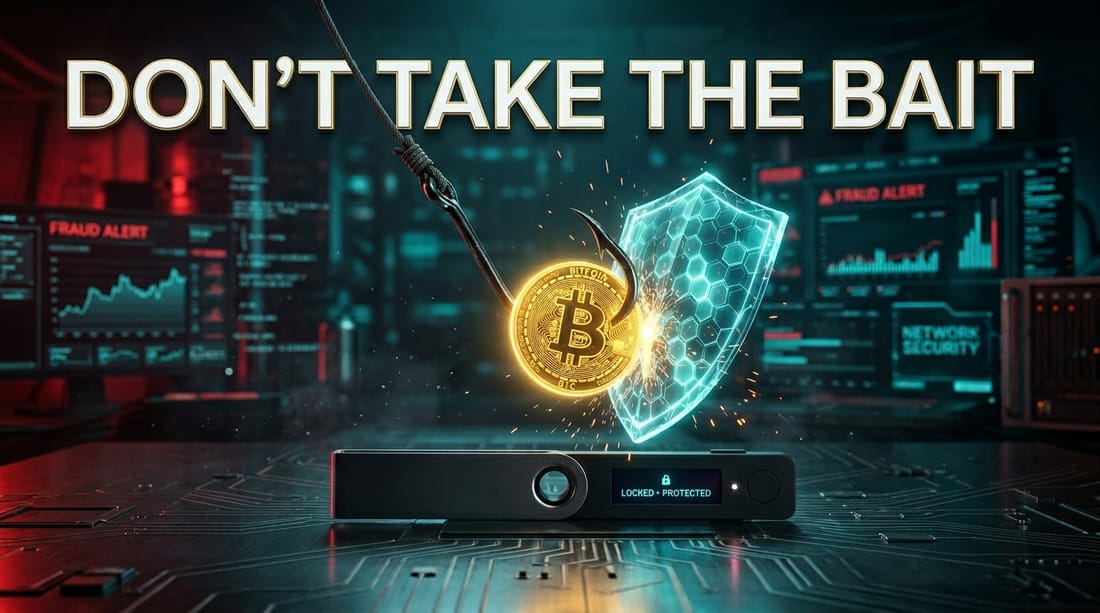
Here's a fact that reshapes how you should think about crypto security: the overwhelming majority of crypto theft is not hacking. Nobody is cracking your wallet's cryptography — that's effectively impossible. Instead, you are tricked into approving the theft yourself, on a fake website that looks exactly like the real thing.
These traps are called wallet drainers, and they've stolen billions. The terrifying part is how legitimate they look. The reassuring part is that, once you understand the playbook, avoiding them becomes almost automatic. Let's make you nearly immune.
How wallet drainers actually work
A wallet drainer is malicious code sitting on a fraudulent website. The attack flow is depressingly consistent:
- You're lured to a fake site — a fake airdrop claim page, a clone of a real project, a fake "wallet validation" tool, a counterfeit NFT mint.
- You connect your wallet. This alone usually just reveals your address — not yet dangerous.
- The site asks you to sign something — to "claim," "verify," "enable," or "approve." It looks routine.
- What you're actually signing is a token approval or transfer that hands the attacker permission to move your assets.
- Your wallet empties — sometimes instantly, sometimes hours later when the attacker pulls the trigger on the permission you granted.
The genius and the horror is that no security was broken. You had the keys, you clicked confirm, the blockchain obeyed. As we explained in what crypto movies get wrong, the vault is unbreakable — so thieves go after the human holding the keys.
The lures: how they get you to the site
Drainers can't drain you if you never visit them, so the whole game is getting you onto the fake page. The common bait:
- Fake airdrops and giveaways. "You're eligible to claim 500 tokens!" Urgency plus free money switches off your skepticism.
- Look-alike domains. A real project at example.io gets cloned at examp1e.io or example-app.net. One wrong character.
- Malicious ads. Search for a popular app and the top result is sometimes a paid ad pointing to a perfect fake. Ads are a major attack vector.
- DMs and "support." Someone messages you offering help, a giveaway, or a "validation" link. Unsolicited help in crypto is almost always a trap, a cousin of the pig-butchering con.
- Compromised official channels. Occasionally a real project's social account or Discord gets hacked and posts a malicious link. Even "official" sources can be momentarily poisoned.
The two emotions every drainer exploits are greed (free tokens!) and urgency (claim in the next hour!). The instant you feel either while looking at a crypto link, stop. Those feelings are the attack working on you in real time.
The habits that make you nearly immune
You don't need technical skill to defeat this. You need a small set of non-negotiable habits.
1. Navigate by bookmark, never by link. Find the real site once, verify it carefully, bookmark it, and from then on only reach it through your bookmark. Never click crypto links from ads, search results, DMs, emails, or social posts. This single habit defeats most phishing outright.
2. Read every signature request. Before approving anything, understand what it does. If a "claim free tokens" page asks you to approve access to your existing tokens, that makes no sense — claiming shouldn't require giving away access. When the request doesn't match the action, reject it. Learning to read what you're signing in MetaMask is the core skill here.
3. Use a burner wallet for anything risky. Keep a separate wallet with minimal funds for claiming airdrops, minting unknown NFTs, or trying new apps. If it gets drained, you lose pocket change, not your savings. Your main wallet should never touch unfamiliar sites.
4. Keep real money on a hardware wallet. A hardware wallet won't stop you from signing a malicious transaction, but it forces a deliberate, physical confirmation step that breaks the autopilot clicking drainers rely on — and it keeps your keys off your internet-connected computer entirely.
5. Revoke old approvals periodically. Permissions you granted long ago can be exploited later. Use a reputable approval-checker to review and revoke access you no longer need, shrinking your attack surface.
6. Slow down — always. Every drained wallet has the same final ingredient: the victim was rushing. There is no legitimate crypto opportunity that requires you to connect and sign right now. Urgency is the scammer's tool, never your friend.
The mindset shift that protects you
Stop thinking "could my wallet get hacked?" and start thinking "could I get tricked into approving something?" Because that's the real threat, and it reframes your defenses entirely. You're not trying to out-engineer a hacker; you're trying to not be fooled by a con artist.
Treat every connection and every signature as a small, deliberate decision rather than a reflexive click. Verify the site is real, understand what you're approving, and keep your serious money somewhere a single bad click can't reach. Do that, and the entire category of wallet-draining attacks — the thing that empties more crypto wallets than anything else — simply stops being able to touch you. The thieves are counting on your haste. Disappoint them.
Frequently asked questions
A wallet drainer is malicious code on a fake or compromised website that, once you connect your wallet and approve a request, transfers your tokens or NFTs to the attacker. You authorize the theft yourself by signing a deceptive transaction.
They impersonate real projects with look-alike domains, fake airdrops, urgent 'claim now' messages, and ads. Once you connect and sign, they drain your assets. The trick is social engineering, not breaking the wallet itself.
Simply connecting usually only lets a site see your address. The danger comes when you approve a transaction or signature. The problem is that malicious sites disguise draining approvals as harmless actions, so you sign without realizing.
Bookmark real sites and use only those, never click links from DMs/ads/emails, read every signature request, use a separate burner wallet for risky claims, and keep most funds on a hardware wallet. Slow down and verify before signing anything.
Keep reading




Popular this week
- 01Rug Pulls Hall of Shame: Famous Crypto Exit ScamsAnalysis · 4 min
- 02Grid Trading Bots Explained, and When They Blow UpGuide · 4 min
- 03Where AI and Crypto Actually Meet: Compute, Data, and DePINAnalysis · 9 min
- 04Modular vs Monolithic Blockchains: The Design FightExplainer · 6 min
- 05Base and Coinbase's Quiet Bet on Bringing Millions On-ChainAnalysis · 5 min