Stablecoin Yield: Where It Comes From and When It's a Trap
A "stable" coin paying 18% should make you curious, not greedy. Here's where stablecoin yield actually comes from, the honest sources, and the red flags that precede most blowups.
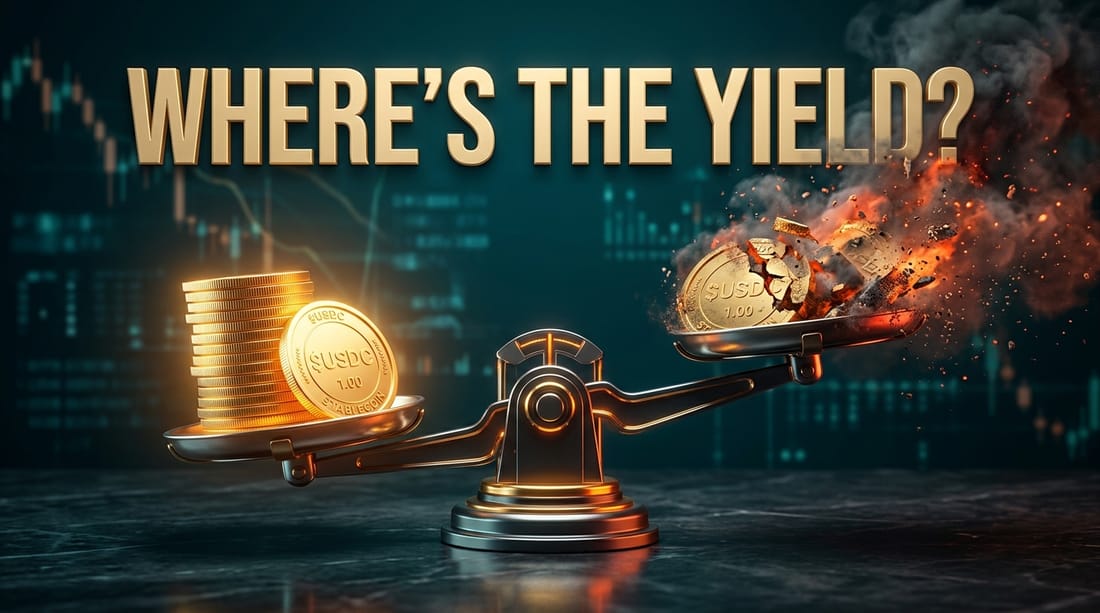
Somewhere right now, an app is offering double-digit yield on a "stable" dollar token, and someone is about to deposit their savings into it thinking they've found free money. They haven't. They've found a payment — and every payment is compensation for a risk. The only question that matters is: which risk, and is the rate honest about it?
Stablecoin yield isn't a scam by default. Plenty of it is legitimate. But the gap between "sensible return" and "you're the exit liquidity for a Ponzi" is wide, and it's invisible unless you know where to look.
The one rule: yield is rent on risk
Money doesn't grow because an app is generous. If you're earning yield, someone, somewhere, is paying it — and they're paying it because your capital is doing something with risk attached. Sustainable yield always traces back to a real source of revenue. Unsustainable yield traces back to new depositors' money. Your entire job is to figure out which one you're looking at. (This is the same instinct we apply to crypto staking yield.)
The honest sources of yield
When stablecoin yield is real, it usually comes from one of these:
- Lending. You lend your stablecoins to borrowers — traders, businesses — who pay interest. Your risk: the borrower defaults, or the lending platform fails.
- Real-world assets. Some yield is backed by genuinely boring things like short-term government debt. This tends to be the most conservative source, with returns roughly in line with prevailing interest rates — which is the tell: it's modest, because the risk is modest.
- Liquidity provision. You earn trading fees by supplying liquidity to a pool. Real fees, real risk (including impermanent loss on non-stable pairs).
Notice that none of these produce 40%. Honest yield is usually unexciting, and unexciting is a feature.
The red flags of a trap
The dangerous products share a family resemblance:
- A rate that doesn't match reality. If safe government debt pays low single digits and a "stablecoin" product promises 18% fixed, the extra return is buying extra risk — even if nobody says so out loud.
- No clear answer to "where does the yield come from?" Vague talk of "arbitrage," "proprietary strategies," or "the protocol" with no specifics is a flashing light.
- Yield that depends on growth. If the returns require a constant inflow of new depositors to pay the old ones, that's the literal shape of a Ponzi, whatever it's wearing.
- Pressure and urgency. Limited-time bonus APYs and "deposit now" countdowns are marketing, and good investments rarely need a stopwatch.
Remember the algorithmic stablecoin that paid ~20% and was marketed as safe \u2014 right up until it collapsed to near zero in days, vaporizing tens of billions. The yield wasn't the reward for the risk. The yield was the risk, wearing a stable costume.
Don't forget the coin itself
There's a second layer of risk people skip: the stablecoin's own peg. A high yield on a less-proven token stacks de-peg risk on top of yield risk. Earning 12% means nothing if the underlying "dollar" quietly becomes 80 cents. Stick to well-established, transparently-backed stablecoins for anything you can't afford to lose, and read how stablecoins hold $1 and when they don't before chasing a rate on an exotic one.
A sane way to participate
If you want stablecoin yield, you can have it without volunteering as someone's exit liquidity. Favor established platforms and conservative sources. Keep the rate's modesty as a sign of health, not a disappointment. And if you do park stablecoins on a trading venue to earn or to trade, use a large, reputable one rather than the highest number you can find:
The good news is that you don't need the suspicious 18% — you need to not lose the whole principal chasing it. In stablecoin yield, survival is the strategy, and boredom is usually the safest number on the screen.
Frequently asked questions
It ranges from fairly conservative to extremely risky depending on the source. The yield is a payment for taking on some risk — the key is knowing exactly which risk and whether the rate matches it.
Common honest sources include lending to borrowers who pay interest, returns on real-world assets like short-term government debt, and fees from providing liquidity. Each carries its own risk.
Sky-high fixed rates, vague explanations of where returns come from, pressure to deposit fast, and yields that depend on a constant stream of new depositors rather than real revenue.
Yes. Stablecoins can de-peg under stress, and some have collapsed entirely. A high yield on a less-proven stablecoin stacks peg risk on top of yield risk.
Keep reading




Popular this week
- 01Rug Pulls Hall of Shame: Famous Crypto Exit ScamsAnalysis · 4 min
- 02Grid Trading Bots Explained, and When They Blow UpGuide · 4 min
- 03Where AI and Crypto Actually Meet: Compute, Data, and DePINAnalysis · 9 min
- 04Modular vs Monolithic Blockchains: The Design FightExplainer · 6 min
- 05How to Spot Wash Trading and Fake VolumeGuide · 5 min