The Memecoin Supercycle Thesis, and Why It Might Be Wrong
A loud corner of crypto argues that memecoins aren't a passing fad but the future — that attention itself is the only real fundamental left. It's a more serious argument than it sounds. It also has serious holes. Let's take both halves seriously.
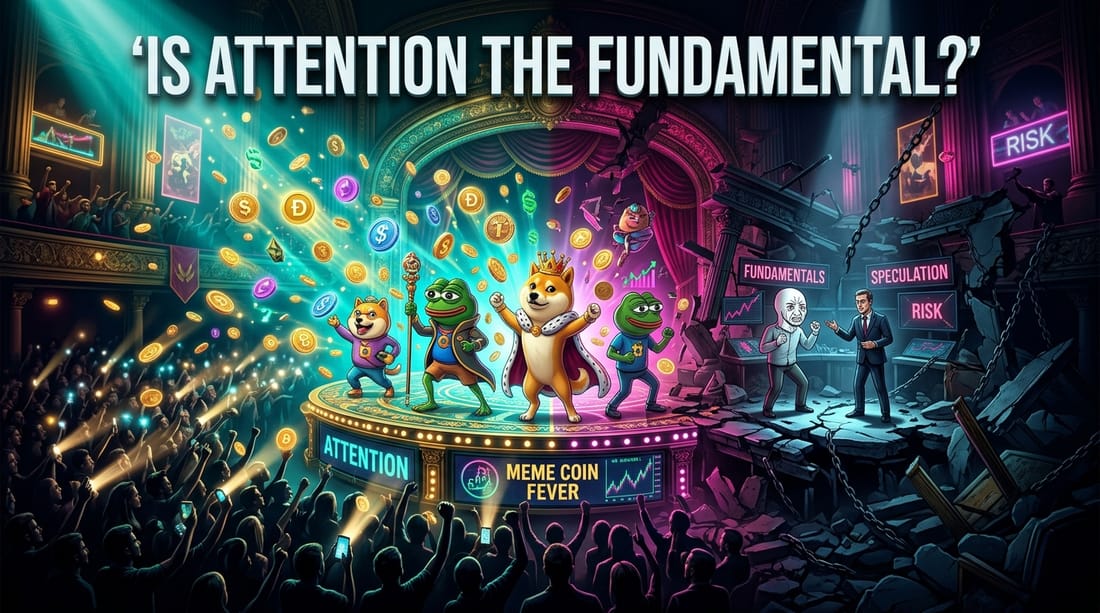
It's easy to dismiss memecoins as stupid, and most of the time you'd be right. But there's an argument circulating in crypto that they're not a joke at all — that they're actually the most honest thing in the entire market, and the shape of its future. It's tempting to laugh it off. Don't, at least not before you've heard it properly, because the strongest version of the memecoin thesis lands some uncomfortable hits on "serious" crypto. Then we'll see where it breaks.
The thesis, in its strongest form
Here's the argument made as well as I can make it, no strawman.
Crypto has a token-saturation problem. Anyone can create a coin in seconds — the Solana machine proved that — so there are effectively infinite tokens chasing a finite pool of money and attention. In that world, what actually makes one token worth more than another? The thesis answers: not the technology, because most "innovative" tokens are forgotten in months, but attention and community. The coins that win are the ones that capture the culture, command a tribe, and stay in the conversation. Attention, the argument goes, is the only scarce resource and therefore the only real fundamental left.
And then the thesis lands its sharpest punch: most "serious" tokens are secretly attention plays too — they just dress it up. A blockchain project with a whitepaper full of jargon, a token with no real cash flow, a valuation floating on narrative and hype rather than usage — how is that fundamentally different from a memecoin? At least the memecoin is honest about what it is. The supposedly serious token wears a costume of fundamentals over the same empty engine. By this view, memecoins didn't break the rules of crypto valuation; they just stopped pretending, and that connects directly to the discomfort in why every new crypto project sounds exactly the same.
That's a genuinely provocative argument, and the honest observer has to admit it contains real truth. A huge share of crypto value is driven by narrative, community, and attention rather than fundamentals — that's not a memecoin pathology, it's what moves crypto prices across the board. The thesis is at its strongest as a critique of crypto's self-flattery.
Where it starts to break
Granting all that, the thesis has serious holes once it tries to graduate from "sharp critique" to "investment future."
Attention is finite and brutally fickle. The thesis treats attention as a resource you can capture and hold. But attention is the most fleeting thing in the world. A memecoin that owns the conversation today is forgotten next week as the crowd stampedes to the next one. "Attention is the fundamental" cuts both ways: if attention is all there is, then there's nothing sticky underneath to hold value when attention inevitably moves on. Most memecoins don't just underperform — they go to zero, fast, because the only thing holding them up left the room.
It depends on an endless supply of new buyers. Strip away the philosophy and the economics are a transfer machine: early insiders and platforms profit from money that latecomers bring in, as the casino structure makes plain. That works only as long as fresh buyers keep arriving to hand their money to the people who got there first. A "supercycle" built on perpetually expanding new money entering to pay the earlier entrants describes something the market already has a much older, less flattering name for. It can run for a surprisingly long time. It cannot run forever.
"Honest about being empty" is still empty. Conceding that some serious tokens are also overvalued attention plays doesn't elevate memecoins — it just indicts both. The memecoin thesis sometimes smuggles in a sleight of hand: because some serious projects are hollow, therefore hollow is fine, even virtuous. But "they're hollow too" is an argument for more skepticism everywhere, not for embracing the most nakedly hollow assets as the future.
The memecoin thesis is most valuable as a question, not an answer. It forces you to ask of any token — serious or silly — "what is actually holding this value up?" That's a fantastic question. Its mistake is concluding that because the answer is so often "just attention," you should buy the assets that are purely attention. The better conclusion is the opposite: be more suspicious of everything floating on narrative alone, memecoins most of all.
What the thesis gets right that you should keep
Don't throw it all out. The durable insight is this: a great deal of crypto runs on attention, community, and story far more than on fundamentals, and pretending otherwise is its own kind of self-deception. Anyone investing in crypto should internalize that, because it explains a lot of behavior that "fundamentals" can't — and it's a useful immune system against the next project promising the world from a whitepaper. The thesis is a sharp tool for seeing clearly.
What you shouldn't keep is the leap from that insight to "therefore buy memecoins." Recognizing that attention drives value doesn't make attention predictable or holdable, and it doesn't change the fact that the structure systematically rewards early insiders at the expense of everyone who shows up later.
The honest verdict
The memecoin supercycle thesis is smarter than its critics admit and weaker than its believers hope. It correctly diagnoses that crypto valuation leans heavily on attention rather than fundamentals — a truth the "serious" side would rather not discuss. But it mistakes a diagnosis for a prescription, treating the most volatile, insider-favoring, zero-bound assets in the market as a destination rather than a symptom.
Hold the insight; reject the trade. Let the thesis sharpen your skepticism of everything that floats on narrative, and let that same skepticism keep you from treating a lottery ticket as a thesis. If you choose to buy memecoins anyway, do it for the only honest reason there is — you're gambling, and you've decided that's fine — not because you've convinced yourself you're early to the future. The thesis is worth taking seriously. Taking it literally is how it costs you.
Frequently asked questions
The argument that memecoins are not a fad but a lasting category, because in a world saturated with tokens, attention and community are the only real differentiators. It claims memecoins are honest about being pure attention plays, while many 'serious' tokens secretly are too.
Yes, in part. It correctly observes that much of crypto's value is driven by narrative, community, and attention rather than fundamentals, and that many tokens with elaborate technical stories perform no better than memecoins. That critique has teeth.
Because attention is finite and fickle, the space relies on a constant flow of new buyers, most memecoins go to zero, and a structure that mainly transfers money from latecomers to insiders is hard to call a lasting investment category rather than serial gambling.
Treat memecoins as gambling regardless of any thesis. Even if attention drives value, predicting which memecoin captures it is closer to a lottery than an investment, and the overall structure favors early insiders over everyone else.
Keep reading




Popular this week
- 01Rug Pulls Hall of Shame: Famous Crypto Exit ScamsAnalysis · 4 min
- 02Grid Trading Bots Explained, and When They Blow UpGuide · 4 min
- 03Where AI and Crypto Actually Meet: Compute, Data, and DePINAnalysis · 9 min
- 04Modular vs Monolithic Blockchains: The Design FightExplainer · 6 min
- 05How to Spot Wash Trading and Fake VolumeGuide · 5 min