The Story of XRP and Ripple: Banks, Courtrooms, and a Coin That Won't Quit
XRP was built to move money between banks, made a handful of founders very rich, and then spent years fighting the U.S. government in court. Few coins are this loved, this hated, and this misunderstood. Here's the real story.
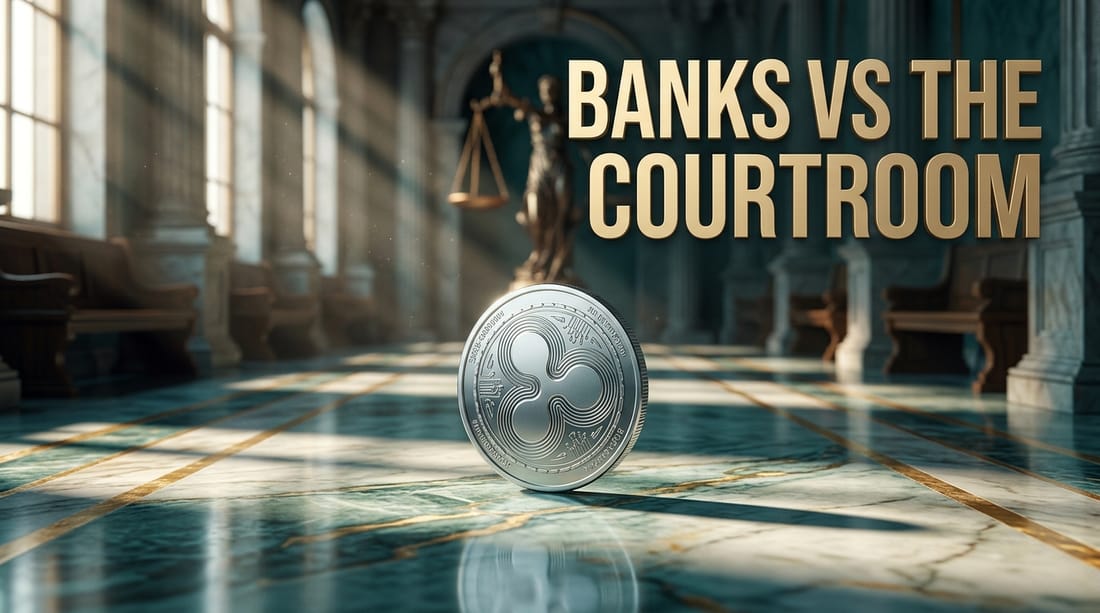
Almost every coin in crypto markets itself as a rebellion against banks. XRP did the opposite. It was built to sell to the banks — to be the boring, fast plumbing that moves money between institutions in seconds instead of days. That contrarian bet made its founders rich, earned it one of the most fiercely loyal communities in the industry, and dropped it into a years-long legal war with the United States government.
It's one of crypto's most polarizing stories. Let's tell it straight.
Before Bitcoin, there was an idea
The roots of XRP go back further than most people realize. In 2004, a web developer named Ryan Fugger built "RipplePay," a system for people to extend credit to one another through chains of trusted connections. It predated Bitcoin entirely, and it didn't really catch on. But the name and the core idea — money as a web of trust lines that net out — survived.
The technology that became today's XRP came together in 2011-2012, when three engineers — David Schwartz, Jed McCaleb, and Arthur Britto — built the XRP Ledger. They wanted Bitcoin's open-money promise without its energy-hungry mining and its slow, expensive confirmations. Their ledger settled transactions in seconds using a network of validators rather than miners. McCaleb, notably, was also the person who had earlier started the Mt. Gox exchange — a recurring character in crypto history.
In 2012, Chris Larsen and Jed McCaleb founded a company — first called OpenCoin, soon renamed Ripple — to build businesses on top of the ledger.
The original sin (or the original plan)
Here is the fact that defines every XRP debate: unlike Bitcoin, all 100 billion XRP were created at once, at the start. None of it is mined. The founders kept large allocations, and the bulk — tens of billions — went to the company to fund development and seed the market.
Supporters see this as perfectly sensible: a company needs a treasury to build a payments business, and in 2017 Ripple locked most of its holdings in escrow, releasing up to a billion XRP per month on a fixed schedule to reassure the market it wouldn't dump everything at once. Critics see something closer to a private currency where the issuer holds most of the supply — a structure that looks far more like a company stock than digital cash. Both readings contain truth, and which one you lean toward basically determines how you feel about XRP.
This is the single most important thing to understand about XRP before forming an opinion: most of the supply was created and held by the founding company, not earned by an open market of miners. That fact sits at the heart of both the bull case (a funded company building real products) and the bear case (concentrated control). Don't let anyone skip past it.
Jed McCaleb eventually fell out with the company, left around 2013, and went on to co-found Stellar, a near-cousin network. He spent years slowly selling his enormous XRP stake, an overhang the market watched nervously.
Who invests in it
Ripple the company has been backed by serious money. Over the years its investors have included top venture firms like Andreessen Horowitz and Google Ventures, and — most strategically — Japan's SBI Holdings, which became both an investor and a regional partner pushing XRP-based payments across Asia. This is a meaningful contrast with Bitcoin: there is a well-funded private company whose job is to drive adoption of XRP, with sales teams, banking partnerships, and a product roadmap. That's a strength and a vulnerability at the same time.
The lawsuit that froze everything
Then came December 2020. The U.S. Securities and Exchange Commission sued Ripple and two of its executives, alleging that XRP was an unregistered security and that the company had raised over a billion dollars selling it illegally. U.S. exchanges scrambled to delist XRP. Its price cratered. Many in crypto wrote it off for dead.
The case became a landmark, because the SEC was effectively testing whether a huge swath of crypto tokens were illegal securities all along. After two and a half years, in July 2023, Judge Analisa Torres issued a famously split ruling: XRP sold to the public on exchanges (so-called programmatic sales) was not a security, but XRP sold directly to sophisticated institutions under contracts was.
Both sides declared victory, and in truth both got something. For the broader market it was a genuinely important precedent — the first time a U.S. court drew a line suggesting the way a token is sold matters more than the token itself. If you want the wider context of how regulators are reshaping this entire industry, see the institutionalization paradox.
What XRP is actually for — my honest take
Strip away the tribal loyalty and the lawsuit drama, and what is XRP, really?
The genuine use case is cross-border settlement. Moving money between countries today runs on a slow, expensive web of correspondent banks where funds sit idle for days. XRP's pitch is to be the instant bridge asset between two currencies, so an institution doesn't need to pre-fund accounts all over the world. When this works, it's elegant and the speed is real. The XRP Ledger settles in seconds and costs a fraction of a cent.
My skepticism, in fairness, is twofold. First, the "banks will use XRP" thesis has been promised for nearly a decade, and adoption has been steadier in payments corridors than in the wholesale Wall Street takeover the loudest fans imagine. Banks can also move value with stablecoins or their own systems, and many prefer to. Second, the concentrated supply and the company's central role mean XRP carries a different kind of risk than a truly decentralized network — its fortunes are tied to one company's success and legal standing in a way Bitcoin's simply aren't.
So my conclusion is deliberately unfashionable: XRP is neither the scam its harshest critics claim nor the inevitable backbone of global finance its army of supporters insists. It is a fast, cheap settlement network with a real product, a real company, and a real (if slower-than-hyped) adoption story — wrapped in a token whose value depends heavily on that company and on regulators who keep changing the rules. If you're going to research a coin this divisive, do it the disciplined way we lay out in how to research an altcoin before you buy it. XRP rewards skepticism in both directions.
Frequently asked questions
The XRP Ledger was built in 2011-2012 by David Schwartz, Jed McCaleb, and Arthur Britto. The company now called Ripple was co-founded in 2012 by Chris Larsen and Jed McCaleb to develop products around it.
XRP is the digital asset and the XRP Ledger is the open network it runs on. Ripple is a private company that builds payment software using XRP. They are related but not the same thing, a distinction that became central to the SEC lawsuit.
In December 2020 the SEC alleged that XRP was an unregistered security. In July 2023 a judge ruled that programmatic sales of XRP on exchanges were not securities, while certain direct institutional sales were, a split decision both sides claimed as a win.
All 100 billion XRP were created at once at launch rather than mined over time. A large share was given to the founding company, much of which is locked in escrow and released on a monthly schedule.
Keep reading




Popular this week
- 01Rug Pulls Hall of Shame: Famous Crypto Exit ScamsAnalysis · 4 min
- 02Grid Trading Bots Explained, and When They Blow UpGuide · 4 min
- 03Where AI and Crypto Actually Meet: Compute, Data, and DePINAnalysis · 9 min
- 04Modular vs Monolithic Blockchains: The Design FightExplainer · 6 min
- 05How to Spot Wash Trading and Fake VolumeGuide · 5 min