TON and Telegram's Billion-User Crypto Experiment
Most blockchains spend years desperate for users. TON has the opposite problem and the opposite opportunity: it's wired into a messaging app with close to a billion people already inside. That single fact makes it one of crypto's most fascinating experiments.
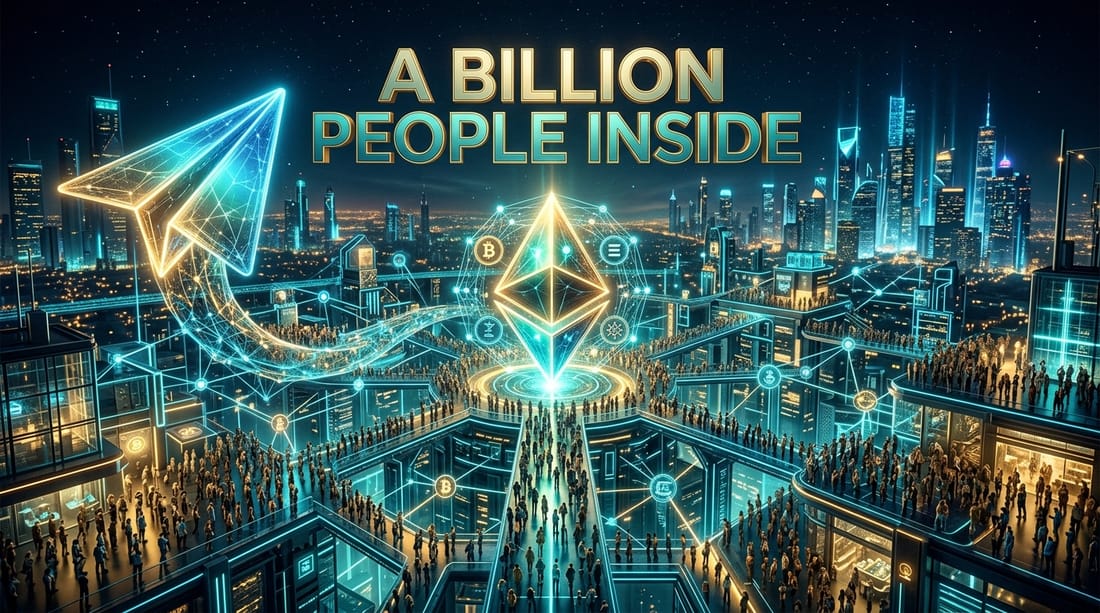
Here's a riddle that captures crypto's central frustration: most blockchains have brilliant technology and almost no users, while the apps with billions of users have almost no crypto. TON is the most audacious attempt to short-circuit that mismatch. Instead of building a network and praying people show up, it bolted itself to a messaging app where close to a billion people already live. Whether that's genius or a house of cards depends on questions nobody has fully answered yet — which is exactly what makes it worth understanding.
The unusual backstory
TON — The Open Network — has one of the stranger origin stories in crypto. It began as a blockchain project launched by Telegram, the wildly popular messaging app, years ago. The plan was grand: a fast, scalable network woven into Telegram's huge audience. Then it hit a wall. A regulatory dispute forced Telegram to step back from directly operating the network, and the project looked like it might die there.
Instead, it survived in an unusual form. The network continued as a community-driven project, while staying closely associated with Telegram — and over time, crypto features tied to TON became integrated back into the Telegram app itself. So TON occupies a peculiar space: not quite Telegram's official chain in the way it was first envisioned, but bound to it tightly enough that the app's gravity is the whole story. That history matters, because the dependency that defines TON's opportunity is also the source of its biggest risks.
Why the Telegram link changes everything
To grasp why TON is fascinating, you have to understand crypto's deepest, most stubborn problem: adoption. The technology is years ahead of its audience. Blockchains spend enormous time and money trying to attract users, and the experience is so intimidating — wallets, seed phrases, gas, phishing — that mainstream people bounce off. The bottleneck isn't capability; it's getting normal humans to actually show up and use the thing. It's the same wall that Base is trying to climb from the exchange side.
TON attacks that wall from a completely different angle. Telegram has close to a billion users who open the app every day for an entirely non-crypto reason — to message friends, follow channels, join groups. If crypto features live inside that app, then using crypto doesn't require those billion people to seek out a strange new platform. It can meet them where they already are, inside a chat they already trust, as naturally as sending a sticker. That's a distribution advantage no standalone blockchain can replicate. You can't buy your way to a billion engaged users; Telegram already has them.
The bet is elegant: don't drag users to crypto, bring crypto to where the users already are. A blockchain integrated into a messaging app a billion people open daily has solved, in principle, the single hardest problem in the industry — distribution. The entire TON thesis rests on whether "they're already here" can be converted into "they're actually using it." Proximity is not the same as adoption, and that gap is the whole experiment.
The genuine potential
If even a modest slice of Telegram's users start transacting on TON — sending payments in chats, using simple in-app financial features, playing the viral tap-to-earn games and mini-apps that have already drawn enormous engagement — that's potentially tens or hundreds of millions of people doing crypto things, a scale that dwarfs most networks. TON has shown real flashes of this: in-app games and mini-applications have pulled in massive user numbers, demonstrating that the integration can drive activity at a scale standalone chains rarely touch. The vision of bringing crypto to a mainstream audience — which the whole industry talks about endlessly — is more plausibly within reach for TON than for almost anyone, simply because of where it sits.
The real risks and dependencies
But the same closeness that is TON's superpower is also its central vulnerability, and honesty requires dwelling on it.
Dependency concentration. TON's fortunes are bound tightly to Telegram and to the health of that relationship. A network whose entire thesis rests on one app's user base is exposed to anything that happens to that app — its business decisions, its priorities, its willingness to keep deepening the integration. That's a lot of eggs in one basket, and the basket isn't fully under TON's control.
Regulatory overhang. The original project was derailed by regulators once already, and a crypto network fused with a messaging app used by a billion people across many jurisdictions is exactly the kind of thing regulators scrutinize. The legal questions are not all settled, and they could shape or constrain what's possible.
The activation gap. Having users near crypto features is not the same as having users use them meaningfully. Viral tap-to-earn games prove people will tap for free tokens; they don't prove those people will adopt crypto for real payments, savings, or finance. Converting idle proximity and game-driven curiosity into durable, valuable usage is the unproven leap at the heart of it all.
Concentration and decentralization questions. A network this entwined with a single app and its ecosystem invites the same decentralization scrutiny that follows any chain with a strong central gravity, echoing the trade-offs around BNB Chain and others.
The honest take
TON is one of the most interesting experiments in crypto because it's testing a genuinely different theory of how mainstream adoption happens — not by building better technology and hoping, but by embedding crypto inside an app where the users already are. If the bet pays off, it could onboard people to on-chain activity at a scale the industry has only dreamed about. The distribution advantage is real and close to unique.
But the bet is also unusually concentrated and unusually exposed. Its success leans heavily on Telegram, on an unsettled regulatory picture, and on the unproven jump from "a billion people are nearby" to "millions of them actually use this for something that matters." The proximity is extraordinary; whether it becomes adoption is the open question.
Watch TON not as a coin to cheer for, but as a live test of a powerful idea: that the path to mainstream crypto runs through the apps people already love, not through convincing them to leave. If that idea works anywhere, TON is where it's most likely to show. And if it doesn't work even with a billion users already inside, that failure would teach the whole industry something important about how stubborn the gap between having users and activating them really is.
Frequently asked questions
TON, The Open Network, is a blockchain closely associated with the Telegram messaging app. It's designed for fast, low-cost transactions and is integrated into Telegram, giving it potential access to the app's enormous global user base.
TON originated from a blockchain project Telegram started years ago. Though Telegram stepped back from directly running it after a regulatory dispute, the network remained closely tied to Telegram and is now integrated into the app, letting users access crypto features inside their chats.
Because the hardest problem in crypto is getting mainstream users. Telegram has close to a billion users, so integrating crypto directly into the app could onboard people at a scale no standalone blockchain could easily reach.
Its fortunes are heavily dependent on Telegram and on the relationship between the app and the network. Regulatory questions, the concentration of that dependency, and the gap between having users and getting them to actually use crypto features are all real risks.
Keep reading




Popular this week
- 01Rug Pulls Hall of Shame: Famous Crypto Exit ScamsAnalysis · 4 min
- 02What Is the Bitcoin Halving and Why Does It Matter?Explainer · 2 min
- 03The Withdrawal That Never Comes: Shady Exchange Lock ScamsExplainer · 4 min
- 04Grid Trading Bots Explained, and When They Blow UpGuide · 4 min
- 05What Moves Crypto Prices? The Forces Behind the VolatilityAnalysis · 3 min