What Is a Seed Phrase — and the Right Way to Store It
Your seed phrase is the master key to your crypto. Here is what it actually is, how people lose it, and a storage setup that works.
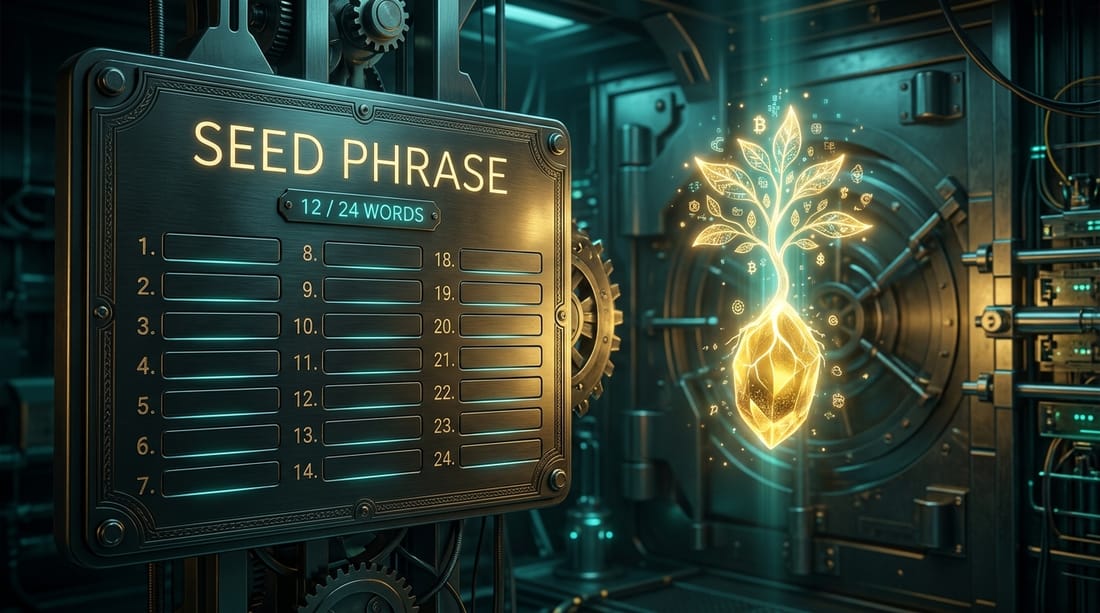
Twelve or twenty-four ordinary English words stand between your crypto and anyone who wants to take it. That's your seed phrase (also called a recovery phrase), and how you store it matters more than any other security decision you'll make in crypto.
What the seed phrase actually is
When you create a self-custody wallet, the app generates a master secret and encodes it as a sequence of words drawn from a fixed list of 2,048 (the BIP-39 standard). From those words, the wallet mathematically derives every address and private key you will ever use.
Two consequences follow:
- Anyone with the words has your money. They don't need your phone, your password, or your fingerprint. They can restore the wallet on their own device and drain it in minutes.
- If you lose the words and your device dies, the money is gone. No company can reset it for you — that's the entire point of self-custody. There is no "forgot password" in Bitcoin.
Where people go wrong
The most common seed phrase disasters, in rough order of frequency:
- Typing it into a phishing site. A fake "wallet validation" or "support" page asks you to enter your phrase. This is how the majority of wallets get drained — a classic move from the crypto scam playbook — not by hackers breaking encryption, but by owners handing over the words.
- Storing it digitally. A screenshot, a note in your phone, a file called
seed.txt, an email to yourself, a cloud backup. Malware and infostealers scan devices for exactly these. A seed phrase that has ever touched the internet should be considered compromised. - Keeping a single paper copy in one place. Paper burns, floods, fades, and gets thrown out during a move. One copy is one accident away from total loss.
A storage setup that actually works
You don't need a bunker. You need the words offline, durable, and recoverable:
- Write the phrase on paper or, better, stamp it into steel. Steel backup plates cost $20–50 and survive fire and water. For holdings worth protecting, it's the cheapest insurance available.
- Make two copies and keep them in two separate locations — for example, home and a relative's house or a bank deposit box. The threat model is fire and theft, not spies.
- Never photograph it, never type it anywhere except directly into a wallet app during recovery — and only on a device you trust, ideally a hardware wallet where the words never touch an internet-connected computer.
- Don't get clever. Splitting the phrase in halves stored separately, reordering words, or inventing your own cipher mostly creates ways for you to lose access. If you want stronger protection, use a passphrase (the "25th word") supported by the BIP-39 standard — and understand it fully before you commit funds.
A hardware wallet doesn't replace the seed phrase — it generates one too. The difference is that signing happens on the device, so the phrase never appears on an internet-connected screen.
Test your backup before it matters
A backup you've never tested is a hope, not a backup. Before moving serious money to a wallet, do a fire drill: wipe the wallet (or use a second device), restore it from your written words, and confirm the addresses match. Ten minutes now versus discovering a transcription error after your phone is at the bottom of a lake.
Quick checklist
- Words written on paper or steel — never stored digitally
- Two copies, two locations
- Nobody else has seen them; no website ever will
- Restore tested at least once
- Family knows the backups exist (and how to use them) if something happens to you
Master this one habit and you've eliminated the way most people actually lose crypto. Everything else in wallet security is details.
Frequently asked questions
Twelve or twenty-four ordinary English words that are the master key to your crypto. When you create a self-custody wallet it generates a master secret and encodes it as words from a fixed 2,048-word list (the BIP-39 standard); from those words the wallet derives every address and private key you'll ever use.
Two hard consequences. Anyone with the words has your money — they don't need your phone, password, or fingerprint, just the phrase, and can drain it in minutes. And if you lose the words and your device dies, the money is gone for good: there's no company to reset it and no "forgot password" in crypto.
Typing it into a phishing site. A fake "wallet validation" or "support" page asks for your phrase, and people hand it over — that's how the majority of wallets get drained, not by hackers breaking encryption. The second most common mistake is storing it digitally (a screenshot, a notes app, a photo) where malware can find it.
Write it on paper or stamp it into metal, store copies in more than one secure physical location, and never put it in any internet-connected form. Crucially, test your backup — restore the wallet from the words once — before you trust real money to it, so you find out it works before it matters.
Keep reading




Popular this week
- 01Rug Pulls Hall of Shame: Famous Crypto Exit ScamsAnalysis · 4 min
- 02The Hidden Costs of Leverage: Funding, Fees, and SpreadsExplainer · 5 min
- 03Grid Trading Bots Explained, and When They Blow UpGuide · 4 min
- 04Where AI and Crypto Actually Meet: Compute, Data, and DePINAnalysis · 9 min
- 05Modular vs Monolithic Blockchains: The Design FightExplainer · 6 min