Why "Not Financial Advice" Doesn't Protect Anyone
Three little words follow every crypto tip like a nervous shadow: "not financial advice." They make people feel safe on both sides. They mostly protect no one. Here's what they actually do.
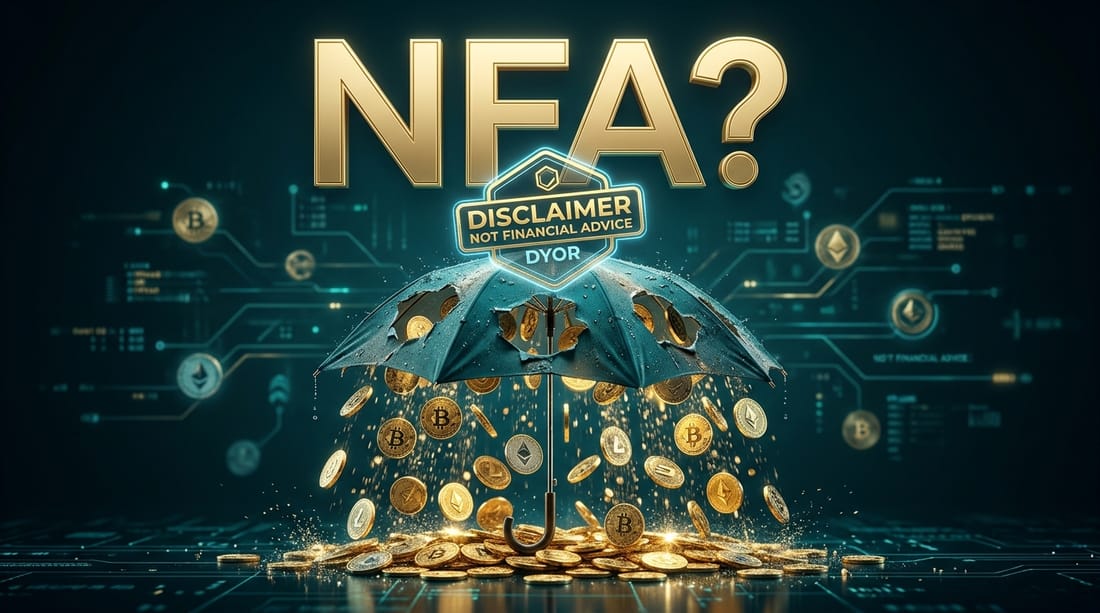
Scroll any crypto feed and you'll meet a phrase that trails behind tips like a nervous shadow: "not financial advice." Sometimes it's shortened to "NFA," as if the abbreviation makes the legal force stronger. It's recited so reflexively that people add it to things that were never advice in the first place. "Just had a great sandwich. NFA."
It's a fascinating little ritual, because it's designed to make everyone feel safe — and it mostly protects no one.
What people think it does
The fantasy is that those three words are a force field. The person giving the tip imagines it means "you can't blame me if this goes to zero." The person receiving it hears a grown-up, responsible caveat and feels reassured that they're dealing with someone careful.
Both are comforting. Both are mostly wrong.
What it actually does
A disclaimer is not a magic spell that deletes responsibility. If someone is paid to promote a token, or is quietly selling their own bag into the excitement they're generating, "not financial advice" does very little to change what that behavior is. You can't shill a coin to a hundred thousand followers, dump on them, and then hide behind a hashtag. Regulators, and increasingly the courts, are not impressed by abbreviations.
And on the receiving end, the phrase does something subtly harmful: it lowers your guard at the exact moment it should go up. The tip still lands in your brain. The disclaimer just makes you feel mature for acting on it.
The honest translation of most "NFA" tips is: "I want to influence your decision, and I want to disclaim any consequences of influencing your decision." Those two desires don't actually fit together.
Its more useful cousin
Its companion phrase, DYOR — "do your own research" — has the same double life. Good advice, frequently used as a getaway car. Someone posts a low-float coin with a rocket emoji, adds "DYOR," and vanishes before anyone asks the obvious question: research it how, exactly? We wrote a real answer to that in how to research an altcoin before you buy it, precisely because "DYOR" so rarely comes with instructions.
How to read tips like an adult
You don't need to become cynical about everyone — plenty of thoughtful people use these phrases sincerely. You just need to treat them as a prompt rather than a passport. When you see "not financial advice," ask the three questions it's hoping you'll skip:
- Who benefits if I act on this? If the speaker holds the token, they benefit from your buy. That's not evil, but it's not neutral either.
- What's the downside they're not mentioning? Tips are loud about the upside and quiet about the part where you can lose everything.
- What do they actually hold, and would they tell me if they sold? Conviction is easy to broadcast and easy to abandon off-camera.
The part no phrase can outsource
Here's the thing the disclaimer is trying to hand off, and can't: the decision is yours. The money is yours. The consequences are yours. No combination of capital letters transfers that to the person who gave you the idea.
So keep enjoying the feed. But the next time three little words try to make you feel safe, remember what genuinely protects you — small position sizes, your own homework, and a healthy suspicion of anyone with something to sell. That's not financial advice. It's just true.
Frequently asked questions
Rarely as much as people think. A disclaimer doesn't automatically erase responsibility, especially where someone is promoting a token they're paid to shill or are quietly selling into the hype.
It's part ritual, part liability reflex. It signals 'don't blame me' while still delivering the tip — letting the speaker influence you and disclaim influence at the same time.
No — plenty of thoughtful people use it sincerely. Use it as a prompt to ask the real questions: who benefits, what's the downside, and what do they hold?
Position sizing, your own research, and skepticism toward anyone with something to sell. Process protects you; phrases don't.
Keep reading




Popular this week
- 01Rug Pulls Hall of Shame: Famous Crypto Exit ScamsAnalysis · 4 min
- 02The Hidden Costs of Leverage: Funding, Fees, and SpreadsExplainer · 5 min
- 03Grid Trading Bots Explained, and When They Blow UpGuide · 4 min
- 04Where AI and Crypto Actually Meet: Compute, Data, and DePINAnalysis · 9 min
- 05Modular vs Monolithic Blockchains: The Design FightExplainer · 6 min