Gold vs Bitcoin: The Digital Gold Debate Grows Up
For a decade the 'Bitcoin is digital gold' slogan was mostly faith. Now there's enough history to actually test it. The honest comparison is less of a slam dunk for either side than the tribes claim — and far more interesting.
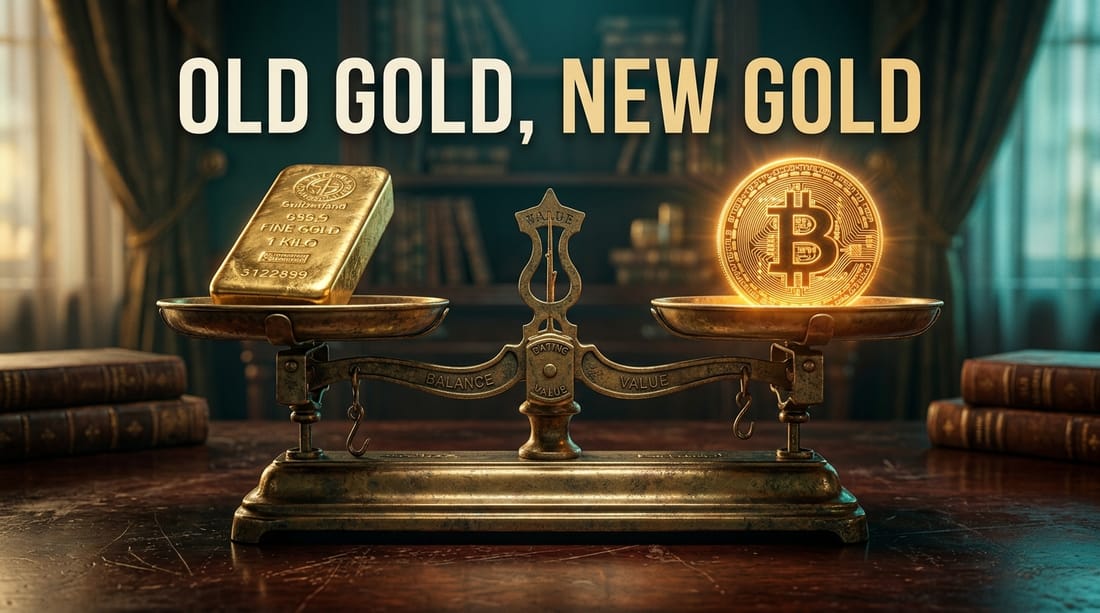
"Bitcoin is digital gold" started as a slogan you either believed or laughed at, with not much evidence either way. That era is over. There's now enough history, enough institutional adoption, and enough hard market behavior to actually examine the claim instead of just chanting or mocking it. And the grown-up verdict is more nuanced than either tribe wants: Bitcoin genuinely shares gold's monetary DNA and improves on parts of it, while still lacking the very things — stability and a track record — that make gold gold. Let's weigh it properly.
What they actually have in common
The comparison isn't arbitrary. Gold and Bitcoin share the core properties that make something a store of value, and this is the real foundation of the whole debate.
Gold is valuable for reasons that have nothing to do with cash flow or productivity — it just sits there, doing nothing. Its worth comes from being scarce, durable, hard to counterfeit, and globally trusted as a way to hold value outside the control of any government, for thousands of years. That last part matters enormously: gold is money that no central bank can print more of and no state can easily debase. In a world where every national currency can be expanded at will, gold has been humanity's escape hatch.
Bitcoin was explicitly designed with these same properties in mind, which is why the comparison is fair rather than forced. It's scarce by design — only 21 million will ever exist — durable, effectively impossible to counterfeit, and outside any government's control. It is, like gold, a bet on holding value in something no institution can dilute. The slogan isn't marketing nonsense; it points at a genuine kinship.
Where Bitcoin improves on gold
Take the comparison seriously and Bitcoin actually beats gold on several monetary properties — this is the strongest part of the bull case, and it's legitimate:
- Verifiable, fixed scarcity. Gold's total supply is unknown, and miners keep digging up more every year. Bitcoin's supply is fixed, transparent, and auditable by anyone. As a scarcity instrument, Bitcoin is in some ways more sound than gold.
- Portability. Moving a billion dollars of gold across the world is a logistical nightmare of vaults, guards, and ships. Moving a billion dollars of Bitcoin is a transaction. For transferring value, Bitcoin is dramatically superior.
- Storage and divisibility. Storing large amounts of gold is costly and physical; Bitcoin can be secured digitally and divided into tiny fractions effortlessly.
- Native to a digital world. As economies move online, a digital store of value has obvious advantages over a physical metal that has to be dug up, refined, shipped, and guarded.
These aren't trivial. On the pure mechanics of being sound, transferable money, Bitcoin has real edges over the metal it's compared to.
Where gold still wins decisively
But honesty cuts the other way too, and the gold case is just as real. Gold has things Bitcoin conspicuously lacks, and they happen to be exactly the things a store of value is supposed to provide.
- A multi-thousand-year track record. Gold has been trusted as a store of value across civilizations, empires, and collapses for millennia. Bitcoin has roughly a decade and a half. Trust as a store of value is built by surviving time, and gold has survived almost all of recorded history. That is not a gap intelligence or technology can shortcut — it can only be earned slowly.
- Stability. Gold is relatively stable. Bitcoin is wildly volatile, regularly falling 50% or more. This is the most damning point against the "digital gold" claim: a store of value is supposed to preserve wealth, and an asset that can halve in months is doing the opposite of what gold is prized for. Bulls argue volatility will fade with maturity; until it does, gold holds a decisive advantage on the single most important job.
- Independence from technology. Gold needs no network, no electricity, no internet. It's a physical object that exists regardless of any infrastructure. Bitcoin depends on a functioning network and the technical competence of its holders to self-custody safely.
- Deep institutional and cultural trust. Central banks hold gold. It's woven into finance and culture in a way that took thousands of years and that Bitcoin is only beginning to approach.
The cleanest way to see it: Bitcoin is arguably better money on paper — more verifiably scarce, more portable, more divisible — but gold is a better-proven store of value, because it has done the one thing Bitcoin can't yet claim: held value, with relative stability, across thousands of years. The debate is really about whether superior monetary properties eventually outweigh a missing track record and stubborn volatility. Time is the only judge that can settle it.
What the growing-up looks like
The reason the debate has matured is that Bitcoin has started doing things that test the thesis in public. The arrival of spot Bitcoin ETFs and institutional adoption means serious capital is now treating Bitcoin as a holdable reserve-style asset — exactly the behavior the digital gold thesis predicts. At the same time, Bitcoin's continued correlation with risk assets and its persistent volatility keep undercutting the claim. The evidence is genuinely mixed, which is why the grown-up answer is "partially, and not yet fully," not a triumphant yes or a dismissive no.
So which should you hold?
This is where the tribalism does the most damage, because it frames as either-or what is really a question of risk profile and goals. Gold offers stability, a track record, and independence — it's the conservative store of value. Bitcoin offers superior monetary mechanics and far higher potential, at the cost of volatility and a short history — it's the higher-risk, higher-upside candidate. These are different tools, and many serious investors treat them as complementary rather than rivals: gold for proven stability, a Bitcoin allocation for asymmetric upside on the thesis that it's growing into a digital version of the same role. The right mix depends on your risk tolerance and what you want the asset to do, not on which team you've joined.
The takeaway
The digital gold debate has grown up, and so should the way we discuss it. Bitcoin genuinely shares gold's monetary essence — scarcity, durability, independence from governments — and beats gold on verifiable supply, portability, and divisibility. Gold genuinely beats Bitcoin on the things that matter most for a store of value — a thousands-of-years track record, stability, and independence from any technology. Both of those statements are true, and pretending either isn't is how the tribes mislead you.
Bitcoin is best understood not as gold's replacement nor its imitator, but as a young, volatile, technologically superior candidate for a role gold has held since the beginning of civilization — a candidate that has earned a serious hearing and not yet earned the title. Whether it grows into the role is the open question, and the only honest judge is time. In the meantime, treat them as the different instruments they are, size your exposure to the very real risks of each, and leave the tribal certainty to the people who haven't noticed the debate matured.
Frequently asked questions
It shares key properties with gold — scarcity, durability, and use as a store of value outside any government's control — and improves on some, like portability and verifiable supply. But it's far more volatile and far younger, so it's an evolving candidate for the role rather than a proven equal.
A multi-thousand-year track record, deep institutional and cultural trust, lower volatility, and physical existence independent of any technology or network. That history and stability are exactly what a store of value is supposed to provide, and Bitcoin hasn't matched them yet.
Verifiable, fixed scarcity, far greater portability and ease of transfer, easy storage of large amounts, resistance to counterfeiting, and a digital nature suited to a digital world. These are real improvements on gold's monetary properties for some uses.
They're different risk profiles, not strictly either-or. Gold offers stability and a long track record; Bitcoin offers higher potential and higher risk. Many treat them as complementary. The right mix depends on your goals and risk tolerance, not on tribal loyalty.
Keep reading




Popular this week
- 01Rug Pulls Hall of Shame: Famous Crypto Exit ScamsAnalysis · 4 min
- 02Grid Trading Bots Explained, and When They Blow UpGuide · 4 min
- 03Where AI and Crypto Actually Meet: Compute, Data, and DePINAnalysis · 9 min
- 04Modular vs Monolithic Blockchains: The Design FightExplainer · 6 min
- 05How to Spot Wash Trading and Fake VolumeGuide · 5 min