Is Bitcoin Still Just a Tech Stock? The Decoupling Debate
For years Bitcoin has risen and fallen in near-lockstep with risky tech stocks — awkward for an asset that's supposed to be independent digital gold. Whether it ever truly decouples is one of the most consequential open questions in crypto.
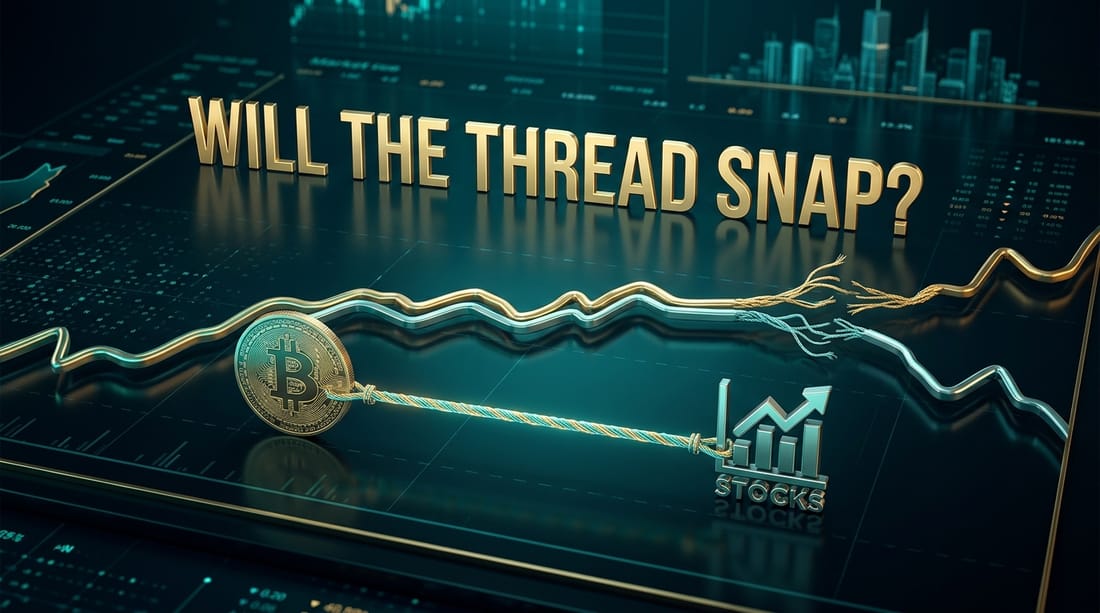
Here's an awkward fact for Bitcoin's biggest believers: for much of its recent history, the asset sold as independent "digital gold" has moved in near-lockstep with the riskiest corner of the stock market. When tech stocks rallied, Bitcoin rallied. When they sold off, Bitcoin sold off, often harder. For something meant to be a hedge against the financial system, behaving like a leveraged bet on it is a problem. Whether Bitcoin ever breaks that pattern — the decoupling debate — is one of the most consequential unresolved questions in all of crypto, and it cuts to the heart of what Bitcoin even is.
The uncomfortable observation
Start with what's actually been happening, because the debate only makes sense against the data. Over recent years, Bitcoin has frequently traded as a risk-on asset: it rises when investors feel bold and optimistic, and falls when they're frightened and reaching for safety. That's precisely how risky growth and tech stocks behave. In practice, Bitcoin has often looked like a high-octane version of the Nasdaq — same direction, bigger swings.
Why? Because a large share of the market treats it that way. To many investors, especially institutions, Bitcoin sits in the mental bucket of "speculative bets that do well when there's appetite for risk." When the mood is greedy and money is loose, capital flows into risky assets, Bitcoin included. When fear hits and people de-risk, they sell the speculative stuff first — and Bitcoin gets sold right alongside the risky stocks. The behavior isn't mysterious; it follows directly from how a big part of the market categorizes it. This is the stock-and-crypto correlation made concrete.
Why this is a problem for the thesis
Now see why this matters so much, because it's not a trivial quibble. Bitcoin's central bull case is that it's an independent store of value — digital gold, a hedge against currency debasement and financial instability, something that holds or grows value when other things fall apart. That's the whole pitch for why it belongs in a portfolio.
But a true hedge is supposed to behave differently from the risk assets it's meant to protect against. Gold often rises when fear hits and stocks fall — that's what makes it valuable as a hedge. If Bitcoin instead falls alongside risky stocks exactly when fear strikes, it's failing at the one job the thesis assigns it. You don't want your insurance to crash at the same moment as the thing it's supposed to insure. So the persistent correlation with tech stocks directly undercuts the "independent digital gold" story. This is why the debate is so loaded: it's not really about correlation statistics, it's about whether Bitcoin is what its believers say it is.
The case that it will decouple
The bulls have a genuine argument, and it deserves a fair hearing. They say the correlation is a feature of Bitcoin's immaturity, not its destiny:
- It's still early. Bitcoin is young and still being figured out by the market. Early on, it's natural for it to be lumped in with other speculative bets. As it matures and its store-of-value role is better understood, the argument goes, it will increasingly trade on its own logic.
- Adoption changes the holder base. As more people and institutions hold Bitcoin as a long-term reserve asset rather than a speculative trade — driven by ETFs and institutional adoption — the base of holders shifts from fast-money speculators toward long-term believers, which could loosen the link to risk sentiment.
- The macro hedge moments. Bulls point to episodes where Bitcoin has acted as a hedge — rising amid specific currency or banking fears — as glimpses of the independent behavior they expect to become the norm.
It's a coherent story: decoupling as the natural result of maturation. Not proven, but not empty.
The case that it won't
The skeptics have an equally real argument, and intellectual honesty requires giving it the same weight:
- It's been "early" for a long time. The "it'll decouple as it matures" claim has been made for years while the correlation persisted. At some point, a pattern that keeps holding despite predictions of its end deserves to be taken as the base case, not the exception.
- Speculation may be its nature, not a phase. Perhaps Bitcoin trades like a risk asset because, for now, it largely is one — a high-volatility, speculative holding that people buy for upside and dump when scared. If that's its enduring character rather than a temporary phase, the decoupling never fully arrives.
- Institutional adoption can deepen the link, not break it. Here's the twist: as Bitcoin gets absorbed into mainstream portfolios via ETFs, it becomes part of the same risk-management machinery as stocks — sold in the same de-risking waves, allocated by the same models. Institutionalization might tie Bitcoin more tightly to traditional risk assets, not less.
The decoupling debate is really a debate about Bitcoin's identity. Is it a maturing store of value temporarily miscategorized as a risk asset, or is it a speculative risk asset that's been wearing a digital-gold costume? The honest answer is that the market hasn't decided yet, and you can't either. Watch the behavior over multiple cycles of fear and greed, not over a single dramatic week. Identity reveals itself slowly, in how an asset acts when everyone is scared.
How to actually track it
If you want to follow this honestly rather than cheering for an outcome, watch the right thing: how Bitcoin behaves relative to risky stocks across full cycles of fear and greed, especially during genuine market panics. Does it keep falling in lockstep when investors flee to safety, or does it start holding up — or even rising — like a real hedge? One or two episodes prove little; a consistent shift over several cycles would be meaningful evidence of decoupling. Also watch the metals: when fear hits, is Bitcoin moving with gold (hedge behavior) or with the Nasdaq (risk behavior)? That comparison is one of the cleanest tells available.
The takeaway
Is Bitcoin still just a tech stock? Right now, much of the time, the market treats it like one — and that's a genuine challenge to the thesis that it's independent digital gold, because a hedge that crashes alongside the risk assets it's meant to protect against isn't doing its job. The bulls argue this is the awkwardness of an immature asset that will decouple as it grows into its store-of-value role. The skeptics argue it trades like a risk asset because it substantially is one, and that institutional adoption may bind it even tighter to the system.
Both cases are real, and the evidence is genuinely mixed, which is exactly why this remains one of the most important open questions in crypto rather than a settled fact. Don't take either side on faith. Watch how Bitcoin behaves when the world is actually afraid, across cycle after cycle, and let that slow evidence — not the slogans of either camp — tell you what Bitcoin is becoming. Until the thread clearly snaps, the honest answer is the uncomfortable one: it still mostly trades like a tech stock, and whether that ever changes is the question the whole digital-gold thesis is waiting on.
Frequently asked questions
Because for much of its recent history it has risen when investors feel confident and fallen when they're fearful, the same pattern as risky growth stocks. Both are treated as speculative bets that do well in good times and get sold off in bad ones.
It's the question of whether Bitcoin will break its correlation with risk assets like tech stocks and start trading as an independent store of value, or 'digital gold,' rather than as just another speculative risk-on asset.
Bitcoin's core bull thesis is that it's an independent store of value and hedge. If it keeps moving in lockstep with risky stocks, that thesis is undermined, since a true hedge should behave differently from the risk assets it's meant to protect against.
It's genuinely uncertain and debated. Some argue maturing adoption and its store-of-value role will eventually decouple it; others argue it remains a speculative risk asset. The evidence is mixed and the question is far from settled.
Keep reading




Popular this week
- 01Rug Pulls Hall of Shame: Famous Crypto Exit ScamsAnalysis · 4 min
- 02Grid Trading Bots Explained, and When They Blow UpGuide · 4 min
- 03Where AI and Crypto Actually Meet: Compute, Data, and DePINAnalysis · 9 min
- 04Modular vs Monolithic Blockchains: The Design FightExplainer · 6 min
- 05How to Spot Wash Trading and Fake VolumeGuide · 5 min