How Bitcoin Began: The People and Ideas Behind the First Cryptocurrency
A nine-page PDF, an anonymous author, and a stubborn idea that money could exist without a bank. Here is where Bitcoin actually came from, who kept it alive, and what I think it got right and wrong.
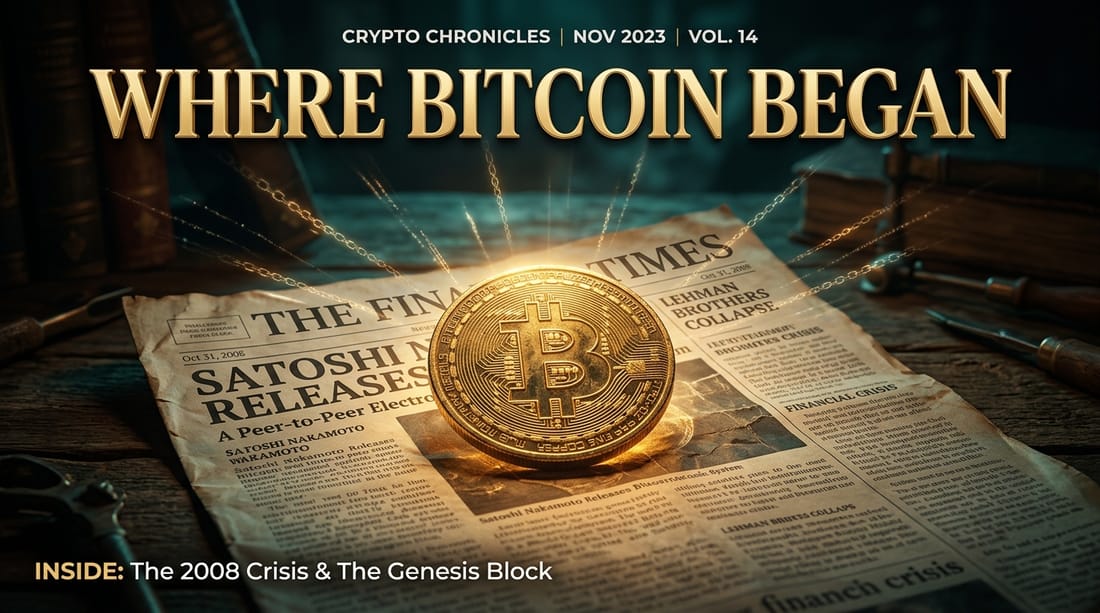
Most technologies arrive with a press release and a founder eager to take a bow. Bitcoin arrived as a nine-page PDF, posted to an obscure cryptography mailing list by someone nobody had ever met, on the last day of October 2008, while the global banking system was visibly on fire.
That timing was not an accident.
A whitepaper sent into the dark
On October 31, 2008, a message appeared on a mailing list popular with cryptographers and privacy obsessives. The sender called themselves Satoshi Nakamoto. The subject was modest: "Bitcoin P2P e-cash paper." The document attached to it proposed something that decades of brilliant people had tried and failed to build — digital money that did not need a bank, a government, or any trusted middleman to work.
The problem they were solving has a boring name and a deep difficulty: the double-spend problem. Digital files are trivial to copy. If money is just a file, what stops me from spending the same coin twice, or a thousand times? Every previous attempt had solved this by appointing a central referee to keep the ledger honest. Satoshi's insight was to remove the referee entirely and replace it with a public ledger that thousands of strangers maintain together, secured by raw computing work. If you want the plain-English version of that machinery, we wrote a whole piece on what a blockchain really is.
On January 3, 2009, Satoshi mined the very first block — the genesis block — and tucked a small message inside it: "The Times 03/Jan/2009 Chancellor on brink of second bailout for banks." It was a headline from that day's London newspaper. It was also a thesis statement. Bitcoin was born as a reaction to a financial system that had just gambled itself into needing rescue.
The man (or people) who disappeared
Here is the part that still unsettles people: we do not know who Satoshi Nakamoto is.
For about two years, Satoshi wrote code, answered questions on forums, and traded emails with early collaborators. The first known Bitcoin transaction was a test, ten coins sent to a developer named Hal Finney in January 2009. Finney, a respected cryptographer who was already living with ALS, was one of the first people to take the idea seriously. He died in 2014, and to his last days denied being Satoshi.
Then, around late 2010, Satoshi quietly handed the project to other developers, wrote a few final messages, and disappeared. The wallets believed to belong to them — holding roughly a million bitcoin — have never moved. Think about that restraint for a second. The creator of a now trillion-dollar asset has, by all evidence, never spent a cent of an enormous fortune. Whether that is principle, death, or caution, it is the single most credibility-building act in the entire history of crypto.
Plenty of people have been accused or have claimed the title. None has ever produced the one piece of proof that would settle it: a cryptographic signature from Satoshi's known keys. Until someone does, the honest answer remains we don't know, and I'd argue the mystery has been good for Bitcoin. A leaderless network is harder to pressure, sue, or co-opt.
So who actually builds Bitcoin now?
A question I get constantly: if there's no company, who pays the engineers?
The answer is genuinely strange by corporate standards. Bitcoin's software, Bitcoin Core, is open-source and maintained by a rotating cast of independent contributors scattered around the world. Nobody owns it. Changes are debated publicly and adopted only when the broader network of users and miners voluntarily runs the new code. There is no CEO who can push an update.
The developers do need to eat, though. Their work is funded mostly through grants from non-profits and aligned companies — organizations like Brink, Chaincode Labs, Spiral (the Bitcoin unit of Jack Dorsey's company Block), MIT's Digital Currency Initiative, and the Human Rights Foundation's Bitcoin Development Fund. Crucially, these sponsors fund the people but do not control the protocol. A grant buys you a developer's time, not a vote. It's a messy, slow, occasionally frustrating model, and it is also exactly why no single corporation has been able to capture Bitcoin.
This is the cleanest line between Bitcoin and almost every other coin. Most projects have a company, a foundation, and a treasury steering them. Bitcoin has a constitution made of code that no one is in charge of changing. That makes it slow to improve — and very hard to kill.
From a pizza to a national reserve
The early years were a comedy of accidental history. In May 2010, a programmer paid 10,000 BTC for two pizzas — a transaction that would later be worth hundreds of millions of dollars and is now memorialized every year as Bitcoin Pizza Day. We told that whole bittersweet saga, and a few others, in the fortunes locked forever.
From there the evolution came in waves:
- 2011-2013: Bitcoin found its first real-world use — and its first scandal — on the darknet market Silk Road, then survived the spectacular 2014 collapse of the Mt. Gox exchange, which lost hundreds of thousands of customer coins.
- 2017: A bitter, multi-year fight over how to scale the network ended with upgrades like SegWit and a permanent community split that birthed Bitcoin Cash. The lesson stuck: changing Bitcoin is supposed to be hard.
- 2021: El Salvador became the first country to make Bitcoin legal tender, and corporations began holding it on their balance sheets.
- 2024: U.S. regulators approved spot Bitcoin ETFs, opening the door for pension funds and ordinary brokerage accounts to hold it. That same wave of institutional money is a double-edged sword, which we dug into in why Bitcoin and the stock market started moving together.
Running underneath all of it is the halving — a built-in event roughly every four years that cuts the rate of new supply in half. It is the metronome of Bitcoin's entire economic story, and it's worth understanding on its own; we covered it in what is the Bitcoin halving.
What I think Bitcoin got right — and wrong
After sitting with this history, here's my honest read.
What it got right is hard to overstate. Bitcoin solved a problem computer scientists had considered nearly impossible, and it did so with an elegance that still holds up. It created genuine digital scarcity for the first time. And by being deliberately boring — no central party, slow to change, predictable supply — it earned a kind of trust that flashier projects keep failing to replicate. When people call it "digital gold," they're pointing at this: it does one thing, and it has done that one thing without interruption for over fifteen years.
What it got wrong, or at least left unfinished, is just as real. Bitcoin is slow and expensive to use as everyday cash; that ship has largely sailed, and most of its actual payment activity now happens on layers built on top of it. Its energy use is enormous and a legitimate point of debate, even if the picture is more nuanced than the headlines suggest. And the same rigidity that protects it also means it improves at a glacial pace while competitors sprint.
If, after all this history, you decide you want to own a little of the asset that started it all, a regulated exchange is the simplest on-ramp:
My conclusion is that Bitcoin stopped trying to be cash a long time ago and became something else: a neutral, scarce, apolitical store of value — a bet that in a world of money printed at will, something uncapped-by-decree has a permanent place. You don't have to believe that bet pays off. But you should understand that this is the bet, because everything else in this industry, including the nine coins in the price rail next to this article, is in some sense a response to the door Satoshi opened on that last day of October 2008.
Frequently asked questions
A person or group using the name Satoshi Nakamoto published the Bitcoin whitepaper in October 2008 and mined the first block in January 2009. Their real identity has never been confirmed, and they vanished from public communication around 2010-2011.
There is no central company. Protocol development is done by independent contributors, many funded through grants from non-profits and firms such as Brink, Chaincode Labs, Spiral (part of Block), MIT's Digital Currency Initiative, and the Human Rights Foundation.
The supply is capped at 21 million. New coins are released through mining rewards that halve roughly every four years, a schedule that will issue the last fraction of a bitcoin around the year 2140.
No. It is pseudonymous. Every transaction is public on the blockchain forever; what is hidden is the real-world identity behind an address, and that link can often be uncovered with analysis.
Keep reading




Popular this week
- 01Rug Pulls Hall of Shame: Famous Crypto Exit ScamsAnalysis · 4 min
- 02Grid Trading Bots Explained, and When They Blow UpGuide · 4 min
- 03Where AI and Crypto Actually Meet: Compute, Data, and DePINAnalysis · 9 min
- 04How to Spot Wash Trading and Fake VolumeGuide · 5 min
- 05Base and Coinbase's Quiet Bet on Bringing Millions On-ChainAnalysis · 5 min