The Fortunes Locked Forever: Stories of Lost Bitcoin
Millions of bitcoins are gone — not stolen, just lost behind forgotten passwords and thrown-away drives. These stories are sad, strangely beautiful, and the best argument for taking key storage seriously.
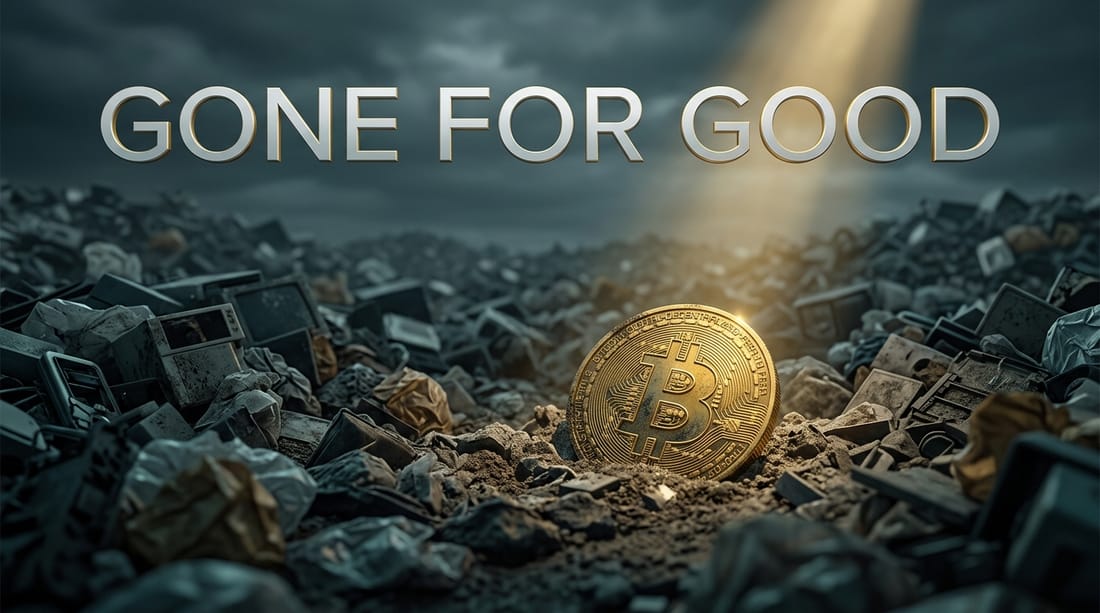
Somewhere under a landfill in Wales, by his own account, a man named James Howells believes a hard drive is buried with the keys to thousands of bitcoins on it. He threw it out years ago, back when the coins were worth almost nothing. He has spent years trying to get permission to dig. The drive — and the fortune it may hold — is still down there, somewhere in the layers.
It's one of the most expensive bits of spring cleaning in history, and it's not even the saddest story in this genre.
A fortune behind a forgotten password
The programmer Stefan Thomas became a well-known cautionary tale for a quieter reason. He held a large amount of Bitcoin on an encrypted drive of a type that permanently locks itself after a set number of wrong password guesses. He couldn't remember the password. As the failed attempts ticked up, he had to stop trying — because every guess brought him closer to locking the fortune away for good.
Imagine a vault you can see into, stacked with money that is unmistakably yours, and a lock that will swallow the key if you knock too many times. That's not a metaphor. That's just how the technology works when the human part fails.
"Lost" doesn't mean "stolen"
This is the part newcomers find hard to believe: a meaningful chunk of all Bitcoin that will ever exist is most likely gone — not hacked, not seized, simply unreachable. Forgotten passwords. Discarded drives. Seed phrases written on paper that got soaked, burned, or tidied into the recycling. People who passed away without telling anyone how to find their keys.
The coins are still right there on the public ledger. Anyone can look at the addresses and see the balances sitting untouched for a decade. They just can't move, because the one thing that can move them — the private key — is gone.
There is no password reset in self-custody. That's the entire point, and the entire risk, in one sentence. The freedom of having no gatekeeper is also the loneliness of having no safety net.
The strange beauty of it
There's something almost poetic about a fortune that exists and doesn't at the same time — visible to all, owned by no one reachable, frozen mid-air. Lost Bitcoin even quietly benefits everyone who still holds the accessible kind: every coin that disappears makes the rest a little scarcer than the official supply numbers suggest. The careless are, in a sense, gifting the careful.
But mostly these stories are just sad. Each one is a person who was early, who was right about the technology, and who lost it all to the most ordinary human failures — forgetting, discarding, not writing it down.
The lesson is boring, and that's why it matters
The takeaway from these dramatic tales is almost insultingly mundane: back up your keys properly. Write your seed phrase on paper. Keep more than one copy, in more than one safe place. Test that you can actually recover a wallet before you trust it with anything serious. Decide, while you're alive and lucid, how someone you trust could find your keys if you couldn't.
None of that is exciting. None of it will get you likes. But every legendary lost-fortune story is, underneath the drama, the same small failure repeated — a person who did everything right except the dull part at the end. Don't be the next beautiful, tragic anecdote. Be the boring one who wrote it down.
Frequently asked questions
Estimates vary widely, but analysts often suggest several million BTC — a meaningful share of all that will ever exist — are likely lost in inaccessible wallets, forgotten keys, and discarded drives.
Generally no. Without the private key or seed phrase, the coins remain visible on the blockchain but permanently unspendable. There is no central authority to reset access.
Indirectly. Lost coins effectively reduce the circulating supply, making the remaining accessible Bitcoin scarcer than the headline supply number suggests.
Back up your seed phrase on paper in more than one secure location, test recovery before funding heavily, and never store the only copy of a key in a single fragile place.
Keep reading




Popular this week
- 01Rug Pulls Hall of Shame: Famous Crypto Exit ScamsAnalysis · 4 min
- 02Where AI and Crypto Actually Meet: Compute, Data, and DePINAnalysis · 9 min
- 03How Hedge Funds Actually Trade CryptoExplainer · 6 min
- 04Modular vs Monolithic Blockchains: The Design FightExplainer · 6 min
- 05CEX vs. DEX: How Crypto Exchanges Actually WorkExplainer · 3 min