Meme Coins: The Absurd Economics of Dogs and Frogs
A coin based on a dog meme is worth billions. A frog token mints millionaires overnight. It sounds like a joke — and it mostly is. Here's how meme coins actually work, and how people lose everything chasing them.
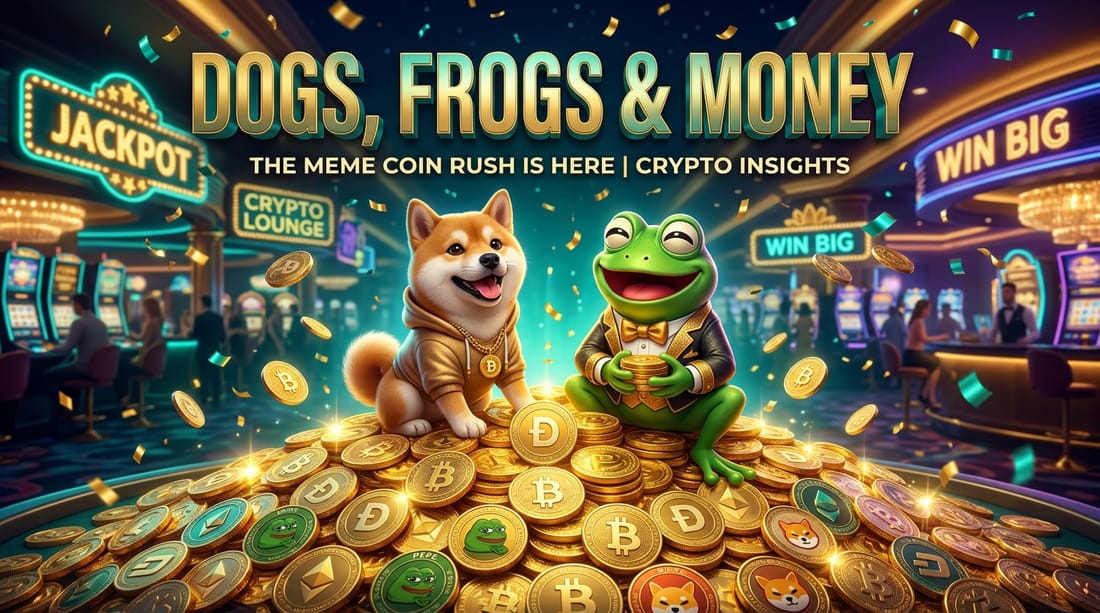
Somewhere right now, a token named after a dog is worth more than a century-old industrial company. A coin whose entire brand is a cartoon frog has minted real millionaires. Somebody made generational wealth from a crypto called, with total sincerity, "fartcoin."
If that makes you feel like the world has lost its mind, good. You're paying attention. Meme coins are simultaneously the funniest and most dangerous corner of crypto, and understanding them teaches you more about markets, psychology, and human nature than most "serious" assets ever could.
What a meme coin actually is
A meme coin is a cryptocurrency with no pretense of utility. It doesn't claim to revolutionize finance, scale the blockchain, or secure anything with proof-of-stake. Its product is a joke, a mascot, a vibe. Dogecoin started in 2013 as a literal parody of crypto hype, built around the "Doge" Shiba Inu meme. Shiba Inu, Pepe, and a thousand others followed, each riding some flavor of internet absurdity.
And here's the uncomfortable truth that makes people angry: that's not necessarily a flaw. As we explored in the story of the $400 million pizza, money is a shared belief. A meme coin is just that belief in its purest, most honest form — value built on nothing but collective attention, with no fundamentals to hide behind.
How they pump
The lifecycle of a successful meme coin is remarkably consistent:
- A token launches, usually with a low price and a huge supply, so a single coin costs a fraction of a cent. (Psychologically, "I own 10 million coins" feels better than "I own 0.001 of something expensive," even though it's identical math — a quirk we unpack in the numbers that actually matter.)
- A community forms on social media, fueled by memes, in-jokes, and the intoxicating possibility of getting rich.
- Influencers and momentum traders pile in, the price rockets, and screenshots of life-changing gains flood the timeline.
- The story goes mainstream, latecomers buy the top, and the early buyers quietly sell into their enthusiasm.
- Attention moves on, the price collapses, and the cycle restarts with a new animal.
The entire thing runs on a single fuel: attention. A meme coin is worth exactly as much as the number of people currently excited about it. When the excitement peaks, so does the price — usually right before it falls.
In a meme coin, you are not investing in a business. You are betting on how many people will be excited after you. That's not analysis; it's musical chairs with real money.
How people lose everything
The danger isn't just volatility — it's that meme coins are the favorite vehicle for outright fraud. Because anyone can launch a token in minutes, the space is riddled with rug pulls and honeypots, where developers either vanish with the liquidity or design the contract so you can buy but never sell.
The common traps:
- Concentrated supply. A handful of wallets (often the creators) hold most of the tokens and dump on you.
- Unlocked liquidity. The team can pull the trading pool and walk away, leaving your coins worthless and unsellable.
- The "can't sell" trick. The contract allows buys but blocks sells for everyone but insiders.
If you ever do venture in, the bare minimum is to verify the basics yourself — locked liquidity, distributed holders, a working sell function. Our guide on reading a token's contract on a block explorer walks through exactly how. And do it on a reputable exchange where you can; if you must use a decentralized platform, platforms like at least let you keep your speculative bag separate from your serious holdings.
So should you touch them?
Here's the honest framing. Meme coins are not investments — they're entertainment that occasionally pays out, like a casino. Some people genuinely enjoy the game, treat it as gambling, only risk money they're fully prepared to lose, and have fun. That's a legitimate choice, as long as you're clear-eyed about what it is.
The people who get hurt are the ones who mistake the casino for a strategy — who put rent money into a frog because a stranger online promised "this one's going to 100x." They're applying hope where they should be applying the boring, proven discipline of dollar-cost averaging into real assets.
The absurd economics of dogs and frogs are a perfect mirror of crypto itself: equal parts genuine innovation and pure human folly, often in the same candle. Laugh at it, learn from it, and if you play — play with money you can afford to set on fire.
Frequently asked questions
A meme coin is a cryptocurrency built around a joke, a mascot, or an internet trend rather than a technical use case. Its value comes almost entirely from attention, community, and speculation — not from solving a problem.
Because enough people buy them. Price is set by supply and demand, and a viral meme with a passionate community can generate real demand. That value is real while the attention lasts, and can evaporate just as fast when it fades.
People do, and people lose far more. Meme coins are closer to lottery tickets than investments. For every life-changing win you hear about, thousands quietly went to zero. Never risk money you can't afford to lose entirely.
Check whether liquidity is locked, whether a few wallets hold most of the supply, and whether you can actually sell. Many meme coins are honeypots or rug pulls designed to trap buyers. Treat every new token as guilty until proven innocent.
Keep reading




Popular this week
- 01Rug Pulls Hall of Shame: Famous Crypto Exit ScamsAnalysis · 4 min
- 02Grid Trading Bots Explained, and When They Blow UpGuide · 4 min
- 03Where AI and Crypto Actually Meet: Compute, Data, and DePINAnalysis · 9 min
- 04Modular vs Monolithic Blockchains: The Design FightExplainer · 6 min
- 05Base and Coinbase's Quiet Bet on Bringing Millions On-ChainAnalysis · 5 min