Proof of Work vs. Proof of Stake: What Changed and Why People Still Argue
Two ways to secure a blockchain, two very different bets about trust, energy and power. Here's what proof of work and proof of stake actually do — and why the debate refuses to die.
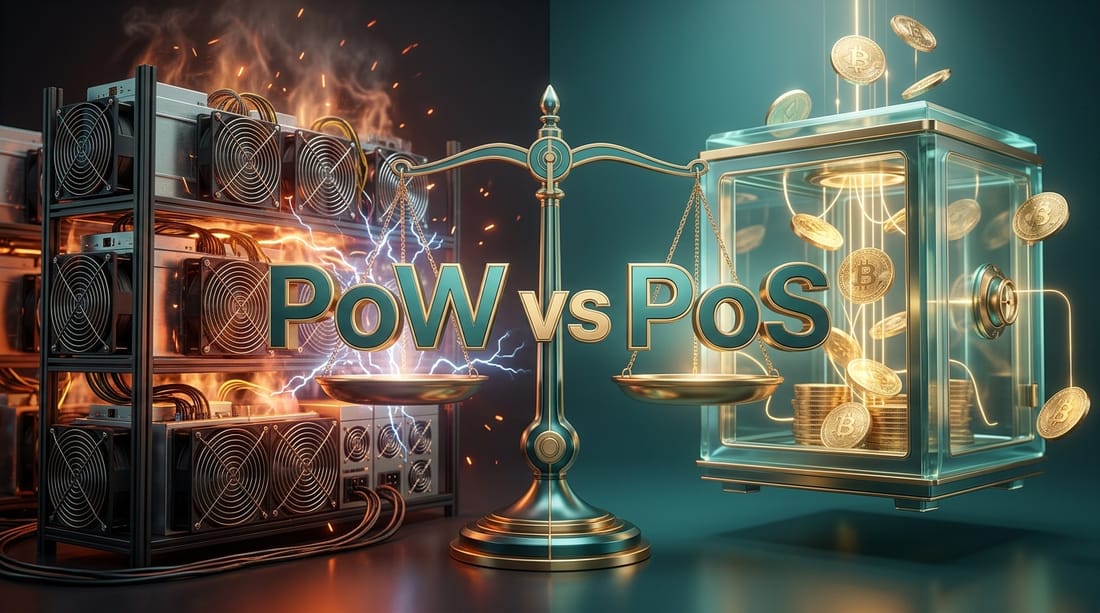
Every blockchain has to answer one deceptively hard question: with no central boss, who gets to write the next page of the ledger, and why should everyone trust them? The two famous answers — proof of work and proof of stake — are really two different bets about how you buy trust. Understanding them explains the single biggest philosophical split in crypto, and why otherwise calm people get heated about it.
Proof of work: trust bought with electricity
In proof of work, computers around the world compete to solve a pointless-but-hard math puzzle. The first to crack it earns the right to add the next block and collect the reward. Solving the puzzle takes enormous computation, which takes enormous electricity.
That waste is the point. To attack the network — to rewrite history — you'd need to out-compute the entire honest majority, which means buying a staggering amount of hardware and power. The defense is physics and a power bill. Bitcoin runs on this, and it's the bedrock under what the Bitcoin halving is and why it matters.
Proof of stake: trust bought with money at risk
Proof of stake swaps the electricity bill for a security deposit. Instead of racing to burn energy, validators lock up a large amount of the network's own coin as collateral. The system picks who proposes the next block based partly on that stake.
The enforcement is elegant: if a validator tries to cheat, the network can destroy part of their stake (called "slashing"). So honesty isn't enforced by wasted energy — it's enforced by the threat of setting your own money on fire. Ethereum switched to this model in 2022's "Merge," cutting its energy use by roughly 99%.
Both systems solve the same problem the same basic way: make attacking the network cost more than it could ever pay off. They just choose different currencies for that cost \u2014 one spends energy, the other risks capital.
So why do people still argue?
Because the trade-offs are genuine, and your priorities decide the winner.
- Energy. Proof of stake's case is overwhelming here — a fraction of the consumption. Proof of work supporters counter that its energy use can incentivize stranded and renewable power, and that the physicality is a feature, not a bug.
- Security philosophy. Proof of work's defenders argue that its real-world, physical cost makes it the most battle-tested and hardest to fake. Proof of stake's defenders argue that putting capital directly at risk is a cleaner, more direct deterrent.
- Centralization worries. Each side accuses the other of concentrating power. Proof of work can centralize around cheap electricity and big mining operations; proof of stake can centralize around whoever holds the most coins. Different roads, similar fear.
- Issuance. Proof of stake networks can run "leaner," issuing fewer new coins to pay for security, which changes the supply story over time.
The honest takeaway
There's no objectively correct answer, which is exactly why the debate is immortal. If your top concern is energy and efficiency, proof of stake makes a powerful case. If your top concern is a security model that's been stress-tested by over a decade of adversaries throwing everything at it, proof of work's track record is hard to dismiss.
What's worth resisting is the tribal version of this argument, where one model is "obviously" a scam and the other is "obviously" doomed. They're two reasonable engineering answers to a genuinely hard problem. The more useful question isn't which is morally superior — it's which set of trade-offs you actually want backing the coins you hold.
Frequently asked questions
A system where computers compete to solve a hard math puzzle to add the next block, spending real electricity. The cost of that energy is what makes attacking the chain expensive. Bitcoin uses it.
A system where validators lock up (stake) the network's coin for the right to add blocks. Misbehave and your stake can be destroyed, so honesty is enforced by money at risk rather than energy spent. Ethereum uses it.
It's a trade-off, not a clear win. Proof of stake uses far less energy; proof of work's supporters argue its physical cost makes it more battle-tested and harder to capture. Reasonable people disagree.
Mainly to cut its energy use dramatically and change its security and issuance model. The 2022 'Merge' moved Ethereum from proof of work to proof of stake without disrupting balances.
Keep reading




Popular this week
- 01Rug Pulls Hall of Shame: Famous Crypto Exit ScamsAnalysis · 4 min
- 02The Hidden Costs of Leverage: Funding, Fees, and SpreadsExplainer · 5 min
- 03Grid Trading Bots Explained, and When They Blow UpGuide · 4 min
- 04Where AI and Crypto Actually Meet: Compute, Data, and DePINAnalysis · 9 min
- 05How to Spot Wash Trading and Fake VolumeGuide · 5 min