The Day a Stablecoin Died: The Terra-Luna Collapse
A 'stable' coin that promised 20% yields wiped out $40 billion in days and dragged half of crypto down with it. The Terra-Luna collapse is the most important cautionary tale in crypto history.
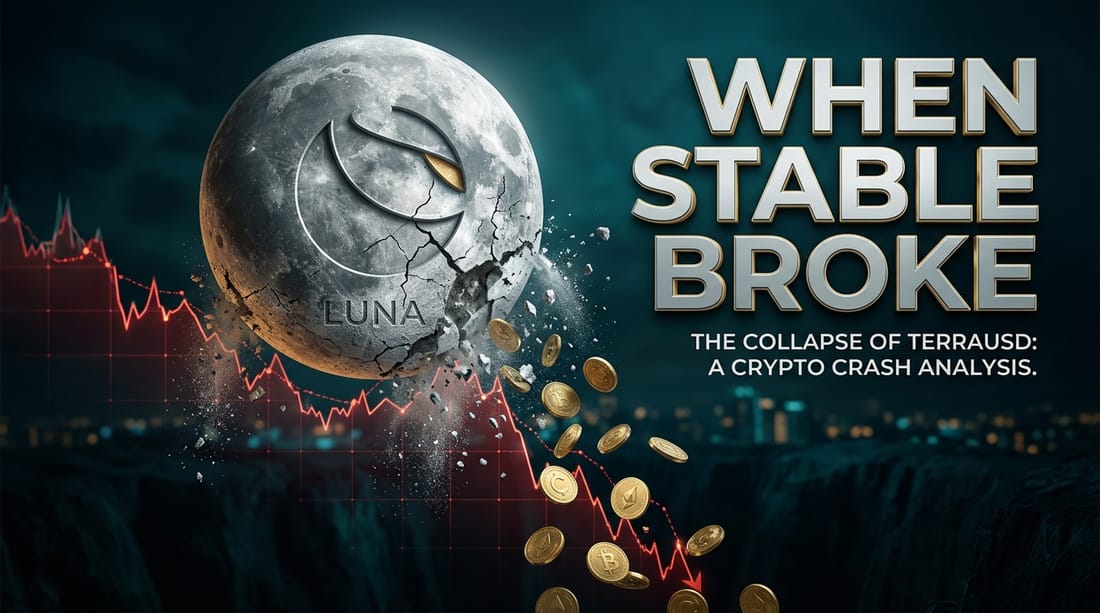
In early May 2022, an asset called "stable" lost half its value in a day, then kept falling. Within a week, roughly $40 billion had simply ceased to exist. Fortunes vanished. A sister token that had traded near $80 went to a number with so many zeros after the decimal point it was effectively worthless. And the shockwave took down lenders, funds, and companies across the entire industry, helping trigger a brutal bear market.
This was the Terra-Luna collapse — the single most important disaster story in crypto, because it didn't happen to some obvious scam. It happened to a top-ten project that millions of smart people trusted. Understanding how is one of the most protective things you can learn.
The promise that was too good
Terra was a blockchain with a star product: TerraUSD (UST), a stablecoin designed to always equal one US dollar. But UST wasn't backed by actual dollars in a bank like the big reserve-backed stablecoins. It was an algorithmic stablecoin, holding its peg through a clever trading mechanism involving a sister token called Luna.
The mechanism, simplified: you could always swap $1 of UST for $1 worth of Luna and vice versa. If UST drifted below a dollar, traders were incentivized to buy the cheap UST and redeem it for a full dollar of Luna, pushing the price back up. On paper, math kept it pegged. There were no reserves to run out of — just code and incentives.
Layered on top was Anchor Protocol, a lending platform that paid an eye-watering ~20% annual yield on UST deposits. In a world where banks paid almost nothing, 20% on a "stable" dollar was irresistible. Billions poured in. What almost nobody asked loudly enough was the only question that mattered: where is that 20% actually coming from? As we warn in stablecoin yield: where it comes from and when it's a trap, a yield far above the rest of the market is rarely a free gift.
The death spiral
The fatal flaw in algorithmic stablecoins is reflexivity: the thing propping up UST (Luna) was itself a volatile asset whose value depended on confidence in the whole system. That works beautifully when everyone's optimistic and falls apart the instant they aren't.
In May 2022, amid a jittery market, a series of large UST withdrawals knocked the coin slightly below its dollar peg. Normally the mechanism would absorb it. But this time, the sheer size shook confidence, and people rushed for the exits at once. To defend the peg, the system had to mint and sell enormous amounts of Luna — flooding the market with new supply and crashing Luna's price.
Here's the lethal feedback loop: a falling Luna meant the system had to print even more Luna to honor the same UST redemptions, which crashed Luna further, which broke the UST peg more, which triggered more redemptions. Round and round, faster and faster. This is a death spiral, and once it starts, there is no bottom.
Luna's supply exploded from around 350 million tokens to trillions in days as the system desperately tried to defend the peg. The price went to effectively zero. The mechanism didn't fail gradually \u2014 it failed all at once, exactly as its harshest critics had predicted.
The contagion
Terra was too big to fail quietly. Major funds and lenders had huge exposure to UST and Luna, or had borrowed against them. When the assets vaporized, those institutions imploded too — setting off a chain reaction of bankruptcies across crypto over the following months. The collapse turned an ordinary downturn into a full-blown crisis, and it foreshadowed the broader theme of how the money that lifts crypto can also weigh it down. A single broken peg cascaded into systemic contagion.
The lessons that could save you
Terra-Luna is painful, but its lessons are clear and permanently useful:
- "Stable" is a claim, not a guarantee. If a stablecoin isn't backed by real, verifiable, liquid reserves, its peg is only as strong as collective confidence — and confidence can evaporate overnight. Know what backs any stablecoin you hold.
- Unsustainable yield is a warning, not a reward. Twenty percent on a "risk-free dollar" should have triggered alarm, not greed. Abnormally high returns always hide abnormally high risk; the risk was simply invisible until it wasn't. When you can't identify where a yield comes from, assume you are the yield.
- Reflexive systems are fragile. Anything that depends on its own token's price to stay stable is built on sand. The same confidence that lifts it can collapse it.
- Size is not safety. Terra was enormous and widely trusted. Being top-ten protected no one. Do your own research and understand the actual mechanism, not just the market cap.
The hardest part of the Terra story is that the victims weren't reckless gamblers chasing a dog coin. Many were cautious people who thought they'd found a safe, stable place to earn a little yield. They trusted the word "stable" and the comfort of a big, popular project. The blockchain doesn't grade on intentions. When the mechanism broke, it broke for everyone equally — and it broke completely.
Frequently asked questions
Terra was a blockchain whose flagship product, TerraUSD (UST), was an 'algorithmic stablecoin' meant to hold $1 using a sister token called Luna instead of cash reserves. In May 2022 the system collapsed, wiping out roughly $40 billion in value within days.
UST kept its peg through a trading mechanism tied to Luna rather than real reserves. When confidence cracked and large withdrawals hit, the mechanism spiraled: holding the peg required printing huge amounts of Luna, which crashed Luna's price, which broke the peg further — a 'death spiral.'
Anchor was a lending platform on Terra that offered about 20% annual yield on UST deposits. That unsustainable rate drew billions in deposits and was the main reason so many people were exposed when the system failed.
If a 'stable' asset isn't backed by real, verifiable reserves, treat its stability as a promise that can break. And a yield far above what the rest of the market offers is a warning sign, not a gift — someone is taking a risk you may not see.
Keep reading




Popular this week
- 01Rug Pulls Hall of Shame: Famous Crypto Exit ScamsAnalysis · 4 min
- 02Grid Trading Bots Explained, and When They Blow UpGuide · 4 min
- 03Where AI and Crypto Actually Meet: Compute, Data, and DePINAnalysis · 9 min
- 04Modular vs Monolithic Blockchains: The Design FightExplainer · 6 min
- 05Base and Coinbase's Quiet Bet on Bringing Millions On-ChainAnalysis · 5 min