The Whale Watchers: How People Track Big Money On-Chain
Because every transaction is public, an entire culture of detectives watches the blockchain for whales moving millions. Here's how on-chain sleuthing works — and what it can and can't tell you.
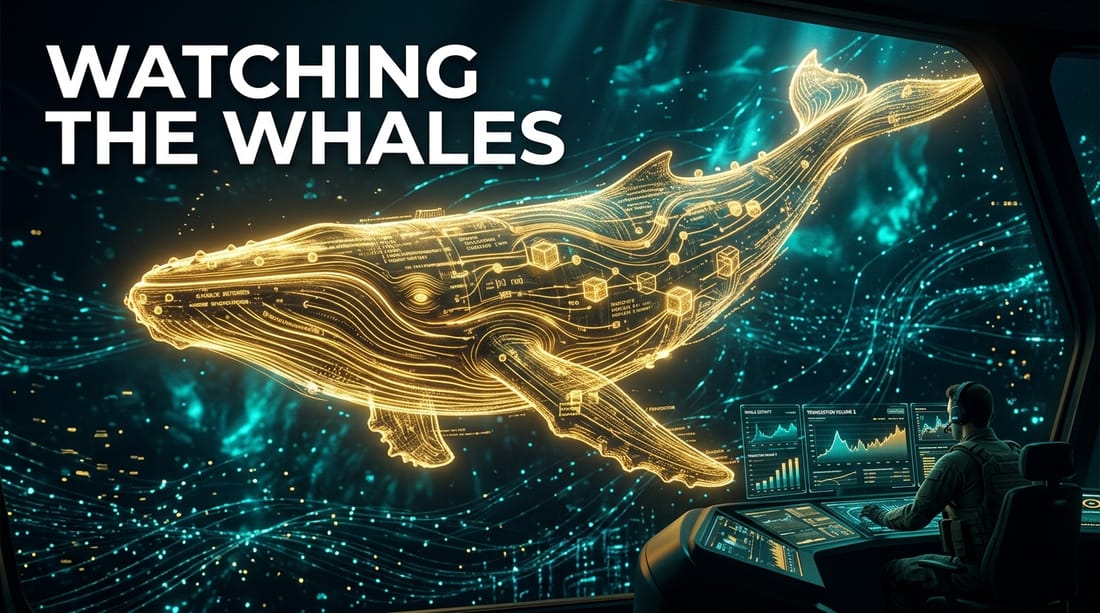
Imagine if every bank account on earth were visible to the public. Not the names attached to them — just the balances and every transfer, in real time, forever. You could watch the richest accounts move money, spot a giant withdrawal seconds after it happened, and follow the cash as it bounced from place to place.
That's not a fantasy. That's exactly how public blockchains work, and it has spawned one of crypto's most fascinating subcultures: the whale watchers. Armed with nothing but free tools and obsessive curiosity, they track the biggest players on-chain — and occasionally catch thieves, predict market moves, and expose frauds in the process.
Why this is even possible
The whole thing rests on a feature that surprises newcomers: blockchains are radically transparent. As we cover in what a blockchain really is, every transaction is permanently recorded on a public ledger that anyone can read. Your wallet address isn't stamped with your name, but the activity tied to it is fully visible to the world.
So a "whale" — a wallet holding enough crypto to move markets — leaves footprints everywhere it goes. When a whale shifts $200 million in Ether from cold storage to an exchange, thousands of people see it within seconds, and many immediately start asking the obvious question: are they about to sell?
The tools of the trade
On-chain detectives use a layered toolkit, most of it free:
- Block explorers (the search engines of a blockchain) let you punch in any address and see its entire history — balances, every transaction, every token. This is the same skill you'd use to read a token's contract.
- Analytics platforms layer dashboards on top: alerts when big wallets move, labels for known exchange and institution addresses, and charts of supply flowing on and off exchanges.
- Automated trackers post big transactions to social media the instant they happen, turning whale moves into public spectacle.
- Wallet labeling, the detective's art, slowly maps anonymous addresses to entities — "this cluster belongs to that exchange," "these wallets are one fund" — by studying patterns over time.
What whale watching can actually do
At its best, on-chain analysis is genuinely powerful:
Catching thieves. When a hack happens, investigators follow the stolen funds across the chain in real time, often freezing them at exchanges before the thief can cash out. This is why so many of crypto's biggest heists end with traced or recovered money — the loot is on a public ledger.
Exposing fraud. Whale watchers have repeatedly outed rug pulls and insider dumping by spotting that a "decentralized" project's tokens were all controlled by a handful of connected wallets.
Reading sentiment. Big flows onto exchanges can signal selling pressure; coins leaving exchanges into cold storage can signal long-term holding. It's not prophecy, but it's real information about what might move prices.
The single most useful whale-watching habit for a normal investor isn't predicting the next pump \u2014 it's verifying claims. Before trusting a "decentralized" project, check whether its tokens are actually spread across many holders or quietly hoarded by a few wallets.
Why you can't just copy the whales
Here's the trap that catches beginners. It feels like free money: just watch what the big wallets buy and follow them. In practice, it rarely works, for several stubborn reasons.
You almost always see a move after it happens — the whale already got their price. You usually see only one wallet, not the player's full position; that "buy" might be a hedge against a much larger short you can't see. Sophisticated players know they're being watched and sometimes act specifically to bait followers — moving funds to fake a signal. And linking a wallet to an actual human or strategy is genuinely hard; you're often watching behavior with no idea of the intent behind it.
In other words, whale data is a clue, not a conclusion. Used to verify and investigate, it's invaluable. Used as a trading shortcut — "ape in whenever this wallet does" — it's a fast way to become someone else's exit liquidity.
The transparency trade-off
Whale watching exists because crypto made a radical choice: total transparency over privacy. That openness is a superpower for accountability — it's why fraud is harder to hide here than in traditional finance, where balances are secret. But it cuts both ways. The same tools that track a thief can track you. Anyone you transact with can, in principle, peek at your wallet's history.
That's worth remembering the next time you marvel at how easily the internet tracks a whale's millions. On a public blockchain, everyone is a little bit visible — the whales are just the ones interesting enough to watch.
Frequently asked questions
A whale is a wallet or person holding a very large amount of a cryptocurrency — enough that their buying or selling can move the market. There's no fixed cutoff, but holdings worth millions of dollars generally qualify.
Because public blockchains record every transaction openly, anyone can watch any wallet's activity using a block explorer or analytics tool. You see the balances and transfers, even if you don't know the real person behind the address.
It's tempting but unreliable. You usually see a whale's move after it happens, you rarely know their full strategy or other positions, and large players sometimes act specifically to mislead followers. Treat whale data as one signal, not a crystal ball.
Not quite. Whale watching tracks wallet addresses, which are pseudonymous. Linking an address to a real identity is a separate, harder step. Analysts often track behavior without ever knowing who's behind it.
Keep reading




Popular this week
- 01Rug Pulls Hall of Shame: Famous Crypto Exit ScamsAnalysis · 4 min
- 02Grid Trading Bots Explained, and When They Blow UpGuide · 4 min
- 03Where AI and Crypto Actually Meet: Compute, Data, and DePINAnalysis · 9 min
- 04How to Spot Wash Trading and Fake VolumeGuide · 5 min
- 05Base and Coinbase's Quiet Bet on Bringing Millions On-ChainAnalysis · 5 min