Tokenized Stocks and the Blurring Line Between TradFi and Crypto
Imagine owning a fraction of a stock as a token, tradable 24/7, anywhere in the world, settling in seconds. That's the promise of tokenization, and it's quietly erasing the line between traditional finance and crypto. A long look at what it really means — and what it doesn't.
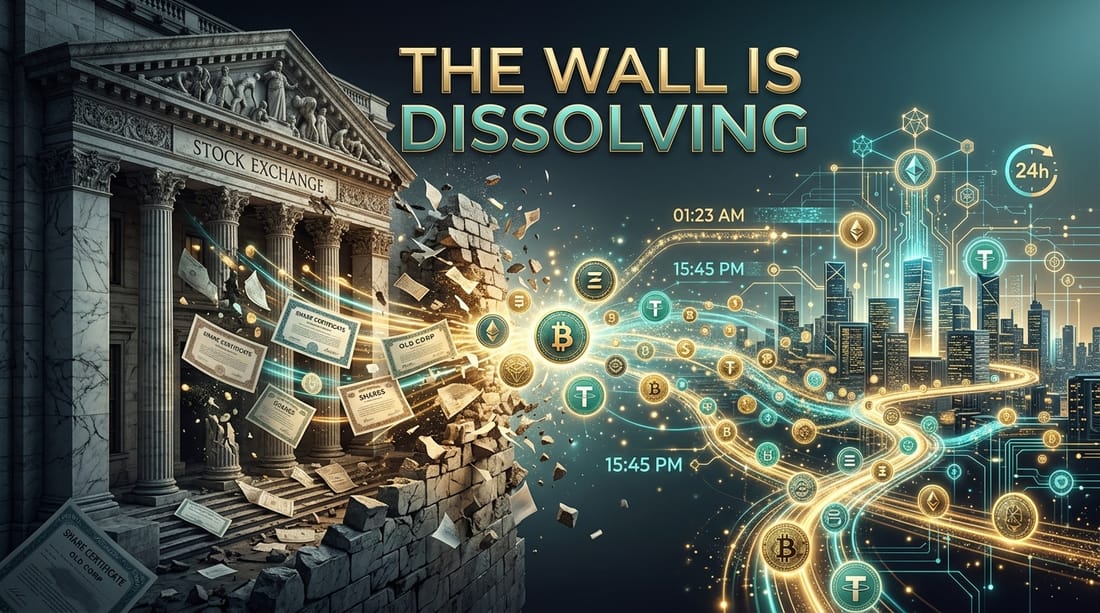
Picture buying a fraction of a famous company's stock not through a brokerage that's open weekday business hours, but as a token — tradable at 3am on a Sunday, from anywhere on earth, in any tiny amount you like, settling in seconds instead of days. That's the promise of tokenization, and it's doing something quietly profound: dissolving the wall between traditional finance and crypto that has stood since crypto began. This is a long look at what that convergence actually means, why it could matter enormously, and why the hardest questions are the ones the hype skips over.
The core idea: putting real assets on-chain
Strip tokenization to its essence. A tokenized asset is a blockchain token that represents ownership of, or economic exposure to, a real asset — a share of stock, a bond, a piece of real estate, a commodity, a fund. The token lives on a blockchain and can be traded on crypto rails, while supposedly tracking or representing the real thing behind it. Tokenized stocks are the most intuitive example: tokens that represent shares of real companies, so you can get stock exposure on a blockchain instead of only through a traditional brokerage.
This is the practical, here-and-now face of the broader idea of real-world assets coming on-chain. And it's a genuinely big idea, because it proposes to merge two worlds that have been separate: the vast universe of traditional financial assets, and the always-on, global, programmable infrastructure of crypto. The wall between TradFi and crypto isn't being knocked down by argument; it's being dissolved by assets that exist in both worlds at once.
Why this could reshape finance
To understand the excitement, look at what traditional markets can't easily do that tokenization promises:
Round-the-clock, global trading. Traditional stock markets keep business hours and are bounded by geography, intermediaries, and national systems. Crypto markets never close and span the globe. Tokenized stocks could let stock exposure trade 24/7, worldwide, on crypto rails — a fundamental change from "the market is open 9:30 to 4:00 on weekdays in one country."
Fractional ownership. Tokens divide infinitely easily. Tokenization could let someone own a tiny fraction of an expensive share, or a slice of a building, or a sliver of a fund — lowering the barriers that currently lock smaller investors out of whole categories of assets. A person with a few dollars could own a fragment of things previously reserved for those with far more.
Faster, cheaper settlement. Traditional securities settlement is famously slow — trades can take days to fully settle through layers of intermediaries. Blockchain settlement can be near-instant. Tokenization could collapse settlement from days to seconds and strip out intermediary costs, a genuine efficiency leap.
Broader access. Billions of people are excluded from traditional financial markets by geography, wealth requirements, or lack of access to brokerages. Tokenized assets on global crypto rails could open those markets to anyone with an internet connection and a wallet — the same democratizing impulse behind much of DeFi.
Programmability. Because tokens live on programmable blockchains, tokenized assets could carry built-in logic — automated dividends, compliance rules, and integration with the broader on-chain financial system, plugging traditional assets into the composable machinery of DeFi.
Put together, the vision is a financial system that's more open, more efficient, more global, and more accessible — traditional assets gaining crypto's superpowers. If it works, it's one of the most consequential shifts finance could undergo. That "if" is doing a lot of work, which brings us to the hard part.
The hard questions the hype skips
Here's where honesty earns its keep, because the promise is real but so are the problems, and the problems are mostly about trust and law, not technology.
Is the token actually backed by the real asset? This is the foundational question. A tokenized stock is only worth something if the token is genuinely, reliably backed by the real share — if someone actually holds the underlying stock and guarantees the token represents it. So who holds the real asset, and who guarantees the link? If a company issues tokens supposedly backed by real shares, you're trusting that company to actually hold those shares and honor the token. That's a counterparty and custody risk: the token is a claim, and a claim is only as good as the entity standing behind it. A tokenized stock from a trustworthy, regulated, audited issuer is a very different thing from one issued by an anonymous outfit — and telling them apart is on you.
Owning a token that tracks a share is not owning the share. This subtlety matters enormously. In many tokenized-stock arrangements, you don't own the actual share with its full legal rights — you own a token that represents exposure to it, issued by some intermediary. Do you get voting rights? Are you a real shareholder, or a holder of a derivative-like claim against an issuer? The legal substance behind the token can differ wildly from genuine share ownership, and the difference becomes painfully real if the issuer fails or disputes arise. "Exposure to the price" and "ownership of the asset" are not the same thing.
Regulatory uncertainty. Stocks and securities are among the most heavily regulated things in finance, for reasons learned through centuries of fraud and collapse. Wrapping them in tokens runs straight into that thicket: Are tokenized stocks securities (almost certainly, in substance)? Who's allowed to issue and trade them, and where? How do existing investor protections apply? The regulatory picture is unsettled and varies by jurisdiction, and this uncertainty is a major brake on the whole vision. Much of what's technically possible isn't yet clearly legal, and that gap is where both innovation and fraud breed.
The trust paradox. Crypto's founding promise was to remove the need to trust intermediaries. But tokenized real-world assets reintroduce intermediaries — the entities holding the real assets and issuing the tokens — right at the center. You're back to trusting a custodian, an issuer, a guarantor. Tokenization doesn't eliminate trust; it relocates it, and pretending otherwise is dangerous. The blockchain can prove the token moved; it cannot prove the issuer actually holds the share behind it.
The technology of moving a token is the easy, solved part. The hard part is everything off-chain: is a real asset actually backing this token, who holds it, who guarantees it, what legal rights do you really have, and is any of this properly regulated? A tokenized stock is a promise wrapped in code, and the code can't verify the promise. Judge a tokenized asset by the credibility of whoever stands behind it and the legal substance of what you actually own — never by the elegance of the blockchain it lives on.
Why it blurs the TradFi-crypto line either way
Step back, and notice that whatever the risks, tokenization represents a genuine convergence. For years, traditional finance and crypto were separate worlds with a wall between them — different assets, different infrastructure, different cultures. Tokenization punches holes in that wall from both directions: traditional assets flow onto crypto rails, and crypto infrastructure starts carrying the real economy's value. The two systems begin to merge into one.
This convergence is happening through multiple channels at once — ETFs bringing crypto into traditional accounts, institutions adopting crypto, companies holding it on balance sheets — but tokenization is arguably the deepest, because it brings traditional assets themselves onto crypto infrastructure rather than just connecting the two worlds at the edges. The line between "a stock" and "a crypto token" starts to dissolve, and with it the old separation between the two financial universes. That's a one-way trend, regardless of how messy the path is.
The balanced verdict
Tokenized stocks and real-world assets sit at one of the most important frontiers in finance: the merging of traditional assets with crypto's always-on, global, programmable, fractional infrastructure. The upside is genuinely transformative — markets that are more open, efficient, accessible, and continuous, with barriers lowered for billions of people currently locked out. It's not hype to call the vision profound.
But the vision lives or dies on the unglamorous questions the marketing rushes past: is the token truly backed, who holds and guarantees the real asset, what do you actually legally own, and is the whole thing properly regulated? These are problems of trust, custody, and law — not problems a blockchain solves by itself, and in some ways problems crypto's trust-minimizing ethos is in tension with. The technology of tokenizing is easy; the trust and legal architecture behind it is hard, and that's where both the real progress and the real dangers will be.
So watch tokenization as one of the defining stories of finance's next phase, and approach any specific tokenized asset with the right question firmly in hand: not "how clever is the technology," but "who stands behind this promise, and what do I really own?" The wall between TradFi and crypto is dissolving — that much is real and probably irreversible. Whether what flows through the gap is trustworthy depends entirely on the off-chain answers, and those are the answers worth demanding before you trust a token to be a stock.
Frequently asked questions
Tokenized stocks are blockchain tokens that represent ownership or economic exposure to real shares of a company. They aim to let people trade stock exposure on crypto rails — potentially 24/7, globally, in small fractions, with fast settlement — rather than only through traditional brokerages and market hours.
It's representing real assets — stocks, bonds, real estate, commodities, funds — as tokens on a blockchain. The goal is to make traditionally illiquid or restricted assets easier to divide, trade, settle, and access globally, merging traditional assets with crypto infrastructure.
Potentially round-the-clock global trading, fractional ownership that lowers barriers, faster and cheaper settlement, broader access for people excluded from traditional markets, and programmable features. These could make markets more open and efficient if the model works as intended.
Key risks include whether the token is truly backed by the real asset and who guarantees it, regulatory uncertainty, counterparty and custody risk, and the difference between owning a real share and owning a token that merely tracks it. The legal and trust questions are serious.
Keep reading



Popular this week
- 01Rug Pulls Hall of Shame: Famous Crypto Exit ScamsAnalysis · 4 min
- 02Grid Trading Bots Explained, and When They Blow UpGuide · 4 min
- 03Where AI and Crypto Actually Meet: Compute, Data, and DePINAnalysis · 9 min
- 04How Hedge Funds Actually Trade CryptoExplainer · 6 min
- 05Coinbase Review: Paying a Premium for Peace of MindAnalysis · 4 min