What Are Real-World Assets (RWA) Coming On-Chain?
Treasuries, real estate, gold, even private credit — trillions in traditional assets are being 'tokenized' onto blockchains. It's one of crypto's most serious frontiers, and it comes with a catch most people miss.
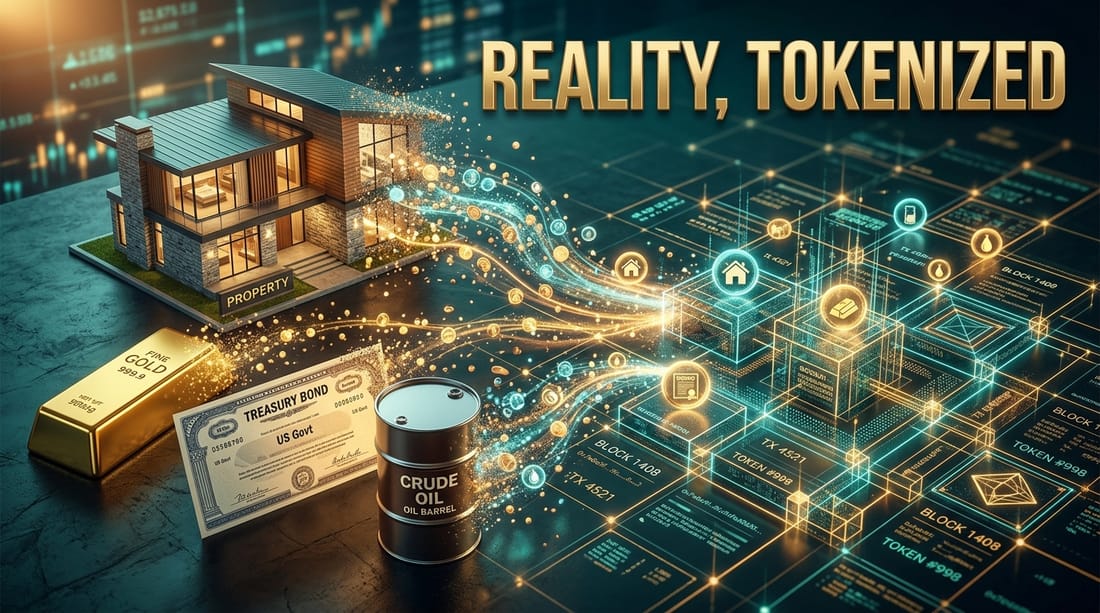
For years, crypto and traditional finance eyed each other across a wall — two separate worlds with different rules, speeds, and assets. Now that wall is being drilled through from both sides, and the drill has a name: real-world asset tokenization, usually shortened to RWA. The idea is to take traditional assets — government bonds, real estate, gold, private credit, even fine art — and represent them as tokens on a blockchain.
It's one of crypto's most serious and best-funded frontiers, drawing in some of the largest financial institutions on earth. The promise is enormous. But so is a catch that most of the excitement conveniently glosses over — and understanding that catch tells you something profound about what blockchains can and can't do.
What "tokenizing" actually means
To tokenize an asset is to create a blockchain token that represents ownership of (or a claim on) something in the real world. Buy a token representing a US Treasury bond, and you hold a digital claim on that bond; the token can be traded, transferred, or used in DeFi like any other crypto asset — but its value is anchored to the real bond sitting somewhere off-chain.
The targets being tokenized span the financial universe:
- Government bonds and treasuries — currently the most popular, because they're low-risk and yield-bearing.
- Real estate — turning illiquid property into divisible, tradeable tokens.
- Commodities like gold, oil, and agricultural products.
- Private credit and loans — bringing off-chain lending on-chain.
- Equities, funds, and more exotic assets like art and collectibles.
Why anyone wants this
The appeal is genuine and substantial, which is why serious money is pouring in:
Liquidity for illiquid things. Selling a building is slow, expensive, and all-or-nothing. Tokenized, a property's ownership can be split into many tradeable pieces that change hands far more easily. Tokenization can make traditionally frozen assets fluid.
Fractional ownership. Tokenization lets assets be divided into tiny fractions, opening investments that were once reserved for the wealthy — owning a sliver of a building or a bond — to far more people.
Speed and availability. Traditional settlement can take days and only runs business hours. On-chain, transfers settle in minutes, 24/7, the way crypto transactions already do. That's a real efficiency leap for global finance.
Programmability and DeFi access. Once on-chain, a real-world asset can plug into DeFi — used as collateral, lent, or built into automated financial products. Imagine borrowing against a tokenized bond instantly, with no bank in the loop.
This is a big piece of the broader institutionalization of crypto — traditional finance and blockchain technology genuinely merging, rather than competing.
The catch crypto can't escape
Here's the part the hype skips, and it's crucial. Crypto's core innovation is trustlessness — a blockchain lets you verify everything without trusting a middleman. A Bitcoin is real because the blockchain says so, no institution required.
But a tokenized real-world asset breaks that property at the seam. The token on the blockchain might be perfectly trustless — but its connection to the actual bond, building, or gold bar in the real world is not. That link depends entirely on trusted off-chain institutions:
- A custodian must actually hold the real asset and not lose, steal, or misrepresent it.
- A legal system must recognize that your token genuinely entitles you to the underlying asset.
- An issuer must honestly honor redemptions, letting you exchange the token back for the real thing.
- Regulators and auditors must keep the whole structure honest.
In other words, you've recreated exactly the trusted intermediaries that crypto was built to remove — just with a blockchain bolted onto the front. If the custodian is fraudulent, the issuer insolvent, or the legal claim unenforceable, your perfectly-functioning on-chain token can become worthless, no matter how flawless the blockchain is.
A blockchain can guarantee that you own a token. It cannot guarantee that the token is honestly backed by a real asset \u2014 that still rests on custodians, lawyers, and regulators. RWAs don't eliminate trust; they relocate it. The "trustless" blockchain ends precisely where the real world begins.
How to think about RWAs
This doesn't make RWAs bad — it makes them different from native crypto, requiring a different kind of due diligence. The blockchain part you can verify; the real-world part you have to trust, which means scrutinizing the off-chain structure:
- Who is the issuer, and are they credible and regulated? This is the team-and-backers question with even higher stakes, because real-world legal claims hinge on it.
- Who custodies the asset, and is it independently audited and verified? "Trust us, the gold is in a vault" is exactly the claim that needs proof.
- What's the legal structure? Does your token actually entitle you to the underlying asset in a way a court would enforce, in a real jurisdiction?
- How does redemption work? Can you genuinely exchange the token back for the real asset, and under what conditions?
Tokenized treasuries are popular precisely because the underlying asset is about as safe and well-understood as finance gets — but even there, you depend on the issuer truly holding the bonds and honoring redemptions. The on-chain token is never safer than the real-world structure behind it.
The frontier ahead
RWAs may turn out to be one of the most consequential developments in crypto — not because they're flashy, but because they connect blockchain's efficiency to the vast, established world of traditional assets, potentially bringing trillions of dollars of value on-chain. If tokenization delivers even part of its promised efficiency and access, it reshapes finance.
But the lesson underneath is the one worth carrying everywhere in crypto: technology can make a token trustworthy, but it can't make the real world trustworthy. Wherever a digital token claims to represent something physical or legal, the old questions return — who's holding it, who's accountable, and what happens if they lie. The blockchain handles its half flawlessly. The other half is still made of custodians, courts, and human promises — and that half is where you'll need to keep your eyes wide open.
Frequently asked questions
RWAs are traditional, off-chain assets — like government bonds, real estate, gold, or private loans — represented as tokens on a blockchain. Tokenizing them aims to bring their value into the faster, more programmable world of crypto.
Tokenization can make traditionally illiquid assets easier to trade, divide ownership into small fractions, settle transactions faster and around the clock, and connect these assets to DeFi. It promises efficiency and broader access.
Crypto can make a token trustless, but the link between the token and the real asset still depends on trusted institutions — custodians, legal systems, and regulators. If the off-chain side fails, the on-chain token's value can collapse despite the blockchain working perfectly.
Tokenized treasuries are among the most popular RWAs because the underlying asset is low-risk, but you still rely on the issuer actually holding the bonds and honoring redemptions. The on-chain token is only as trustworthy as the real-world structure behind it.
Keep reading




Popular this week
- 01Rug Pulls Hall of Shame: Famous Crypto Exit ScamsAnalysis · 4 min
- 02The Hidden Costs of Leverage: Funding, Fees, and SpreadsExplainer · 5 min
- 03Grid Trading Bots Explained, and When They Blow UpGuide · 4 min
- 04Where AI and Crypto Actually Meet: Compute, Data, and DePINAnalysis · 9 min
- 05Modular vs Monolithic Blockchains: The Design FightExplainer · 6 min