What a Spot ETF Actually Does to a Coin's Price
"An ETF got approved" sends prices flying, but most people can't explain why it matters. Here's the real mechanism — new buyers, locked-up supply, and the trap of buying the rumor.
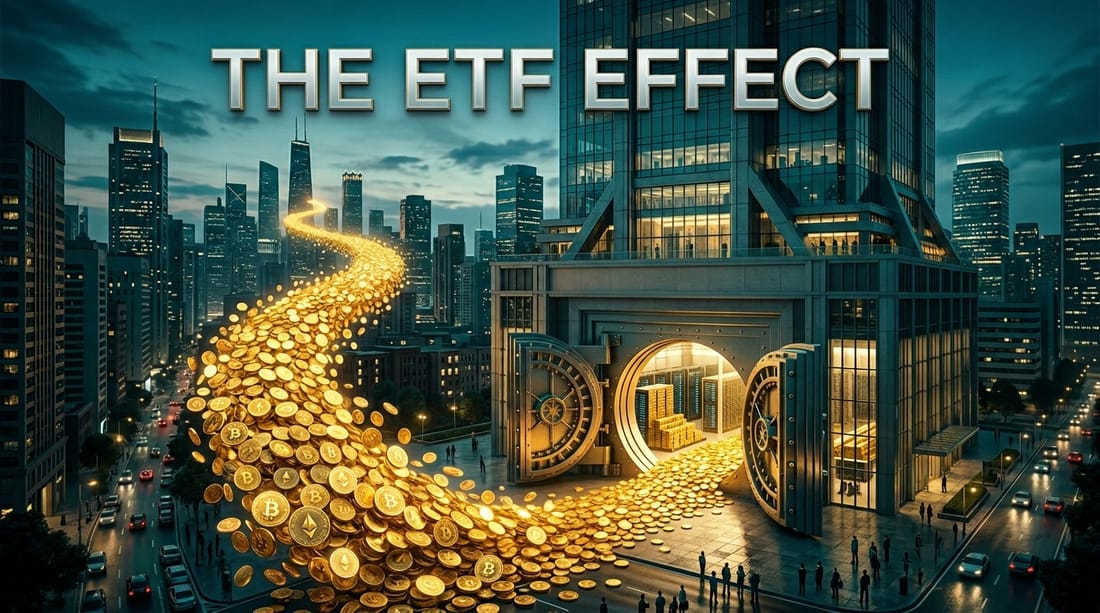
When headlines announce that a "spot ETF" has been approved for a major crypto asset, prices often lurch upward and crypto Twitter loses its mind. Plenty of the people celebrating couldn't actually explain why a financial product with a boring acronym moves the price of a decentralized coin. The mechanism is worth understanding, because it separates a durable demand shift from a headline you're about to overpay for.
What a spot ETF is, minus the jargon
An ETF (exchange-traded fund) is a product that trades on a normal stock exchange, like a share. A spot crypto ETF is one that actually holds the real coin in custody and is designed to track its price. Translation: you can buy crypto exposure through your ordinary brokerage account — the same place you hold stocks — without ever touching a wallet, a seed phrase, or an exchange.
That convenience is the entire story. The coin didn't change. The door to it did.
Why a new door moves the price
Two forces, working together:
- It unlocks money that couldn't get in before. Enormous pools of capital — retirement accounts, financial advisors, cautious institutions — are restricted to regulated, familiar products. They were never going to set up self-custody or open an account on a crypto-native exchange. An ETF hands them a compliant, click-to-buy door. Suddenly a whole category of buyers who were fenced out can participate.
- It locks supply off the market. To back the shares they sell, ETF issuers must go buy and hold the actual coin. Every dollar of net inflow is, in effect, coins being pulled off the open market and parked in custody. Less available supply meeting new demand is the textbook setup for upward price pressure — the same supply-and-demand logic behind what moves crypto prices.
The lasting signal isn't the approval headline \u2014 it's the inflows. An ETF that exists but attracts little money does little. An ETF pulling in steady billions is a continuous bid quietly removing supply, day after day.
The trap: buying the rumor
Here's where people get hurt. Markets are forward-looking, so the anticipation of an ETF often gets bought up long before approval. By the time the official news lands, much of the optimism is already baked into the price. The result is the oldest pattern in trading: "buy the rumor, sell the news." The event everyone waited for arrives, the buyers who positioned early take profits, and the price falls on objectively good news — leaving latecomers who bought the headline holding the bag. It's a close cousin of the "this time it's different" euphoria.
If you only ever buy crypto when it's already in the headlines, you are reliably the person arriving after the smart money has set its table.
What it means for you
- Distinguish access from value. An ETF makes a coin easier to buy; it doesn't change what the coin is. Easier access can sustainably raise demand — but it's not alchemy.
- Watch flows, not announcements. After the launch confetti, the honest question is whether real money keeps coming in. Sustained inflows matter; a one-day headline doesn't.
- Don't chase the candle. Buying the green candle on approval day is exactly when "sell the news" tends to punish you.
And if you'd rather just hold the coin directly — keeping your own keys instead of trusting a fund's custodian — the most direct route is still buying spot on a major, liquid exchange and withdrawing to self-custody:
ETFs are a genuinely big deal: they're the bridge that lets the ocean of traditional money flow toward crypto without anyone learning what a seed phrase is. Just remember that a bridge being built and a flood actually arriving are two different events — and the headline usually celebrates the first while the price has already gambled on the second.
Frequently asked questions
An exchange-traded fund that holds the actual cryptocurrency and trades on a normal stock exchange, letting investors get price exposure through a regular brokerage account without handling wallets or keys.
It opens the asset to large pools of money that couldn't or wouldn't buy it directly. To back their shares, ETF issuers buy and hold the real coin, removing that supply from the open market.
No. Approval can be 'priced in' ahead of time, and prices can fall on the news even after a positive event. Ongoing inflows matter more than the approval headline itself.
Traders buy in anticipation of an event, then sell once it actually happens, so the price can drop on good news because the optimism was already spent.
Keep reading




Popular this week
- 01Rug Pulls Hall of Shame: Famous Crypto Exit ScamsAnalysis · 4 min
- 02Grid Trading Bots Explained, and When They Blow UpGuide · 4 min
- 03Where AI and Crypto Actually Meet: Compute, Data, and DePINAnalysis · 9 min
- 04Modular vs Monolithic Blockchains: The Design FightExplainer · 6 min
- 05How to Spot Wash Trading and Fake VolumeGuide · 5 min