Crypto's Most Expensive Typos and Fat-Finger Trades
Someone paid $500,000 in fees to send $100. A trader sold an NFT for $3,000 instead of $3 million. In crypto, there's no 'undo' button — and these blunders prove it the hard way.
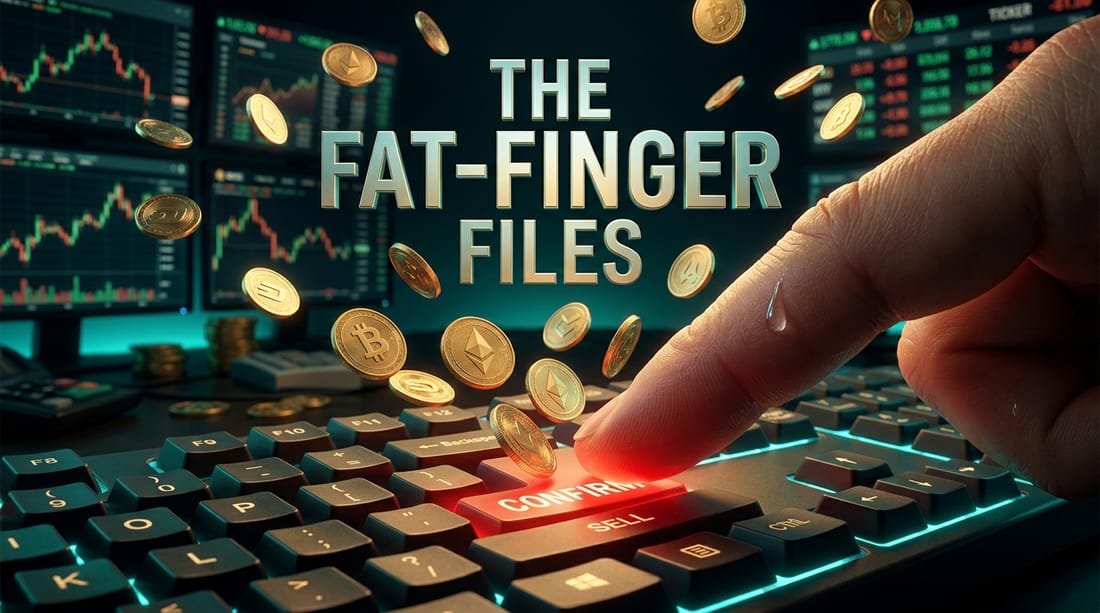
Traditional finance has a safety net woven into everything: chargebacks, fraud departments, "are you sure?" pop-ups, and a bank you can call to reverse a mistake. Crypto has none of that. When you confirm a transaction, it is final — etched permanently into the blockchain, beyond appeal. There is no undo button anywhere in the system.
That irreversibility is a feature. It's what makes crypto censorship-resistant and trustless. But it also means human error has consequences that can make you physically wince. Here is a tour of crypto's most expensive blunders — equal parts comedy and warning.
The half-million-dollar gas fee
In crypto you pay a network fee — "gas" — to process a transaction. Normally it's a few dollars. But the fee is something you can set, and on more than one occasion, someone has catastrophically fat-fingered it.
In a few infamous cases, traders accidentally swapped the fee and the amount fields, or added a string of extra zeros, and ended up paying hundreds of thousands of dollars in fees to move a trivial amount of money. One transaction famously cost over half a million dollars in gas to send a sum worth a fraction of that. The network did exactly what it was told. It always does. That's the terror of it.
The NFT priced 1,000x too low
At the height of the NFT boom, a collector listed a rare NFT for sale and meant to type 75 ETH. They typed 0.75 ETH — leaving off a decimal's worth of zeros. Within seconds, a bot scanning for exactly this kind of mistake snapped it up and instantly flipped it, pocketing a fortune. The seller had meant to ask for the equivalent of roughly $300,000 and instead handed over a six-figure asset for a few thousand dollars, with no recourse.
This is a brutal feature of crypto markets: they are watched by automated bots looking for precisely these errors, ready to pounce in milliseconds. A typo isn't just embarrassing — it's a meal for someone else's algorithm. (It's the same MEV machinery that quietly taxes ordinary trades.)
The wrong-address void
Send crypto to the wrong address and the outcome ranges from bad to catastrophic. If you mistype into a valid address that happens to belong to a stranger, your funds are theirs now — returnable only out of their goodwill. If you send a token to an address on the wrong network, or to a contract that can't handle it, the funds can vanish into a digital void where no one can ever retrieve them.
People have sent life-changing sums to dead addresses by copying the wrong line, trusting malware that swapped their clipboard, or selecting the wrong network in a hurry. The blockchain doesn't know it was a mistake. It just executes.
There is no "support" that can reverse a confirmed transaction. The same finality that protects you from censorship also offers zero protection from your own slip of the finger. In crypto, you are your own fraud department.
Why this keeps happening
These disasters share a common root, and it isn't stupidity — many victims were experienced. It's the collision of three things: irreversibility, manual control, and haste. Crypto hands you the raw controls usually hidden behind layers of bank bureaucracy, removes every safety rail, and then operates in a 24/7 market that rewards acting fast. That combination turns a momentary lapse into a permanent loss.
How to never join the hall of pain
The good news: nearly every one of these catastrophes is preventable with a few unglamorous habits.
- Always send a test transaction first. Before moving a large sum to a new address, send a tiny amount, confirm it arrives, then send the rest. The few cents of fees are the cheapest insurance in finance.
- Triple-check the address and the network. Verify the first and last several characters, and confirm you're on the right chain. Beware clipboard-hijacking malware — this is part of avoiding wallet-draining attacks.
- Watch your decimals and zeros. Read the amount aloud. "Zero point seven five" is very different from "seventy-five."
- Use limit orders, not panicked market orders. A limit order lets you set the exact price calmly instead of fat-fingering a trade in the heat of a pump.
- Slow down. Almost every fat-finger story has the same final ingredient: the person was rushing. Crypto's irreversibility means there is no reward for haste and a potentially infinite penalty.
The expensive-typo hall of fame is funny precisely because it's so avoidable — until it's you, and then it's the least funny thing that's ever happened. Treat every transaction like it's permanent, because it is. Send the test. Check the zeros. Breathe. The blockchain will still be there in thirty seconds, and so will your money.
Frequently asked questions
No. Once a transaction is confirmed on the blockchain, it's permanent. There is no bank to call, no chargeback, and no undo button. This is by design — and it's exactly why mistakes can be so costly.
A fat-finger trade is an error caused by mistyping — entering the wrong price, quantity, or number of zeros. In crypto's 24/7, irreversible markets, these slips have cost people fortunes in seconds.
If the address is valid but belongs to someone else, the funds are usually gone unless that person chooses to return them. If the address is invalid or on the wrong network, the funds may be lost forever. Always double-check before sending.
Send a tiny test amount first, triple-check addresses and networks, set sane defaults, use limit orders instead of rushed market orders, and slow down. Most disasters come from haste, not bad luck.
Keep reading




Popular this week
- 01Rug Pulls Hall of Shame: Famous Crypto Exit ScamsAnalysis · 4 min
- 02Grid Trading Bots Explained, and When They Blow UpGuide · 4 min
- 03Where AI and Crypto Actually Meet: Compute, Data, and DePINAnalysis · 9 min
- 04Modular vs Monolithic Blockchains: The Design FightExplainer · 6 min
- 05How to Spot Wash Trading and Fake VolumeGuide · 5 min