How a Fake Exchange Steals Your Money: Clones and Look-Alikes
The deposit worked. The dashboard showed your balance going up. The charts moved in real time. Everything looked perfect — right up until you tried to withdraw. Here's exactly how fake exchanges are built to feel real.
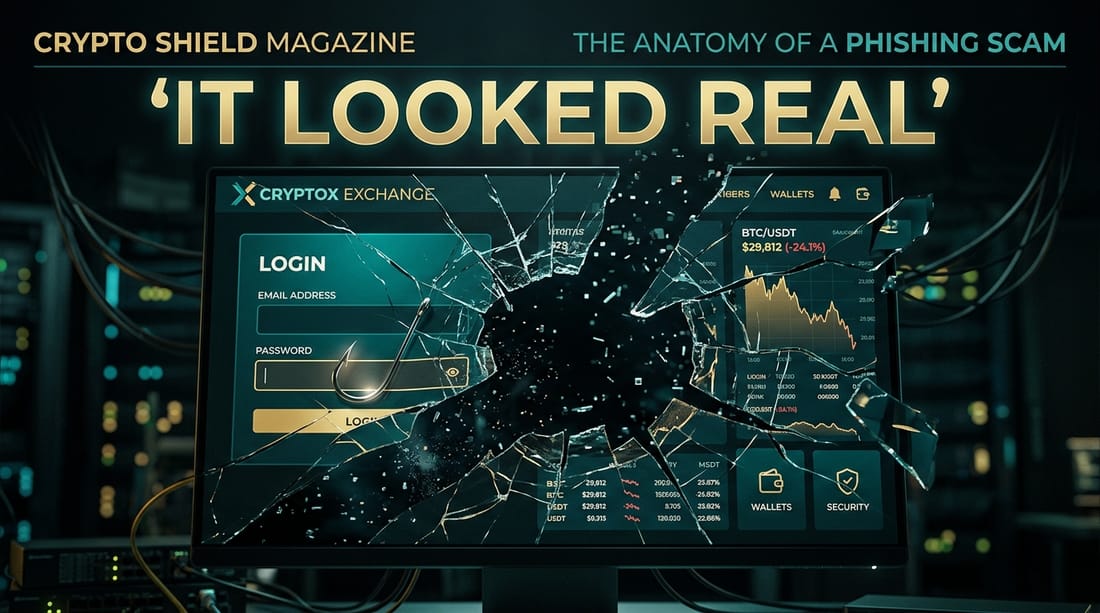
The withdrawal button is where the illusion ends. Until that moment, a good fake exchange feels indistinguishable from a real one — and that's not an accident, it's the entire design. Understanding how these clones are built to feel legitimate is the best defense, because the trick isn't technical. It's theatrical.
The stage is set to look perfect
A fake exchange usually doesn't look sketchy. That's the first thing to unlearn. The sophisticated ones are polished: a clean interface, real-time price charts pulled from genuine market data, a professional-sounding name, sometimes a slick app. They often clone a real exchange's design wholesale, or impersonate a known brand with a near-identical web address — swapping a letter, adding a word, using a different domain ending. Everything is engineered to pass the gut-check.
You typically arrive through one of a few doors: an ad promising incredible returns, a "mentor" or romantic interest who's been chatting with you for weeks (the long con detailed in pig-butchering scams), or a group where everyone seems to be getting rich. The platform itself is just the closing act of a longer setup.
The deposit works — that's the hook
You make your first deposit, usually small. And here's the cruel genius: it appears to work flawlessly. Your balance updates. If they've promised a trading bot or a hot investment, the dashboard shows your money growing, day after day, in beautiful green numbers.
None of it is real. Your deposit went straight into the scammer's wallet the moment you sent it. The "balance" on your screen is just text in a database the scammers fully control — they can type any number they like. The rising profit is a movie playing on a screen, designed to do one thing: convince you to deposit more. And it works, because the evidence of your own eyes says it's working.
A growing balance on a dashboard proves nothing. Numbers on a screen cost the scammer nothing to display. The only thing that proves an exchange is real is money successfully leaving it, into a wallet you control. Everything before a clean withdrawal is just a promise rendered in pixels.
Often a "small successful withdrawal" is even allowed early on — you take out a little, it arrives, and your trust locks in completely. That tiny payout is bait, funded by your own deposits, and it's the most effective move in the playbook.
The withdrawal wall
Then you try to take out a meaningful amount, and the wall appears. The excuses are remarkably consistent across thousands of these operations:
- A surprise tax or fee. "To withdraw, you must first pay a 20% tax / a 'liquidity fee' / an 'unlocking fee.'" You pay it — and there's another fee. There is always another fee.
- A verification deposit. "Your account is flagged; deposit X to verify you're a real trader, then everything unlocks." It never unlocks.
- A frozen account. Suddenly you're accused of "suspicious activity" or "money laundering," and only a payment will resolve it.
Every variation has the same goal: extract more money from someone who has now realized something is wrong and is desperate to recover what they've already put in. This phase is where victims often lose the most, throwing good money after bad to free a balance that was never withdrawable in the first place.
How to verify before you ever deposit
The defenses are unglamorous and they work:
- Be deeply suspicious of how you found it. Real exchanges do not recruit you through romantic chats, surprise DMs, or "a friend's amazing tip." If a person led you to a platform, your guard should be all the way up. The dynamics are in why your friend in the group chat might be a scammer.
- Check its history and reputation independently. Search the exact name alongside "scam" and "review." Look for how long it's operated and whether real, longstanding communities discuss it. Brand-new platforms with no track record are a giant flag.
- Verify the exact web address, character by character. Clones live in tiny spelling differences and odd domain endings. Type known addresses yourself or use a saved bookmark; never trust a link sent to you.
- Reject guaranteed returns outright. Any platform promising fixed daily profits or "risk-free" gains is lying. That promise alone is enough to walk away. The broader rule is in how to spot a crypto scam before it costs you money.
- Stick to established venues. The framework in how to choose your first crypto exchange steers you toward platforms with real, verifiable histories.
If you've already been caught
Stop sending money — immediately, and especially any "fee" to unlock a withdrawal. That payment will not free your funds; it's just the next stage of the same con. Save every screenshot, address, and message. Report it to the relevant authorities in your country and to any platform that was impersonated.
And brace for the aftershock: recovery scams. Within days or weeks, someone may contact you claiming they can get your money back — for a fee, of course. They are, overwhelmingly, the same kind of predator circling a known victim. A real authority will never ask you to pay them to recover stolen funds. The list you're on now is a list of people who already paid once.
The one rule that protects you
Strip away the details and fake exchanges all rely on a single false belief: that a number on a dashboard is your money. It isn't. Your money is only ever yours when it sits in a wallet whose keys you hold. A real exchange lets it leave freely; a fake one builds an ever-shifting wall to keep it from ever leaving. Judge every platform by that one test — can value actually exit, into your own custody — and the polished interface, the live charts, and the lovely green profits lose all their power to fool you.
Frequently asked questions
They build a convincing platform with a working dashboard, live-looking charts, and a balance that appears to grow. Deposits go straight to the scammers, but the displayed balance is just numbers on a screen. The fraud only becomes obvious when you try to withdraw and can't.
Because there's no real money behind your balance. Common excuses include a sudden tax or fee you must prepay, a verification deposit, or a frozen account. Each is a tactic to extract more money before you realize nothing was ever withdrawable.
Check independent reviews and how long it has operated, be suspicious of platforms found through ads or messages from strangers, verify the exact web address, and treat any promise of guaranteed returns as a red flag. Real exchanges don't recruit you in your DMs.
Stop sending money immediately, especially any 'fee' to unlock withdrawals, because that only deepens the loss. Document everything, report it to relevant authorities, and be wary of recovery services, which are frequently a second scam targeting victims.
Keep reading




Popular this week
- 01Rug Pulls Hall of Shame: Famous Crypto Exit ScamsAnalysis · 4 min
- 02Grid Trading Bots Explained, and When They Blow UpGuide · 4 min
- 03Where AI and Crypto Actually Meet: Compute, Data, and DePINAnalysis · 9 min
- 04Modular vs Monolithic Blockchains: The Design FightExplainer · 6 min
- 05How to Spot Wash Trading and Fake VolumeGuide · 5 min