Layer 2 Networks Explained: How Crypto Scales
Layer 2 rollups carry most of Ethereum's activity today. How optimistic and ZK rollups work, why fees collapsed, and the risks to watch.
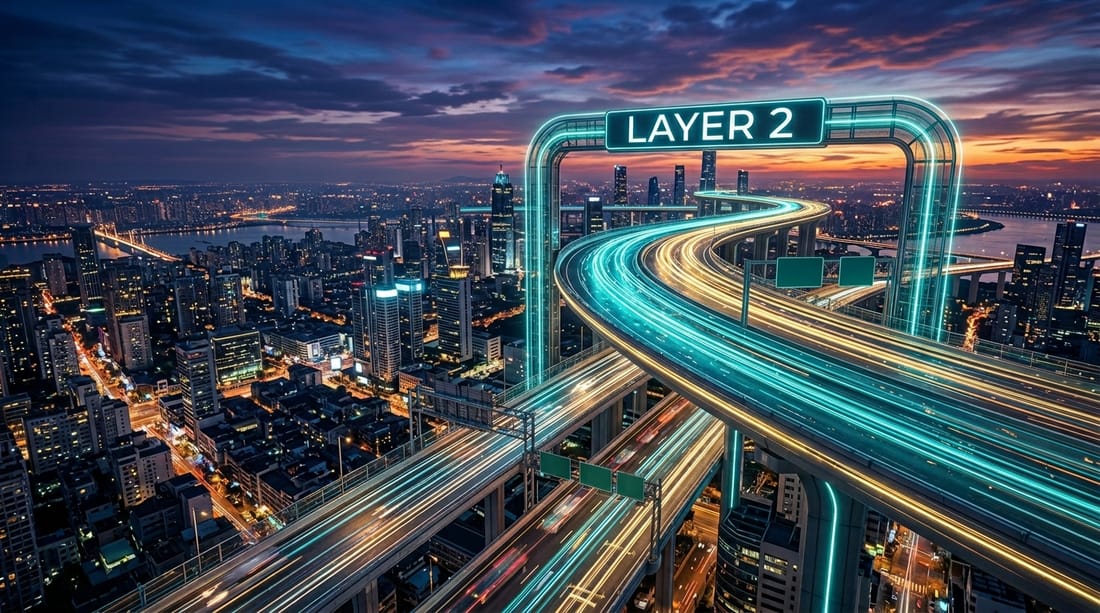
Ethereum can process roughly 15 transactions per second. Visa handles tens of thousands. For years this gap was crypto's most cited dealbreaker — and the source of those infamous $80 swap fees in 2021. Layer 2 networks are the answer that actually shipped, and today they carry the bulk of Ethereum's activity. Here's how they work, minus the jargon.
The problem: every node checks everything
A blockchain is slow on purpose. Thousands of independent computers each verify every transaction — that redundancy is where the security comes from, as we covered in what a blockchain really is. You can't just raise the speed limit without forcing out small node operators and centralizing the network. Block space stays scarce, demand spikes, and gas fees go vertical.
So instead of making the base layer (Layer 1) faster, Ethereum's strategy became: keep L1 maximally secure and decentralized, and move the activity somewhere cheaper that still inherits L1's security.
The core idea: do the work elsewhere, settle the result on Ethereum
A Layer 2 (L2) is a separate, fast network that executes transactions off the main chain, then posts compressed summaries of the results back to Ethereum. Think of L1 as a supreme court and L2s as lower courts: routine business happens quickly downstairs, but everything is ultimately anchored to — and disputable on — the most secure layer.
This batching is why fees collapse: thousands of L2 transactions share the cost of one L1 settlement. A swap that costs $15 on mainnet costs cents on Arbitrum or Base.
Optimistic vs. ZK rollups
The two dominant L2 designs differ in how Ethereum knows the posted results are honest:
Optimistic rollups (Arbitrum, Optimism, Base) post results and assume they're valid — but leave a challenge window (typically seven days) during which anyone can submit fraud proofs. Cheating gets caught and punished; the cost is that withdrawing funds back to L1 the native way takes a week (bridges work around this for a fee).
ZK rollups (zkSync, Starknet, Linea) take the mathematician's route: every batch comes with a cryptographic validity proof that the results are correct. Ethereum verifies the proof — no trust, no waiting period. The technology is harder to build but is widely considered the long-term destination.
For everyday use the difference barely matters: both feel like a faster, cheaper Ethereum, both use the same wallets, and the major ones have processed billions in value for years.
What to actually be careful about
The riskiest part of using L2s has historically been bridges — the contracts that move funds between chains. Several of the biggest hacks in crypto history were bridge hacks (Ronin: $600M+, Wormhole: $320M). Prefer official native bridges and well-established routes, and don't keep funds sitting in transit.
A few more honest caveats. Most L2s today still run centralized "sequencers" (the operator that orders transactions) — decentralizing them is on every roadmap but mostly not done. Each L2 is also a separate environment: your assets on Arbitrum aren't automatically on Base, which fragments liquidity and confuses beginners. And L2 tokens are investments in networks, not automatic claims on their success — read what a token actually entitles you to before buying the story.
Practical starting points
- Moving to an L2 for the first time? Use the network's official bridge or withdraw directly from a major exchange that supports L2 networks — often the cheapest route.
- Verify the receiving network in your wallet before sending; the classic beginner loss is sending tokens to the right address on the wrong chain.
- Small amounts first. Always.
The takeaway
Layer 2s are how Ethereum reconciled security with usability: the base layer stays slow and incorruptible, while rollups make it affordable. The approach works — fees that once made small transactions absurd are now cents. The remaining rough edges (bridges, fragmentation, centralized sequencers) are real but shrinking, and they're the right things to watch as the technology matures.
Frequently asked questions
Ethereum's base layer processes only about 15 transactions per second because every node verifies every transaction — that redundancy is the source of its security. You can't just raise the speed limit without centralizing the network, so when demand spikes, fees go vertical. L2s are the workaround that actually shipped.
An L2 is a separate, fast network that executes transactions off-chain, then posts compressed summaries back to Ethereum. Think of L1 as a supreme court and L2s as lower courts: routine business happens quickly and cheaply downstream, while final settlement and security still inherit from Ethereum.
Optimistic rollups assume transactions are valid and allow a challenge window to catch fraud — simple, but withdrawals back to L1 can take days. ZK rollups use cryptographic proofs to verify validity upfront — harder math, but faster finality. Both post their data to Ethereum; they just prove correctness differently.
Largely, but with caveats worth knowing: many are still partly run by centralized "sequencers," some have upgrade keys that could change the rules, and bridging funds between layers carries its own risk. They've collapsed fees from the infamous $80 swaps of 2021, but "inherits Ethereum's security" is a goal different L2s have reached to different degrees.
Keep reading




Popular this week
- 01Rug Pulls Hall of Shame: Famous Crypto Exit ScamsAnalysis · 4 min
- 02The Hidden Costs of Leverage: Funding, Fees, and SpreadsExplainer · 5 min
- 03Grid Trading Bots Explained, and When They Blow UpGuide · 4 min
- 04Where AI and Crypto Actually Meet: Compute, Data, and DePINAnalysis · 9 min
- 05How to Spot Wash Trading and Fake VolumeGuide · 5 min