The Cash-and-Carry Trade: How Funding Rates Can Pay You
There's a strategy that earns yield from the crypto market's own structure rather than from prices going up. It's how a lot of 'delta-neutral' funds quietly make money. Here's the cash-and-carry trade, explained without the jargon wall.
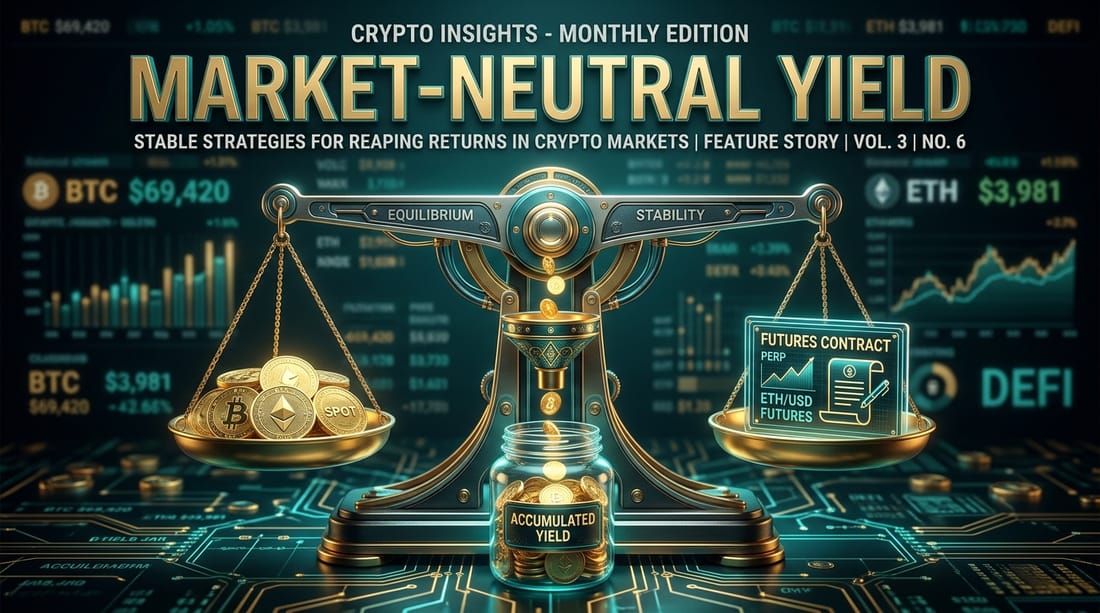
Most people think crypto profits come from one place: the price going up. Buy, wait, sell higher. But there's an entire category of strategy that doesn't care which way the price goes at all — it earns from the plumbing of the market itself. The cleanest example is the cash-and-carry trade, and once you see how it works, a lot of mysterious "low-risk yield" products suddenly make sense.
First, the piece that makes it possible: funding
To understand the trade, you have to understand one quirk of perpetual futures. A perpetual future lets you bet on a coin's price with leverage and no expiry date. But that creates a problem: with no expiry to force it back in line, what keeps the perp's price tethered to the actual spot price of the coin? The answer is the funding rate — a small recurring payment, usually every eight hours, that flows between long and short traders.
The mechanism is self-correcting. When the market is bullish and too many people want to be long, the perp price drifts above spot, and the funding rate goes positive: longs pay shorts. That payment makes being long slightly costly and being short slightly rewarding, nudging the price back toward spot. When the market is bearish, it flips and shorts pay longs. The deeper mechanics live in funding rates, open interest, and liquidations.
Now notice something. In a generally bullish market — which crypto often is — funding is positive much of the time, meaning shorts get paid just for holding their position. The cash-and-carry trade is built entirely around capturing that payment without taking on the price risk that normally comes with being short.
The trade itself
It's a two-legged position, and the elegance is in how the legs cancel:
- Buy the coin in spot. Say you buy 1 ETH and hold it normally. If ETH goes up, you profit; if it drops, you lose. Standard long exposure.
- Short the same amount with a perpetual future. Simultaneously, you open a short on 1 ETH worth of perps. If ETH goes up, this loses; if it drops, this profits. Standard short exposure.
Put them together and the price exposure cancels out. ETH rises $200? Your spot gains $200, your short loses $200, net zero. ETH falls $200? Spot loses, short gains, net zero again. You've built a position that genuinely does not care where the price goes. Traders call this delta-neutral — your sensitivity to price direction is zero.
So if you're indifferent to price, why hold it at all? Because of the third leg: while you sit in this neutral position, you're short the perp, and when funding is positive, you collect the funding payment every eight hours. That stream of payments is the entire point. You've engineered a position that strips out price risk and leaves you holding nothing but a yield faucet fed by the market's structural bullishness.
The mental shift is everything here. A normal trader is betting on direction. A cash-and-carry trader has deliberately deleted direction from the equation, because they don't want to bet on price at all — they want to be the patient party that gets paid by the impatient leveraged longs. It's the difference between gambling on the weather and selling umbrellas.
This is why you'll hear that some "market-neutral" funds and certain stablecoin-yield products make money in any market. Many are running an industrial version of exactly this trade. Understanding it demystifies a whole shelf of products that otherwise sound too good to be true — and tells you where their yield, and their risk, actually comes from. It's a close relative of the dynamics in stablecoin yield, where it comes from and when it's a trap.
Why it is absolutely not free money
Delta-neutral is not the same as risk-free, and conflating the two is how people get hurt. The real risks:
- Funding can turn negative. Your entire profit depends on funding staying positive. In a bearish stretch it flips, and now you're paying instead of collecting. The faucet reverses into a drain. You have to actively manage or exit when the regime changes.
- Exchange and custody risk. You're holding spot and a short, often on a centralized exchange. If that exchange is hacked, freezes withdrawals, or fails outright, your "neutral" position is suddenly exposed to the worst risk of all — the venue itself.
- Liquidation risk on the short. A perp short uses margin. If you under-fund it and the price spikes up hard, the short can get liquidated even though your spot is fine — and now you're left with a naked long you didn't want, at the worst moment. Managing collateral carefully is non-negotiable.
- Execution and fees. Two legs means double the trading fees, plus the operational hassle of keeping the legs balanced as prices move. Small edges get eaten fast by sloppy execution.
- The basis itself moving. The spot and perp prices don't always move in perfect lockstep moment to moment, creating small gaps that can work against you in the short term.
Who actually runs this
In its pure form, cash-and-carry is a professional's game — funds and sophisticated traders who automate the balancing, minimize fees, spread custody risk across venues, and monitor funding constantly to exit when it turns. For an individual, it's understandable but operationally demanding, and the risks above are easy to underestimate. Many people who think they're earning safe market-neutral yield are actually one negative-funding stretch or one exchange problem away from a real loss.
The takeaway
The cash-and-carry trade is worth understanding even if you never place one, because it rewires how you think about making money in crypto. Profit doesn't only come from prices rising. It can come from the market's own mechanics — from being the calm counterparty who collects payments from a crowd of leveraged optimists. That's a genuinely different mental model, and it's the engine behind a lot of "where does this yield come from?" products.
But hold onto the discipline: the trade removes the obvious risk (price direction) and replaces it with a cluster of quieter ones (funding reversal, exchange failure, liquidation, fees). Market-neutral is a description of your price exposure, not a promise about your safety. The yield is real. So is everything that can go wrong underneath it.
Frequently asked questions
You hold a coin in spot and simultaneously short an equal amount via a perpetual future. The two positions cancel out price exposure, so you don't care which way the price moves. The goal is to collect the funding payments that longs pay shorts when funding is positive.
On perpetual futures, the funding rate is a recurring payment between long and short traders that keeps the perp's price close to spot. When more traders are bullish, longs pay shorts. A cash-and-carry trader positions to be the short collecting that payment.
No. It removes price-direction risk but adds others: funding can turn negative and cost you, exchanges can fail or freeze funds, liquidation risk exists if the short isn't managed carefully, and execution and fees eat returns. It's market-neutral, not risk-free.
In bullish conditions, demand to be long with leverage outweighs demand to be short, so the system charges longs and pays shorts to rebalance. Persistently positive funding is what makes collecting it as a short potentially profitable.
Keep reading




Popular this week
- 01Rug Pulls Hall of Shame: Famous Crypto Exit ScamsAnalysis · 4 min
- 02Grid Trading Bots Explained, and When They Blow UpGuide · 4 min
- 03Where AI and Crypto Actually Meet: Compute, Data, and DePINAnalysis · 9 min
- 04Modular vs Monolithic Blockchains: The Design FightExplainer · 6 min
- 05How to Spot Wash Trading and Fake VolumeGuide · 5 min