When a Crypto Exchange Goes Under, Where Does Your Money Actually Go?
An exchange "holding" your Bitcoin doesn't mean what most people think. Here's what really happens to your coins when a platform freezes withdrawals — and how to never be the one standing in line.
In February 2014, a man in Tokyo posted a four-paragraph notice on a website and roughly 850,000 bitcoins effectively vanished from their owners' reach. That was Mt. Gox — once the exchange handling the majority of all Bitcoin trades on earth. Some of those creditors are still waiting to be paid back today, more than a decade later.
That story isn't a relic. It's the template. Celsius froze withdrawals in June 2022. FTX collapsed five months later with a customer shortfall reported around $8 billion. Each time, thousands of people opened an app they'd used a hundred times and found a button that no longer worked.
So it's worth understanding the thing almost nobody checks until it's too late: when your coins sit on an exchange, what do you actually own?
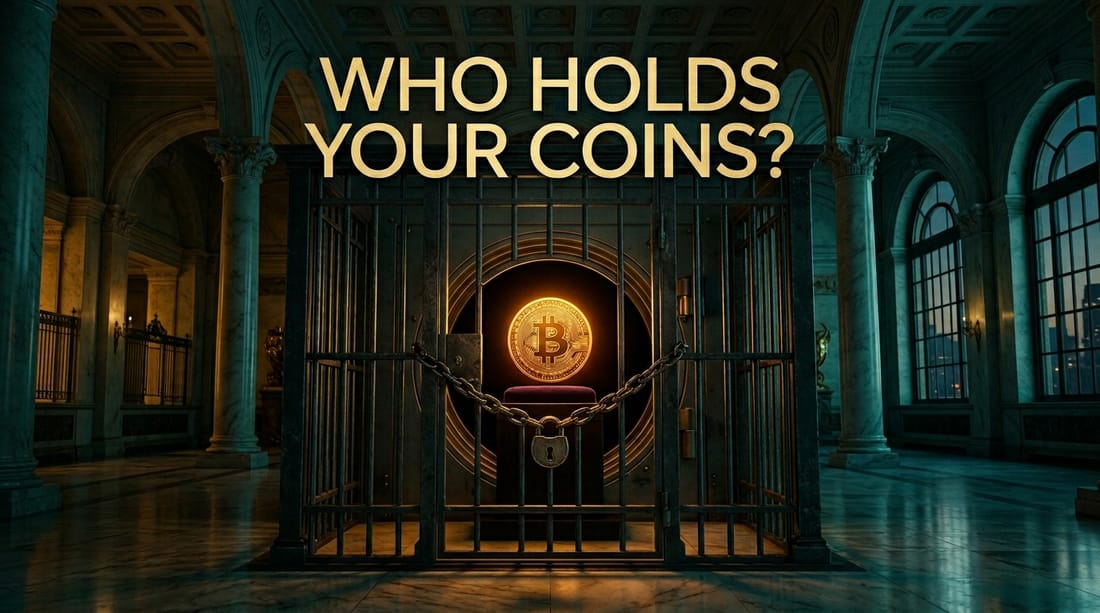
You don't own coins. You own an IOU.
When you "have 0.5 BTC" on a typical exchange, there usually isn't a labeled box somewhere with your specific 0.5 BTC in it. The exchange holds a big pooled pile of crypto and keeps a private database that says it owes you 0.5 BTC. Your balance is an entry in their ledger — a promise, not possession.
That works perfectly right up until the company can't keep the promise. And when a company can't keep its promises, there's a legal process for sorting out who gets paid: bankruptcy. This is the whole meaning behind "not your keys, not your coins." It sounds like a slogan. It's actually a precise description of a legal relationship — the same one we cover in self-custody vs. keeping crypto on an exchange.
What bankruptcy does to your balance
In most of these collapses, customers were treated as unsecured creditors — a specific rung on a ladder. When a company is liquidated, its assets get handed out in order, and unsecured creditors come near the back, in the same line as suppliers and bondholders.
Two things make it worse for crypto:
- Your coins were commingled. Pooled balances mean there's often no clean way to say "these exact tokens are yours."
- Claims get valued in dollars, on the day things froze. When the FTX estate later moved to repay customers, it valued claims at November 2022 prices. Someone with 1 BTC when Bitcoin was around $16,000 had a claim worth ~$16,000 — even as Bitcoin later climbed far above that. "Made whole" in dollars, while missing the entire run-up they were trying to hold for.
A "good" outcome in an exchange bankruptcy can still mean cents on the dollar, years of waiting, or being repaid in dollars that no longer buy back what you lost.
"But the exchange said funds are safe"
They usually do — right up until they aren't. After FTX, many platforms started publishing proof of reserves. It's a genuine improvement, but read it for what it is: proof of reserves is not proof of solvency. It's a photo of a full vault that tells you nothing about the loans taken against it.
The simple fix nobody wants to hear
Self-custody — holding your own keys. It feels scarier: lose your seed phrase and there's no reset, no support line. That trade-off is real, and we walk through doing it safely in what a seed phrase is and how to store it and hot wallets vs. cold wallets.
But notice the asymmetry. With self-custody, the failure mode is your own mistake — something you control. With an exchange, it's someone else's fraud or error — invisible and unstoppable. The practical middle ground most experienced holders use:
- Keep on an exchange only what you're actively trading — money you'd accept having stuck for a while.
- Move long-term holdings to self-custody.
- Don't keep everything in one place. If you do trade actively, a large, transparent venue with regular reserve reporting is a lower-risk home for that slice:
- Write your seed phrase on paper, store it offline, never type it into a website.
The one question to ask before every deposit
Not "is this exchange trustworthy?" — you can't fully verify that from the outside, and the trustworthy-looking ones are exactly the ones that hurt people most. Ask instead: "If this company disappeared tomorrow, would I be okay?" If the honest answer is no, that's not a balance. It's an IOU you can't afford to have broken.
The whole point of this technology was that you don't need to trust a Tokyo website or a bankruptcy judge to reach your own money. Every time you leave it on an exchange, you're quietly opting back into the old system you were trying to leave. Sometimes that's a fair trade for convenience. Just make it on purpose.
Frequently asked questions
Usually not in the way people assume. Most exchanges pool customer funds and credit your account in a database. You hold a claim against the company rather than specific coins, which matters a great deal if it goes bankrupt.
It is someone a bankrupt company owes money to without specific collateral backing the debt. In most crypto collapses, customers were treated as unsecured creditors, meaning they were paid near the back of the line.
No. Proof of reserves shows assets at a single moment but typically not liabilities or debts. It is a small positive signal, not a guarantee of solvency.
Self-custody in a hardware wallet, with your seed phrase written on paper and stored offline. Keep only what you actively trade on an exchange.
Keep reading




Popular this week
- 01Rug Pulls Hall of Shame: Famous Crypto Exit ScamsAnalysis · 4 min
- 02Grid Trading Bots Explained, and When They Blow UpGuide · 4 min
- 03Where AI and Crypto Actually Meet: Compute, Data, and DePINAnalysis · 9 min
- 04Modular vs Monolithic Blockchains: The Design FightExplainer · 6 min
- 05How to Spot Wash Trading and Fake VolumeGuide · 5 min