The Search for Satoshi Nakamoto: Crypto's Greatest Mystery
Someone invented Bitcoin, walked away from a fortune worth tens of billions, and vanished. Fifteen years later we still don't know who. Here's what we actually know — and why it might not matter.
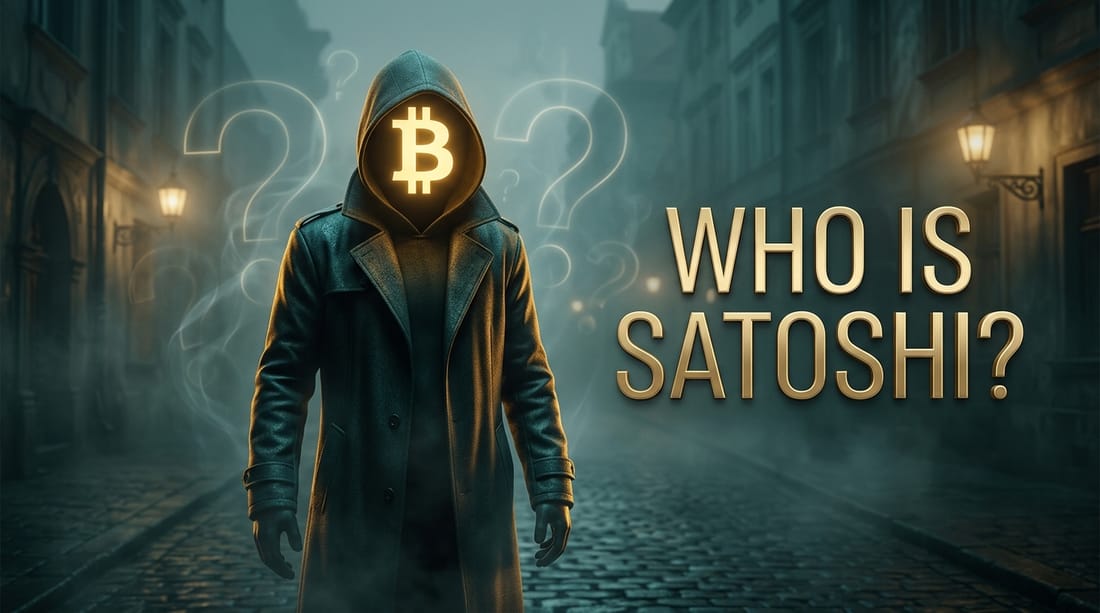
In October 2008, as the global financial system was melting down, someone calling themselves Satoshi Nakamoto emailed a nine-page paper to a cryptography mailing list. It described "a peer-to-peer electronic cash system" — a way to send money online without a bank in the middle. A few months later they released the software. A few years after that, they vanished.
They left behind a working invention, a community, and roughly a million bitcoins they have never spent. They also left behind the single best mystery in technology: who were they? Fifteen years and countless investigations later, the honest answer is still — nobody knows.
What we actually know
Strip away the speculation and a surprisingly thin set of facts remains.
- "Satoshi Nakamoto" wrote with near-perfect British-inflected English ("bloody hard," "maths," spelling like "favour"), which led many to doubt the Japanese name was real.
- Their forum and email activity clustered in patterns that suggested a person awake during European or American daytime, not Japanese hours.
- They were a careful, conservative programmer and an unusually clear writer, comfortable across cryptography, economics, and software.
- They mined an estimated 1 million BTC in the network's earliest days — coins that, crucially, have never moved.
- Around mid-2011, Satoshi handed off the project, sent a few final messages ("I've moved on to other things"), and went silent.
Everything else is inference.
The famous wrong guesses
The hunt has produced a parade of suspects, each with a tidy theory and a fatal gap.
Hal Finney, a brilliant cryptographer, received the very first Bitcoin transaction from Satoshi and lived a few streets away from a man named Dorian Satoshi Nakamoto. Tantalizing — but Finney denied it, and the evidence never closed.
Dorian Nakamoto himself was famously doorstepped by a Newsweek reporter in 2014 who declared him the founder largely on the basis of his name. He had no idea what Bitcoin was. The crypto community rallied and donated to him as an apology.
Nick Szabo, who designed an earlier digital-cash concept called "bit gold," is a perennial favorite based on writing-style analysis. He has consistently denied it.
Craig Wright, an Australian computer scientist, spent years loudly claiming to be Satoshi and suing those who disagreed. In 2024, a UK court ruled comprehensively that he was not Satoshi and had forged documents to support his claim. He remains the most public example of how the one thing nobody faking it can do is the only thing that would settle it.
The proof nobody has provided
Here's the elegant part. There's a definitive test, and it requires no court, no journalist, no handwriting expert. Satoshi could prove their identity in seconds by doing one of two things: moving some of the earliest coins, or signing a message with the cryptographic keys from Bitcoin's first blocks.
No claimant has ever done this. That single fact quietly dismisses every theory. Whoever Satoshi is, they either can't access those original keys — or they refuse to, because using them would shatter the anonymity they so carefully built. (If you're fuzzy on how those keys work, our explainer on what a seed phrase is covers the basics.)
The untouched million coins are the loudest silence in finance. Every day they don't move is another day Satoshi proves they value disappearing more than they value a fortune worth tens of billions of dollars.
Why the disappearance might be the point
It's tempting to treat the mystery as an unsolved crime to crack. But consider the possibility that the vanishing was the invention.
Bitcoin's whole premise is money with no central authority — no CEO to subpoena, no founder to lean on, no headquarters to raid. If Satoshi were a known billionaire, every government and every hopeful con artist on earth would be circling them, and the network's neutrality would be compromised by association. By leaving, Satoshi made Bitcoin truly ownerless. It now runs on the incentives of proof-of-work mining, not on the reputation of any individual.
In that light, the refusal to come forward isn't a riddle to be solved. It's the final, most disciplined design decision — a creator who understood that the most powerful thing they could do for their creation was to make themselves unnecessary.
Does it matter?
Day to day, not really. Bitcoin doesn't need Satoshi; that's the whole idea. The price moves on supply, demand, and macro forces, not on a founder's tweets. But the mystery endures because it's genuinely good — a real-world puzzle with world-changing stakes, a billion-dollar treasure in plain sight, and a protagonist who chose to be no one.
Maybe someday the coins will move and the internet will lose its mind. Or maybe they never will, and Satoshi will remain exactly what they seem to have always wanted to be: the most important person nobody can find.
Frequently asked questions
Satoshi Nakamoto is the pseudonym used by the person or group who created Bitcoin, published its whitepaper in 2008, and developed the early software. Their real identity has never been confirmed, and they disappeared from public communication around 2011.
Researchers estimate Satoshi mined roughly 1 million BTC in Bitcoin's earliest days. Those coins have never moved, which is one of the strongest signals that whoever Satoshi is, they have not touched the fortune — worth tens of billions of dollars.
No. Several people have been named or have claimed to be Satoshi, but none has provided cryptographic proof, such as moving the earliest coins or signing a message with the original keys. Until that happens, every claim remains unproven.
Practically, it may not. Bitcoin runs without its creator. But Satoshi's anonymity is part of its appeal: a money with no leader to pressure, bribe, or arrest. Revealing the identity could also move markets if those untouched coins ever became spendable.
Keep reading




Popular this week
- 01Rug Pulls Hall of Shame: Famous Crypto Exit ScamsAnalysis · 4 min
- 02The Hidden Costs of Leverage: Funding, Fees, and SpreadsExplainer · 5 min
- 03Grid Trading Bots Explained, and When They Blow UpGuide · 4 min
- 04Where AI and Crypto Actually Meet: Compute, Data, and DePINAnalysis · 9 min
- 05How to Spot Wash Trading and Fake VolumeGuide · 5 min