Zero-Knowledge Proofs, Explained Without the Math
Imagine proving you know a secret without revealing the secret. That's a zero-knowledge proof — a piece of mathematical magic quietly reshaping crypto's privacy and scalability. Here it is, with no equations.
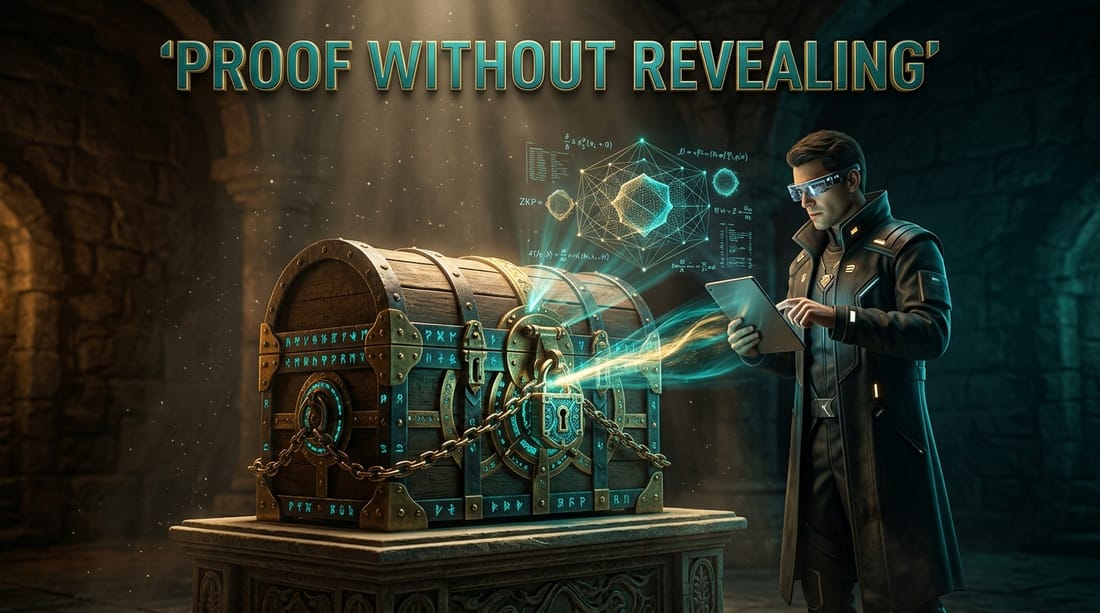
Some ideas in crypto are merely clever. A few are genuinely magical — so counterintuitive that when you first grasp them, you have to sit back for a second. The zero-knowledge proof is the best example. It lets you prove that something is true without revealing any information about why it's true. You can convince someone you know a secret without telling them the secret. It sounds impossible, almost like a paradox. It isn't — it's mathematics — and it's quietly becoming one of the most important technologies in all of crypto.
The good news: you don't need a single equation to understand it. Let's build the intuition.
The impossible-sounding idea
Here's the core claim, stated plainly: a zero-knowledge proof is a method by which one person (the prover) can convince another person (the verifier) that a statement is true, while revealing nothing beyond the truth of that statement itself. No underlying details, no secret, no extra information leaks. Just: "this is true," proven beyond doubt, with everything else kept hidden.
Try a few everyday examples to feel it:
- You could prove you know a password without ever typing the password.
- You could prove you're over 18 without revealing your birthdate, your name, or anything else on your ID.
- You could prove you have enough money to cover a payment without disclosing your account balance.
- You could prove a calculation was done correctly without showing the data that went into it.
In each case, the verifier ends up certain the statement is true, yet learns nothing they could use, copy, or exploit. That's the magic: certainty without exposure.
An intuition for how it's possible
You don't need the cryptography, but here's a flavor of why it isn't a trick. Imagine a friend who's colorblind holds two balls, identical except one is red and one is green. You can see they're different colors; your friend can't. How do you prove to them that the balls really are different colors — without revealing which is which?
Simple: your friend hides both balls behind their back, then either swaps them or doesn't, and shows them to you again. You say whether they swapped. If the balls truly are different colors, you'll be right every single time. If they were actually identical, you'd be guessing — and over many rounds, you couldn't keep being right by luck. After enough rounds, your friend becomes convinced the balls are different colors, with overwhelming certainty — yet you never revealed which ball was which. You proved the statement ("these are different colors") while keeping the secret ("which is which") entirely hidden.
Real zero-knowledge proofs use sophisticated math instead of colored balls, but the spirit is exactly that: a way to convince someone of a fact through a process that could only work if the fact were true, without exposing the underlying secret. The certainty comes from the structure, not from showing your hand.
The mind-bending part isn't that you can keep a secret \u2014 anyone can stay silent. It's that you can keep a secret and still prove something about it that the other person becomes mathematically certain of. Privacy and proof usually pull in opposite directions. Zero-knowledge proofs give you both at once. That's why they feel like magic.
Why crypto is obsessed with them
This isn't just a beautiful curiosity — it solves two of crypto's biggest, most stubborn problems at once.
Privacy. Public blockchains are radically transparent: every transaction is visible to everyone forever, which is terrible for financial privacy. Zero-knowledge proofs offer an escape: you can prove a transaction is valid — that you have the funds, that the rules were followed, that nothing was forged — without revealing the amounts, the parties, or the details. The network stays honest and verifiable while your private business stays private. It's a path to privacy that doesn't sacrifice the trustlessness that makes blockchains work.
Scalability. This is the use that's exploding right now. Blockchains struggle to process many transactions cheaply — every node must verify every transaction, which is slow and expensive, driving up gas fees. Zero-knowledge proofs offer a stunning shortcut. A system can process thousands of transactions off the main chain, then generate a single, tiny zero-knowledge proof that mathematically guarantees all of them were valid. The main chain just verifies that one small proof — instead of re-checking thousands of transactions individually. This is the basis of "ZK-rollups," one of the leading scaling solutions, letting blockchains handle vastly more activity while still inheriting the security of the main chain. One little proof stands in for a mountain of work.
The frontier it's opening
Zero-knowledge technology is still maturing — generating these proofs efficiently is computationally demanding, and the engineering is genuinely hard — but progress has been rapid, and it's increasingly woven into the infrastructure of modern crypto. Beyond privacy and scaling, people are using it to build private identity systems (prove you're a verified human without exposing who you are), confidential applications, and entirely new categories of things that need verifiable truth without disclosure.
Step back and the deeper significance comes into focus. So much of the digital world forces a brutal trade-off: to prove something about yourself, you must reveal it — hand over your data, your balance, your identity, and trust whoever's collecting it. Zero-knowledge proofs quietly shatter that assumption. They suggest a future where you can prove exactly what's necessary and nothing more — where verification no longer requires surrender of privacy.
That's a profound idea, and it reaches far beyond crypto. But crypto is where it's being built first, because crypto is where the need for trustless, verifiable truth is most acute. The next time you hear "ZK" attached to some new project, you'll know what's underneath: a piece of mathematical magic that lets the world check that you're telling the truth — without ever making you give your secrets away.
Frequently asked questions
A zero-knowledge proof is a way to prove that a statement is true without revealing any information beyond the fact that it's true. You can convince someone you know a secret, or that something is valid, without showing them the secret itself.
Imagine proving you know a password without typing it, or proving you're over 18 without revealing your birthdate. A zero-knowledge proof lets you demonstrate a fact is true while keeping the underlying private details hidden.
They enable two big things: privacy, by letting you prove transactions are valid without exposing the details, and scalability, by letting one small proof verify a huge batch of transactions — which is how 'ZK-rollups' help blockchains scale.
A ZK-rollup is a scaling solution that processes many transactions off the main chain, then posts a single zero-knowledge proof to the main chain proving they were all valid. The main chain verifies the tiny proof instead of every transaction, hugely improving capacity.
Keep reading




Popular this week
- 01The Hidden Costs of Leverage: Funding, Fees, and SpreadsExplainer · 5 min
- 02Rug Pulls Hall of Shame: Famous Crypto Exit ScamsAnalysis · 4 min
- 03Grid Trading Bots Explained, and When They Blow UpGuide · 4 min
- 04Where AI and Crypto Actually Meet: Compute, Data, and DePINAnalysis · 9 min
- 05Base and Coinbase's Quiet Bet on Bringing Millions On-ChainAnalysis · 5 min