How to Set Up a Multisig Wallet — and Why
A multisig wallet needs several keys to approve a transaction — so a single stolen key, lost device, or moment of weakness can't drain it. Here's how multisig works and when it's worth the extra effort.
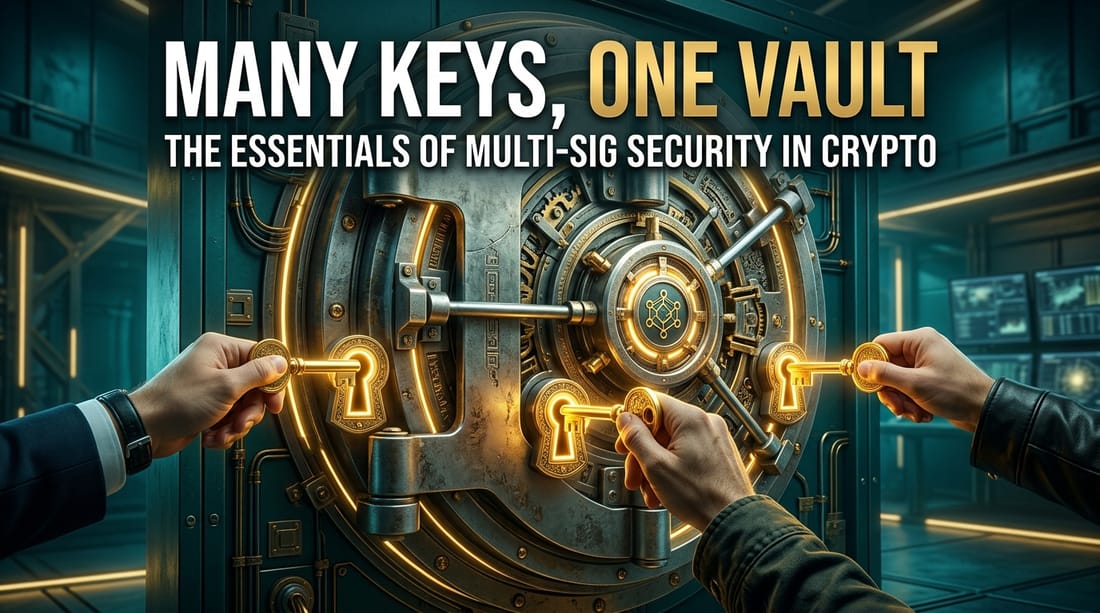
Most crypto security has a fatal single point of failure: one key, one seed phrase, one device. If a thief gets that one secret, your funds are gone. If you lose it, your funds are gone. Everything rests on a single thing not failing — and single things fail.
A multisig wallet solves this elegantly: it requires several keys to approve any transaction. Steal one and you get nothing. Lose one and you're still fine. It's how serious holders, companies, and protocols secure large sums — and understanding it (even if you don't need one yet) sharpens how you think about crypto security entirely.
What multisig actually is
"Multisig" is short for multi-signature. A normal wallet needs one signature (one key) to move funds. A multisig wallet needs multiple. The setup is described as "M-of-N": N is the total number of keys, and M is how many of them must approve a transaction.
The classic example is 2-of-3: there are three keys, and any two of them must sign before money moves. Picture three keys held in three different places — maybe one on a hardware wallet at home, one at a trusted family member's, one in a safe-deposit box. To spend, you need any two. This single design quietly defeats most catastrophes.
Why it's so powerful
Multisig eliminates single points of failure, and that changes your security posture dramatically:
A stolen key isn't enough. In a 2-of-3, a thief who compromises one key — through a phishing attack, malware, or stealing a device — still can't move your funds. They'd need to compromise two keys stored in two different places, which is exponentially harder. The kind of single-click drain that empties ordinary wallets simply doesn't work.
A lost key isn't a disaster. Lose one of your three keys — a device dies, a backup is destroyed — and you can still access your funds with the other two, then re-secure the setup. Compare that to a normal wallet, where losing your one seed phrase means your crypto joins the fortunes locked forever.
It enables shared control. For a company treasury, a DAO, a fund, or a family, multisig means no single person can unilaterally move the money. A 3-of-5 setup might require three of five partners to agree on every transaction — built-in governance and theft protection at once.
The mental shift multisig teaches: security isn't about having one perfect, unbreakable secret. It's about making sure no single failure \u2014 one stolen key, one lost device, one bad click, one rogue insider \u2014 can lose everything. Distribute the risk and no single point can sink you.
How to set one up
You don't build multisig from scratch — you use established tools designed for it (Safe, formerly Gnosis Safe, is the best-known on Ethereum and many other chains; Bitcoin has its own multisig tools). The general process:
- Choose your M-of-N scheme. 2-of-3 is the sweet spot for most individuals: strong protection, still recoverable, not too cumbersome. Larger setups like 3-of-5 suit organizations.
- Generate the keys on separate devices. The whole point is distribution — each key should live on a different device, ideally each one a hardware wallet, kept in a different physical location. Keys all on one laptop defeat the purpose.
- Create the multisig wallet through the chosen tool, registering all the keys (signers) and setting the threshold (how many must sign).
- Test it thoroughly with a tiny amount first. Before trusting it with real money, run a small transaction through the full signing process so you understand exactly how approvals work. This is the same test-first discipline that prevents so many disasters.
- Document the recovery plan. Know precisely where each key is, who controls it, and how you'd recover if one is lost — without writing down anything that compromises the keys themselves.
When it's worth it — and when it's overkill
Multisig is powerful but adds real complexity: more keys to manage, more steps per transaction, more that can go wrong if you're disorganized. So match it to the situation honestly:
- Worth it: large long-term holdings you rarely touch, shared or organizational funds, an inheritance/estate plan, or anyone whose crypto is significant enough that single-point-of-failure risk keeps them up at night.
- Probably overkill: small amounts and everyday spending money. For most beginners, a single well-secured hardware wallet is simpler, safer-than-an-exchange, and entirely sufficient. Don't add complexity you don't yet need — a multisig you don't understand can lose funds too.
The honest path is to grow into it. Start with the basics done well — a hardware wallet, a properly stored seed phrase, good self-custody habits. Then, as your holdings grow into "this would genuinely hurt to lose" territory, graduate to multisig for the serious portion. The professionals securing billions all rely on it for the same reason: in a world where any single secret can be stolen or lost, the only truly robust vault is one that no single failure can open.
Frequently asked questions
A multisig (multi-signature) wallet requires more than one key to approve a transaction. For example, a '2-of-3' wallet has three keys and needs any two of them to sign before funds can move, so no single key alone can spend the money.
It removes single points of failure. A thief who steals one key still can't move funds, and losing one key doesn't lock you out. It's ideal for large holdings, shared treasuries, and anyone wanting extra protection against theft or mistakes.
It describes how many keys exist and how many are needed. In 'M-of-N,' N is the total number of keys and M is how many must sign. A 2-of-3 setup has three keys and needs two; a 3-of-5 has five keys and needs three.
For small amounts, usually yes — a single hardware wallet is simpler and sufficient. Multisig shines for large holdings, shared funds, or long-term storage, where the extra protection outweighs the added complexity.
Keep reading




Popular this week
- 01Rug Pulls Hall of Shame: Famous Crypto Exit ScamsAnalysis · 4 min
- 02Grid Trading Bots Explained, and When They Blow UpGuide · 4 min
- 03Where AI and Crypto Actually Meet: Compute, Data, and DePINAnalysis · 9 min
- 04Base and Coinbase's Quiet Bet on Bringing Millions On-ChainAnalysis · 5 min
- 05What Moves Crypto Prices? The Forces Behind the VolatilityAnalysis · 3 min