How to Actually Back Up Your Seed Phrase
Twelve words stand between you and losing everything — to theft if they leak, to oblivion if they're lost. Here's how to back up a seed phrase so it survives fire, flood, and your own forgetfulness.
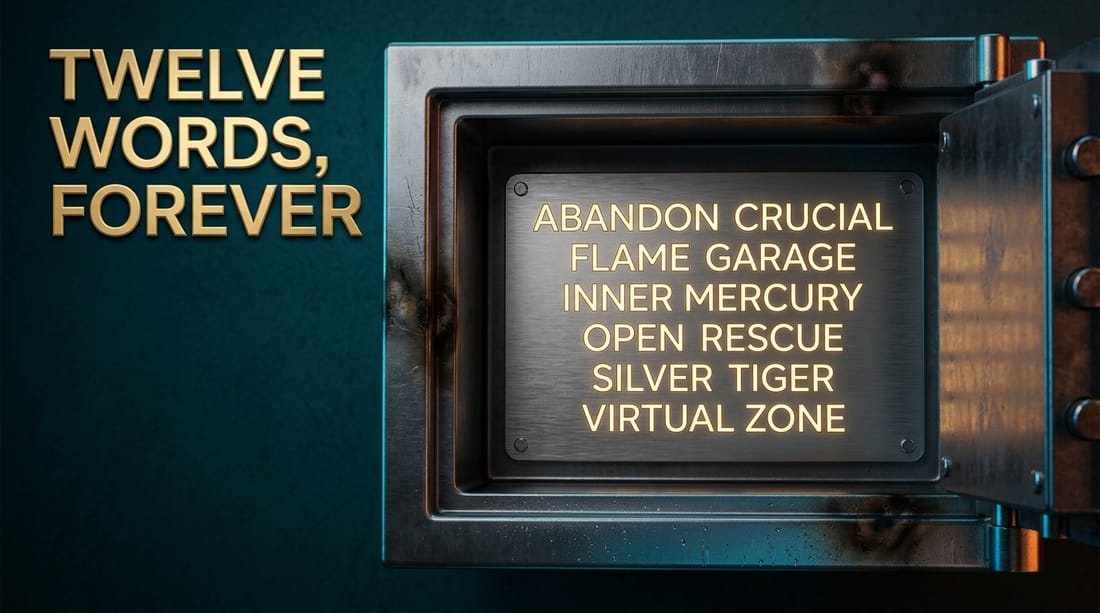
Your seed phrase — usually 12 or 24 words — is the master key to everything you own in crypto. It can restore your entire wallet onto any device, anywhere. Which means it has two opposite failure modes that both end in catastrophe: if it leaks, a thief takes everything; if it's lost, your crypto is gone forever, joining the billions in fortunes locked away for good.
Backing up a seed phrase properly means threading that needle — making it durable enough to survive disasters and your own forgetfulness, while keeping it secret enough that no one else can ever use it. Most people do this badly, in ways that only reveal themselves at the worst possible moment. Let's do it right.
The two rules that govern everything
Every backup decision flows from balancing two opposing dangers:
- Secrecy: anyone who sees your seed phrase controls your funds. So it must be kept where no one — not a hacker, not a houseguest, not a "support agent" — can access it.
- Durability and redundancy: if your only copy is destroyed or lost, your funds vanish. So it must survive fire, flood, decay, and being misplaced — which means more than one copy.
Bad backups fail one rule to satisfy the other: a screenshot is durable and findable but catastrophically un-secret; a single slip of paper hidden too well is secret but a single point of failure. Good backups satisfy both.
Rule #1: Never, ever digital
This is the non-negotiable foundation. A seed phrase must never touch anything connected to the internet. That means:
- No photos (your camera roll often syncs to the cloud automatically).
- No cloud storage, email, or notes apps.
- No password manager that syncs online.
- No text file on your computer, no message to yourself.
The instant a seed phrase exists in digital, internet-connected form, it's exposed to every hacker, breach, and piece of malware on earth. This is exactly how countless wallets get drained — not by breaking cryptography, but by finding a seed phrase someone carelessly stored online. Offline is not a preference here; it's the entire point of self-custody.
If you remember nothing else: a seed phrase that has ever been photographed, typed into a website, stored in the cloud, or sent in a message should be considered compromised. Move your funds to a fresh wallet with a brand-new seed and start over. Digital exposure is permanent.
Rule #2: Write it down — and make it last
The baseline is to write the words by hand, on paper, exactly as shown, in order. But paper has a weakness: it burns, soaks, fades, and tears. A house fire or a burst pipe can erase your only backup in seconds.
For durability, the gold standard is metal: dedicated steel seed-storage plates where you stamp, engrave, or arrange the letters of each word. Metal survives fire, flood, and decades of time that would destroy paper. For any meaningful amount of crypto, a metal backup is cheap insurance against the disasters paper can't survive — the same test-everything, plan-for-the-worst mindset that protects you everywhere in crypto.
If you're starting with paper, at least protect it — a sealed bag against moisture, a fireproof container — and plan to upgrade to metal as your holdings grow.
Rule #3: Redundancy in separate locations
One copy is a single point of failure. The fix is multiple copies in different physical places, so no single disaster — fire, flood, burglary — can destroy them all.
A common, sensible approach: keep two or three copies in separate secure locations, such as a home safe and a bank safe-deposit box, or with deeply trusted family in a sealed arrangement. The principle is the same one behind a multisig wallet: eliminate single points of failure so no one event can wipe you out.
But redundancy multiplies the secrecy challenge — more copies means more places a thief could find one. So each location must be genuinely secure, and you should think carefully about who could access each. The art is in balancing "enough copies that I can't lose access" against "few enough, and hidden well enough, that no one can steal it."
Advanced: splitting and passphrases
As holdings grow, people adopt extra layers — worth knowing exist, but only if you fully understand them:
- Splitting the phrase across locations so no single place holds the complete secret (done carelessly, this can make recovery harder — understand the method completely before relying on it).
- A 25th-word passphrase (an extra secret on top of the seed) that creates a hidden wallet, adding protection even if the seed itself is found.
These add security but also complexity and new ways to lock yourself out. The cardinal rule: never use a backup scheme you don't completely understand, because a clever system you can't reliably recover from is just an elaborate way to lose your own money. Complexity you don't grasp is a risk, not a protection.
Test your recovery
The final, most-skipped step: verify your backup actually works. A backup you've never tested is a hope, not a plan. Once your wallet is funded and backed up, practice recovering it — wipe the wallet (or use a spare device) and restore from your written seed phrase to confirm the words are correct, in order, and complete. Do this with the knowledge that you can restore, so a single transposed word doesn't surface as a horror only when you desperately need the backup years later.
The weight of twelve words
It can feel heavy that so much rests on a short list of words, and it should — that weight is self-custody. You've taken your money out of the bank's hands and into your own, and the price of that freedom is becoming your own vault, your own security team, your own disaster-recovery plan. As we put it in setting up your first hardware wallet, the responsibility is real but entirely manageable once you respect it.
Do it properly, once, and then relax: written offline, on metal, in multiple secure locations, tested and verified. Those twelve words, backed up this way, will survive fire, flood, theft, and the passage of years — and so will everything they protect. That's not paranoia. That's just what it means to truly own your crypto.
Frequently asked questions
A seed phrase is the list of words (usually 12 or 24) that can restore your entire crypto wallet. If you lose your device, the seed phrase recovers everything; if you lose the seed phrase too, your crypto is gone forever. Backing it up is essential.
Written or engraved offline, never digital. Paper works but is fragile; stamped or engraved metal survives fire and water. Store at least two copies in separate secure physical locations, and never photograph or type it into any internet-connected device.
No. The moment a seed phrase touches an internet-connected service — cloud storage, email, photos, a syncing password manager — it becomes vulnerable to hackers. Seed phrases must stay strictly offline.
That's why redundancy and durability matter. Keep multiple copies in different locations so one disaster can't destroy them all, and consider metal backups that survive fire and water where paper would be destroyed.
Keep reading




Popular this week
- 01Rug Pulls Hall of Shame: Famous Crypto Exit ScamsAnalysis · 4 min
- 02Grid Trading Bots Explained, and When They Blow UpGuide · 4 min
- 03Where AI and Crypto Actually Meet: Compute, Data, and DePINAnalysis · 9 min
- 04Modular vs Monolithic Blockchains: The Design FightExplainer · 6 min
- 05Base and Coinbase's Quiet Bet on Bringing Millions On-ChainAnalysis · 5 min