What Is Account Abstraction, and Why Wallets Are Changing
Crypto wallets are powerful but terrifyingly unforgiving — one lost seed phrase and it's all gone. Account abstraction reimagines the wallet itself, making it smart, recoverable, and finally usable by normal humans.
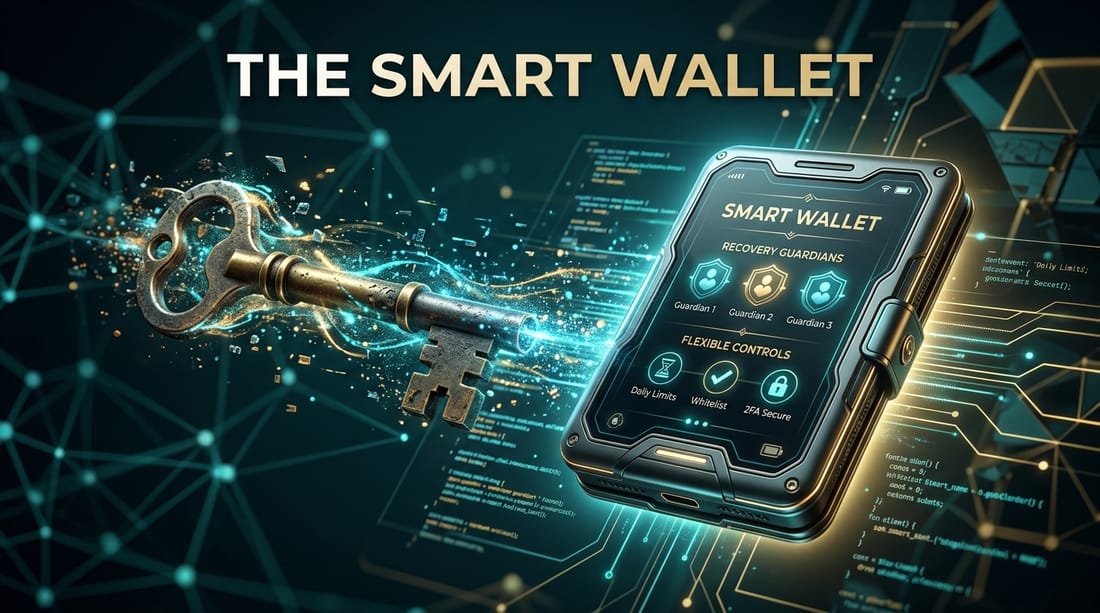
Crypto's self-custody promise is beautiful: be your own bank. But anyone who's actually used a wallet knows the dark side of that promise. A single seed phrase is the only thing standing between you and total loss. Lose it and your funds are gone forever. Leak it and a thief takes everything. Fat-finger an address and your money vanishes irretrievably. One mistake, no undo, no support line. For ordinary people, that's not freedom — it's terror.
Account abstraction is the movement to fix this at the deepest level — by reimagining what a wallet fundamentally is. It's one of the most important developments for crypto's future, because it targets the single biggest barrier to mainstream use: the fact that today's wallets are powerful but unforgiving to the point of being dangerous.
The problem: dumb keys
To see what account abstraction changes, you have to understand what a normal wallet is today. Most wallets are what's called an "externally owned account" — at heart, just a key pair. There's a private key (your secret), and whoever holds it has absolute, unconditional control. That's it. The key can do exactly one thing: sign transactions. It has no logic, no rules, no flexibility, no safety net.
This simplicity is why wallets are so unforgiving. The key doesn't know the difference between you and a thief — it just obeys. It can't enforce a spending limit, can't recognize a suspicious transaction, can't be recovered if lost, can't be paused if stolen. It's a single point of total success or total failure, with nothing in between. Every horror story of drained wallets and lost fortunes traces back to this rigid all-or-nothing design.
The idea: smart wallets
Account abstraction turns your wallet from a dumb key into a programmable smart contract. Instead of "whoever has the key controls everything," your wallet becomes a small program that can have custom rules about how it works. This sounds technical, but the consequences are wonderfully human. A wallet with logic can do things a bare key never could:
Social recovery. This is the headline feature. Instead of "lose your seed phrase, lose everything," a smart wallet can let you designate trusted guardians — friends, family, or your own other devices — who can help you recover access if you lose your key. Crucially, no single guardian can control or steal your funds; they can only collectively help you get back in. It transforms the most terrifying part of crypto — irreversible loss — into a recoverable inconvenience, much like a multisig setup but built into the wallet itself.
Spending limits and rules. A smart wallet can enforce policies: a daily spending cap, requiring extra confirmation for large transactions, or whitelisting trusted addresses. If your wallet is compromised, the damage can be limited by rules the attacker can't override — a safety net that simply can't exist with a bare key.
Gasless and simpler transactions. Account abstraction can let someone else pay the gas fees, or let you pay fees in tokens other than the chain's native coin. Apps can sponsor transactions so newcomers don't need to first acquire ETH just to do anything — removing a baffling hurdle that stops countless beginners cold.
Easier onboarding and login. Wallets can support more familiar security models — like passkeys or biometrics — instead of forcing every new user to safeguard twelve cryptic words on day one.
The mental shift: today your wallet is a key \u2014 a single secret that does one thing and forgives nothing. Account abstraction makes your wallet a program \u2014 something that can have rules, recovery, and safeguards, the way a real bank account has protections. It's the difference between a master key and an intelligent vault.
Why it matters for crypto's future
Here's the big picture. Crypto's biggest obstacle to mainstream adoption was never really the price volatility or the jargon — it was that self-custody is too dangerous for normal people. Telling your parents "if you lose this paper, your life savings disappear, and if anyone sees it, they're stolen, and there's no one to call" is not a product most humans will accept. The unforgiving wallet kept crypto a tool for the technical and the careful.
Account abstraction directly attacks that. By making wallets recoverable, rule-based, and far more forgiving, it offers the genuine benefits of self-custody — you still control your funds, no bank required — without the constant terror of a single irreversible mistake. It's how self-custody might finally become safe enough for everyone, not just the obsessive. This is a major piece of crypto growing up into something usable.
The honest caveats
It's not magic, and a few cautions are fair. Smart-contract wallets introduce their own smart-contract risk — the wallet's code itself must be secure, audited, and trustworthy. Social recovery requires choosing genuinely trustworthy guardians and understanding the setup; done carelessly, a recovery scheme is just a new way to lose access. And good security habits never become optional — convenience features reduce risk but don't abolish the need to think.
But the direction is unmistakably right. For years, "be your own bank" came with an unspoken asterisk: and accept that one slip means catastrophe. Account abstraction is the work of erasing that asterisk — keeping the sovereignty of self-custody while adding the safety nets that real people need. If crypto is ever going to be used by billions rather than millions, this is a large part of how. The wallet, that unforgiving little key, is finally growing a brain.
Frequently asked questions
Account abstraction turns a crypto wallet into a programmable smart contract instead of a simple key pair. This lets the wallet have custom logic — like recovery options, spending limits, and flexible security — rather than depending on a single all-or-nothing private key.
Today's wallets are unforgiving: lose your seed phrase and everything is gone forever. Account abstraction enables features like social recovery, transaction limits, and easier onboarding, making crypto far more usable and less dangerous for ordinary people.
Social recovery lets you regain access to a smart wallet if you lose your key, by relying on trusted 'guardians' (people or devices) to help restore access — without any one of them being able to control or steal your funds.
It can reduce or replace the single-seed-phrase model with more flexible, recoverable security. The seed phrase's all-or-nothing risk gives way to programmable options, though good security habits still matter.
Keep reading




Popular this week
- 01Rug Pulls Hall of Shame: Famous Crypto Exit ScamsAnalysis · 4 min
- 02The Hidden Costs of Leverage: Funding, Fees, and SpreadsExplainer · 5 min
- 03Grid Trading Bots Explained, and When They Blow UpGuide · 4 min
- 04Where AI and Crypto Actually Meet: Compute, Data, and DePINAnalysis · 9 min
- 05Base and Coinbase's Quiet Bet on Bringing Millions On-ChainAnalysis · 5 min